 Mimu Play









product search
Indoor PlaygroundNinja WarriorOutdoor PlaygroundTrampoline
search
If you want to make a professional outdoor playground that meets safety standards and is durable, it’s not as simple as building a shelf. According to my observation on the project site over the years, many people are easy to stumble on details. To get this done, you have to crack down on these 5 core links:
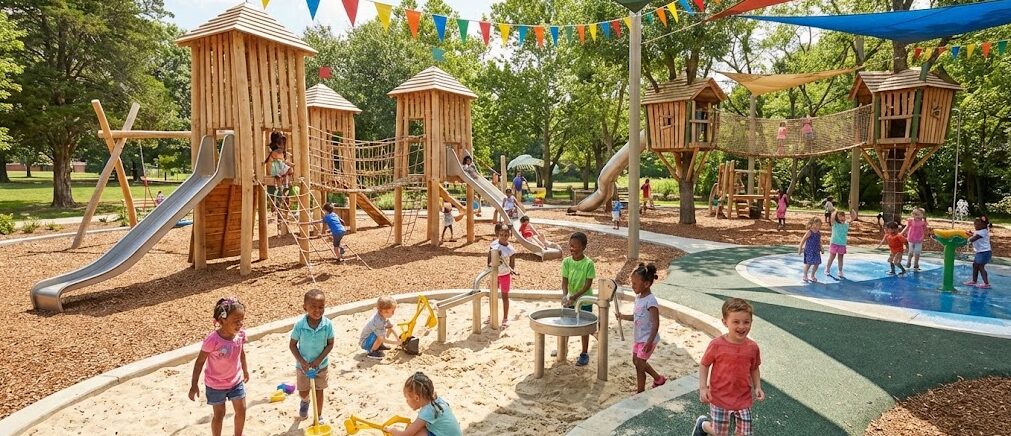
Site Survey And Safety Buffer Planning
Before doing it, site selection is a top priority. The ground must be leveled, not only to look pleasing to the eye, but more importantly, if it is uneven and the equipment is unevenly stressed, the structure will definitely deform after a long time.
6-foot safety rule: At least 6 feet (about 1.8 meters) of “headroom” must be reserved around all static equipment “. To put it bluntly, these 1 circles are free to prevent children from hitting other things when they fall down.
Special requirements for slides and swings: especially for swings, the space reserved before and after is twice the height of the beam. I often see some venues in order to save space to squeeze the swing in the corner, it is simply laying mines.
Saving money on materials is the most uneconomical. Household grade wood will not last long outdoors and must be of professional specifications.
Wood must be picky: it is recommended to use preservative-treated wood (the kind that can directly contact the soil) or natural rot-resistant red cedar. Although red cedar is more expensive, it is not easy to crack and prick, and is very friendly to children’s hands.
Hardware don’t drop the chain: all screws and bolts must be galvanized or stainless steel, rust not only affects the appearance, the critical moment will really break. The ground anchor must be deep enough, otherwise the shelf may shake if there is a strong wind or a few big children toss about.
Discover endless fun and spark imagination! Our indoor playground products create a safe, exciting paradise for children. Experience boundless joy now!
Embrace adventure and fresh air! Our outdoor playground products offer thrilling, safe experiences for kids to explore, play, and grow. Unleash the fun outside!
This is the most easily overlooked and expensive item in the construction of amusement parks. To be honest, many accidents are caused by the hard ground.
Don’t count on the lawn: the damping effect of mud or lawn is almost zero. According to the requirements of the CPSC (US Consumer Product Safety Commission), you have to use professional shock absorbing materials.
Recommended materials:
Engineered wood fiber (EWF): cost-effective, but to be regularly paved.
Rubber particles: excellent shock absorption, maintenance is also worry-free.
Washing rice stone (pea stone): is also a durable way.
Depth is the key: these materials cannot be laid in a thin layer. To cope with possible fall risks, the compacted depth must be a minimum of 9 to 12 inches (23-30cm).
When installing slides, swings and climbing walls, it’s not enough to tighten the screws, you have to have that “occupational disease” type of vigilance.
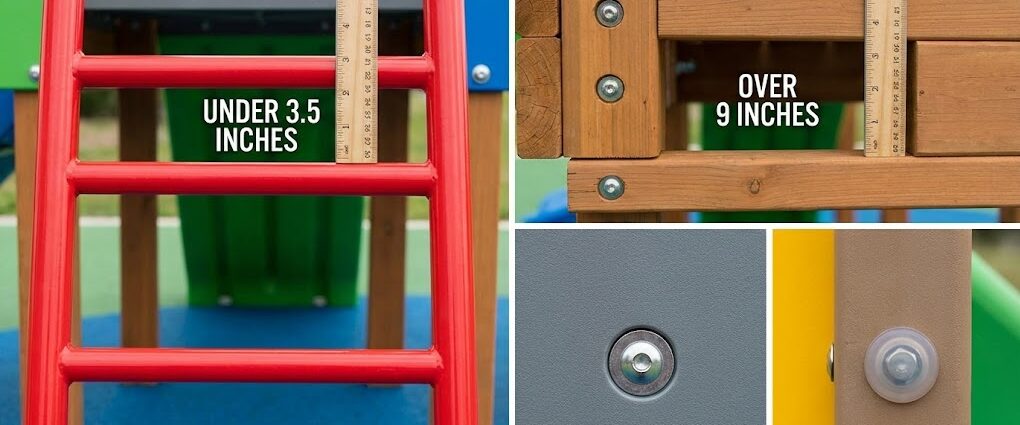
Anti-neck jamming: All holes or gaps, either less than 3.5 inches or greater than 9 inches. The gap between this range is the most dangerous. The child’s body can pass but his head will get stuck. This is an absolute red line in the industry.
Eliminate hook points: check all “S” hooks and exposed bolts. According to my experience, the drawstring on the child’s clothes is particularly easy to hang in these places, once the consequences are very serious. All hardware is best done flush or add a protective cover.
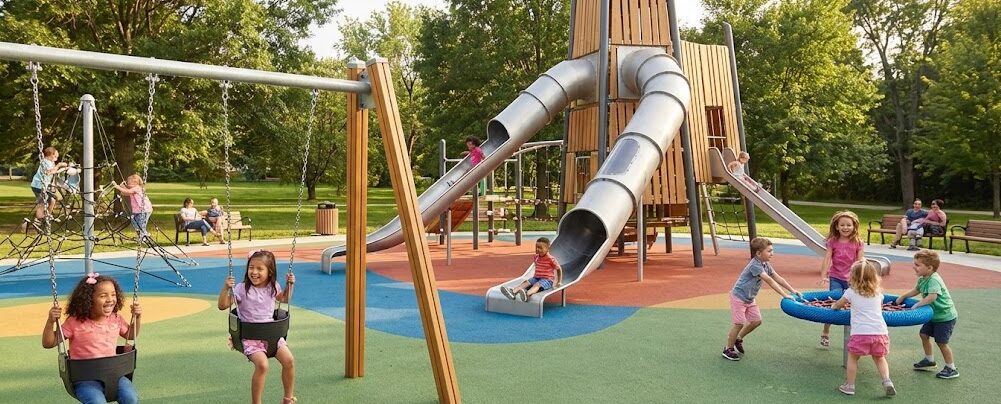
If the amusement park is ready, everything will be fine. The later maintenance is the place to open the gap between professional and amateur.
Monthly “physical examination”: a comprehensive inspection every 30 days. See if the bolts are loose, if the wood is cracked, and if the metal parts are rusted.
Ground backfilling: especially under the swing and the slide exit, children play more, the ground material is easy to be kicked away. Those wood chips or rubber particles must be raked back into place frequently to ensure the thickness is up to standard. If you don’t pay attention to this, the previous buffer will be useless.
In fact, in the final analysis, according to these five steps, although the effort and cost invested in the early stage will be a little more, the things that are tossed out in the end can not only pass the safety inspection, but also make the children play at ease, which is better than anything else.
Author: Marcus Sterling
I am a playground safety specialist and structural consultant with over a decade of experience in facility design.My expertise focuses on ASTM-compliant materials and CPSC safety specifications, ensuring that every outdoor playground I design—or help you build—prioritizes both structural durability and child protection.

The first step in designing an indoor playground is to divide it into different age groups, as children at different stages of development vary greatly in physical development, cognitive abilities, and interests. Our indoor playground designs tai...
View details
Learn How To Use A Fuel Pressure Gauge To Diagnose Pumps, Regulators, And Leaks In This Step-By-Step Guide.
View details
Plan adventure jungle gyms by checking climbing routes, age fit, fall protection, circulation and inspection needs.
View details
Learn How To Winterize Your Trampoline. Protect The Mat, Frame, And Springs From Snow, Ice, And Wind Damage.
View details