 Mimu Play









product search
Indoor PlaygroundNinja WarriorOutdoor PlaygroundTrampoline
search
Yes, in-ground trampolines are generally safer than traditional above-ground models primarily because they completely eliminate the risk of falling from a height of 3–4 feet, which is statistically the leading cause of serious trampoline injuries like bone fractures. However, “safer” does not mean “risk-free.” Being flush with the ground creates a false sense of security; without a proper safety enclosure (net), children can still run onto the mat unexpectedly or bounce off the trampoline onto the surrounding hard landscaping (like patio pavers or concrete). Additionally, if the airflow under the mat is restricted due to poor installation, the “harder” bounce can increase impact shock on children’s joints. Therefore, in-ground trampolines are the superior safety choice only when they are installed with a retained safety enclosure, sufficient padding over the springs, and a minimum of 4-6 feet of soft impact surface (like grass or wood chips) around the perimeter.
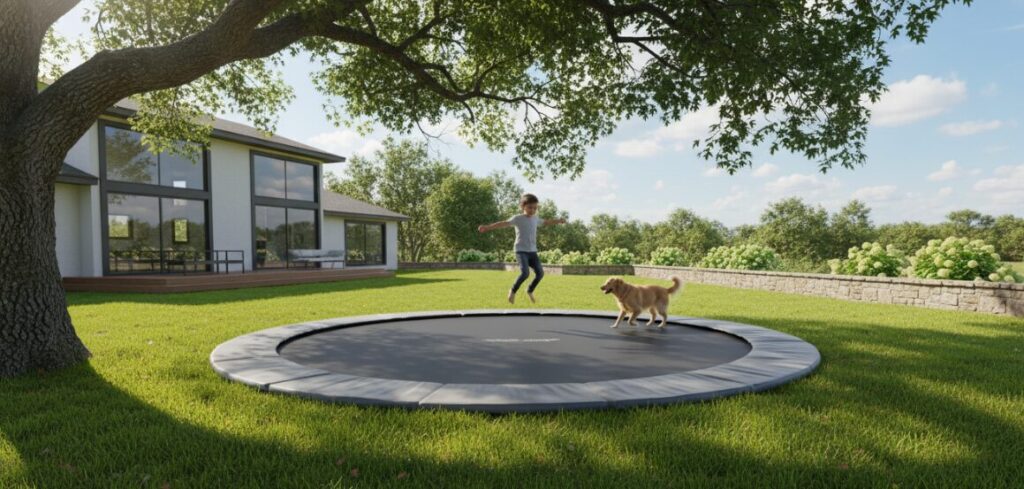
When assessing safety, the disappearance of the vertical height is absolutely the decisive factor. Traditional overhead trampolines are usually 3 to 4 feet above the ground. Statistically, falling from this height is the main cause of serious trampoline injuries (especially fractures). To “bury” the trampoline into the ground is actually to cut off this source of risk from the physical level. If jumpers get out of control and jump out of the mat, they no longer need to go through a few feet of free fall to the ground. This structural change alone gives the embedded model a big win in dealing with the risk of gravity fall.
While it’s a great thing to lose the drop height, I have to remind you of a psychological risk: a false sense of security. Because it is flush with the lawn, parents and children often feel that it is “harmless”.This design is indeed easy to enter and exit, but it is also a double-edged sword. If there is no fence to stop it, it is easy for toddlers, pets or unnoticed children to rush directly into the mat while others are dancing happily.Compared to elevated trampolines that require climbing ladders or zipping up zippers to enter, this “zero-threshold” approach greatly increases the probability of collisions or accidental “double jump” incidents.
Discover endless fun and spark imagination! Our indoor playground products create a safe, exciting paradise for children. Experience boundless joy now!
Embrace adventure and fresh air! Our outdoor playground products offer thrilling, safe experiences for kids to explore, play, and grow. Unleash the fun outside!
There is a common misconception in the industry that embedded trampolines do not need safety nets. According to the security data, this is simply wrong. As I mentioned at the beginning, the premise of “safer” is that there must be a fence. Even at ground level, the jumper flies out of the mat with horizontal momentum. If the trampoline is next to a hard landscape-such as patio tiles, cement road or decorative stone-falling on these can still be seriously injured. To really play the security advantage, must meet two hard conditions:
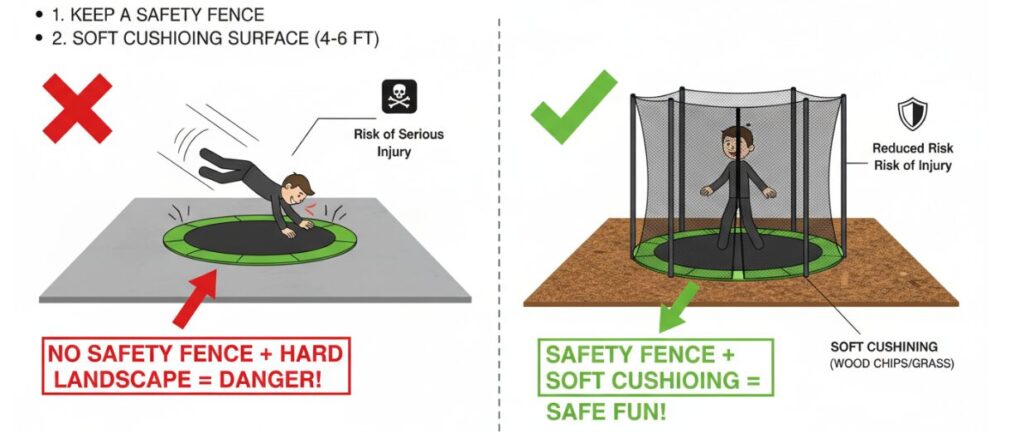
The embedded trampoline is directly installed next to the concrete floor, and its safety advantage is basically zero.
Finally, this point is often overlooked by non-professionals: the safety of the embedded trampoline is directly linked to the quality of the installation (especially the airflow treatment). The air under the elevated trampoline is easy to drain away, but in the pit, if the air cannot be drained out, it will form an “air cushion” resistance. This causes the trapped air to generate a reaction force, resulting in a rebound “too hard” and insufficient cushioning. This additional resistance will transmit the higher impact force directly back to the jumper’s body, especially the child’s joints. If a poor installation restricts airflow, otherwise interesting activities can become a source of high-impact injuries, resulting in strain or acute joint injury. Therefore, good ventilation is not only to jump well, but also a hard safety indicator.
Author:David Miller
Hi, I’m a Backyard Safety Specialist with over 17 years of experience in outdoor play equipment installation. I specialize in analyzing the mechanics of trampoline injuries, focusing on how installation depth, airflow dynamics, and impact surface materials affect joint safety.