 Mimu Play









product search
Indoor PlaygroundNinja WarriorOutdoor PlaygroundTrampoline
search
In fact, when it is disassembled, it is nothing more than those few things: hot-dip galvanized steel pipe frame to build bones, high-strength PP jumping cloth to make muscles, spring (or popular glass fiber rod) to provide power, and finally PVC or PE safety net and cushion. It sounds simple, but it is the difference in these core materials that determines whether you are buying a big toy or moving a hidden source of risk to your home. Understanding these materials can not only help you avoid the pit, but also be responsible for the safety of your family.
The trampoline is unstable, and it depends on the shelf. This not only determines the stability, but also determines its load-bearing limit. In this industry, we most recognize is hot-dip galvanized steel (Hot-Dip Galvanized Steel).
On the factory floor, the process is too different. The best practice is “hot-dip galvanizing”-the steel is thrown directly into molten zinc and rolled 1 circles, and the thick layer of zinc grows on the steel like armor. The shelf produced by this process can withstand corrosion no matter if you throw it outdoors in the sun or in the rain, or even in a high salinity environment. Real high-end goods, even multi-layer galvanized, but also through 3000 hours of salt spray test-this is no joke, this is in accordance with the extremely stringent outdoor standards.
In contrast, the pipes that are electrogalvanized (Electro-Galvanized) or simply sprayed with powder look bright when they leave the factory, but the protective film is as thin as paper. I have seen too many cheap trampolines. After buying them for half a year, the inside of the shelf began to rust. This structural hidden danger is very terrible.
My advice: when picking a trampoline, don’t just look. Ask the merchant directly: How thick is the pipe wall? Is it hot-dip galvanized? Also, touch the interface. Soldered and firmly integrated interfaces are usually much more reliable than those that rely solely on screws. The more screws, the greater the probability of loosening and wear. This is common sense in physics.
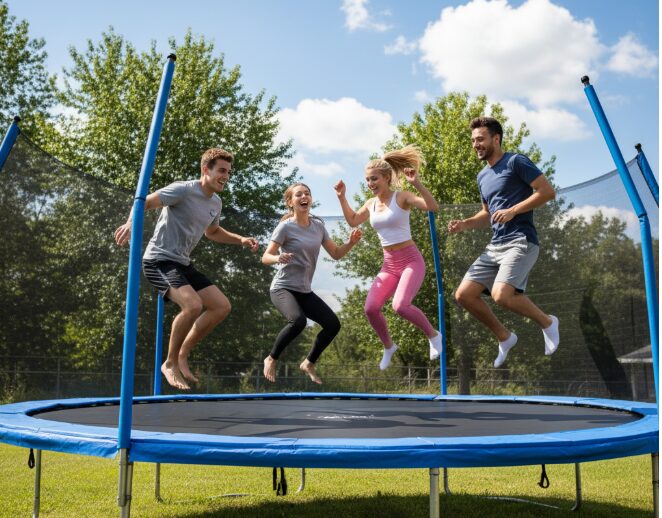
This is the part that users touch the most and is the core of providing “bounce. At present, as long as it is a high-quality trampoline on the market, it is made of polypropylene (PP) fabric.
Why PP? Because this stuff is born to do this stuff. Its synthetic fibers are tightly woven, forming a 1 tough mesh structure with strong pull resistance. Moreover, as an outdoor equipment, its biggest enemy is not the child’s weight, but the sun. High-quality PP fabrics are produced with UV stabilizers (like Permatron®This big brand is very good), otherwise in the sun for two summers, the jumping cloth will become brittle and crack 1 stepping on it.
In addition, the PP material itself does not absorb water, which is very important, mildew and moisture. The special woven structure also ensures breathability, small wind resistance and smooth rebound.
My suggestion: get the real thing and touch the density of weaving. The higher the density, the higher the strength. Be sure to stare at the edge for the stitches-that’s where the stress is most intense. If it is multi-channel reinforcement suture (Reinforced stitching), it is qualified, otherwise once the connection is torn, the consequences are unimaginable.
Trampoline good fun, all look at the spring. This is a key component in converting the jumper’s gravitational potential energy into upward elastic potential energy. Old-school hard-core trampolines mostly still use hot-dip galvanized steel springs.
The doorway here is that the longer the spring and the more turns, the deeper and softer the rebound foot feel, and the more uniform the impact force distribution. If the spring is too short, there will be a “hard landing” feeling when jumping, which is not good for the knee. If it is the kind of thick wire diameter spring, tensile strength after special heat treatment, how to build is not easy to deformation and fracture.
Of course, in order to eliminate the risk of finger injury caused by traditional springs, brands like Springfree have developed flexible composite rods (usually made of glass fiber) to replace springs. The thinking is very clear, the rebound is soft and quiet, and the effective jumping area is increased.
My suggestion: when picking springs, in addition to looking at the galvanizing process, we should also pay attention to the length, thickness and quantity. When trying to jump, listen to the sound. A good spring returns to its position simply, without the strange sound of Caton or metal friction. During routine maintenance, keep your eyes sharp and see rusty springs or springs that cannot be stretched back. Change them quickly and don’t hesitate.

If shelves and springs are for fun, pads and seines are for life.
Let’s start with safety pads, whose mission is to cover hard frames and springs. The lining must be thick, at least 3cm starting with high-density closed-cell foam (Closed-cell foam), and covered with waterproof and UV-resistant PVC or vinyl materials. Don’t buy that kind of thin layer of sponge, that is a fool. Closed-cell foam does not absorb water, mildew and shock absorption performance is stable.
In addition to the security fence (Enclosure Net), usually polyethylene (PE) or polyester material. Here I also have to emphasize anti-UV treatment. Many cheap nets rot when they are pulled, because anti-aging is not done well. The mesh density should also be moderate, not only to block people, but also not to jam fingers.
My advice: don’t save money here, it’s a matter of principle. I ‘ve seen too many cases of children’s feet getting stuck in springs because of aging and brittle pads. Once the quality of this kind of protection is not good, it will soon fail in the outdoor environment.
The manufacturer’s choice of these materials is not determined by the head, which is followed by rigorous materials science and physics considerations.
Steel galvanizing principle: This uses the “sacrificial anode protection method” in electrochemistry “. Zinc is more active than iron, even if the coating is broken, zinc will first corrode itself to protect the steel inside from rust.
PP material characteristics: the molecular structure of the thermoplastic polymer allows it to withstand repeated stretching of high strength, with free radical scavengers (anti UV additives), can greatly delay aging.
Spring Physics: This follows exactly Hooke’s Law and Newton’s Third Law. The heat treatment process of high carbon steel directly determines its elastic limit and fatigue life.
Combination of foam and PVC: closed-cell foam such as EPE is responsible for shock absorption and non-absorption, and the outer PVC is responsible for protecting the foam inside from powdering under the big sun.
If you understand these, you will know why some trampolines sell for hundreds and some for thousands. Materials science never lies when it comes to safety devices.
About the Author :Dark
As an Outdoor Play Equipment Safety Expert, I’ve spent over a decade in trampoline manufacturing, seeing firsthand what makes a trampoline safe and durable—or a potential hazard. My mission is to empower you to make informed choices, ensuring your family’s outdoor fun is built on a foundation of quality materials and uncompromising safety.