 Mimu Play









product search
Indoor PlaygroundNinja WarriorOutdoor PlaygroundTrampoline
search
The answer is yes: as long as the equipment is not wrong and the action is performed in place, training on a mini trampoline (Rebounding) is very beneficial to the health of the knees.
Because it plays an excellent “shock absorber” role-compared to running on hard surfaces such as cement, it can eliminate up to 87% of the impact. This gentle vertical rhythm not only stimulates the secretion of synovial fluid (the joint’s natural lubricant) to nourish the knee, but also strengthens the stable muscles around the patella without putting excessive pressure on the cartilage.
However, safety always comes first: people with knee problems must prefer a trampoline with an elastic rope system rather than a stiff metal spring model. And focus on an exercise called “Health Bounce “,the main point is that their feet hardly leave the net.
The reason why trampoline is better than traditional aerobic exercise in knee health lies in the impact absorption at the physical level.
A high-quality trampoline filters out most of the impact. When you run and jump on this concrete or asphalt road, every step you take to the ground, your knees have to bear all the “hard landing” impact. This repetitive shock tends to exacerbate existing knee pain or accelerate cartilage wear.
In contrast, the surface of the trampoline made a very critical “deceleration” action. It does not stop your feet instantly, but absorbs kinetic energy through the stretching of the mesh surface. This means you can enjoy the benefits of exercise-such as faster blood circulation and lymph return-while avoiding the “ground reaction forces” that usually hurt your knees “.
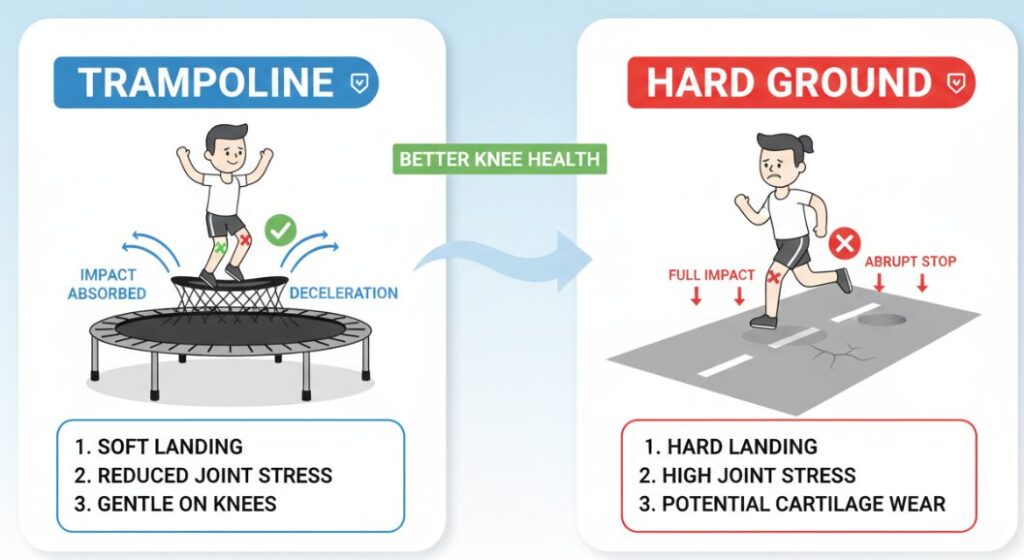
In addition to the simple “stop loss”, the trampoline is actually actively promoting repair, which is mainly due to two biological mechanisms: the generation of synovial fluid and the strengthening of stable muscle groups.
The cartilage of the knee joint does not have a direct blood supply, it relies entirely on the synovial fluid to reduce friction and obtain nutrients. The up and down rhythm of the trampoline changes in gravity, like a pump. During the bouncing process, this rhythmic compression and release forces the synovial fluid into and out of the cartilage. This is like oiling the joints, which not only lubricates the joints, but also delivers the necessary nutrients to the cartilage cells and takes away metabolic waste.
The root cause of a lot of knee pain, or aggravating factor, is actually the muscles around the joint is too weak. When the muscles around the patella are weak, the joint itself has to bear more load. To exercise on a trampoline, you need to maintain your balance on an unstable plane. This automatically forces the body to mobilize stable muscle groups deep in the legs, hips and core. These muscles are strengthened, like wearing a “natural protector” on the knee, absorbing the impact before it reaches the bone and cartilage.
Discover endless fun and spark imagination! Our indoor playground products create a safe, exciting paradise for children. Experience boundless joy now!
Embrace adventure and fresh air! Our outdoor playground products offer thrilling, safe experiences for kids to explore, play, and grow. Unleash the fun outside!
Not all trampolines are the same. When dealing with the question of whether a trampoline is good for your knees, I must emphasize that the equipment you choose is very important.
Traditional trampolines typically use short, stiff metal springs. This kind of product is very easy to produce kind of blunt “touch the bottom feeling” . When you step to the bottom, that vibration will go down the tibia and hit the knee, which is absolutely counterproductive to recovery.
For knee health, the elastic rope system is definitely a better choice. This elastic cord can provide a smoother, deeper and more silent bouncing experience. The deceleration process they provide is gradual, ensuring that the moment you move from downward motion to upward rebound is extremely gentle on the joints.
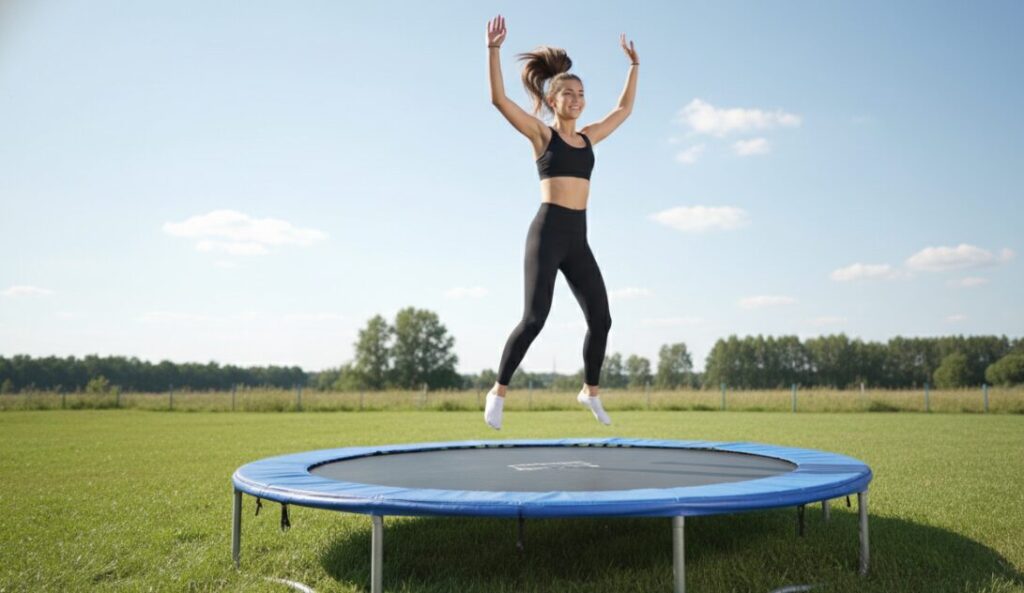
If you have rheumatoid arthritis, are recovering from an injury, or just have sensitive knees, “how to jump” is as important as “what to jump. I definitely don’t recommend you to try high jumps or fancy acrobatics.
You should focus on “The Health Bounce” .
Stand on the net with your feet open shoulder width. Keep your knees slightly bent-never lock your knees. Use the heel-to-toe movement to gently move up and down, but at all times, keep your feet in contact with the net.
By ensuring that your feet barely leave the net (or even not at all), you reduce gravitational acceleration and impact to an absolute minimum. You’ll still get the benefits of a change in gravity-stimulating the lymphatic system and the flow of fluid in the joints-but you’ll avoid the risks of a wrong landing posture.
Here’s an image of someone performing a health bounce on a trampoline.
Author: Alex Mercer
Hi, I’m a certified rehabilitation fitness specialist. I focus on helping clients overcome joint pain through low-impact movement. I advocate for bungee-based rebounding because, as detailed in this article, it uniquely stimulates synovial fluid and strengthens stabilizer muscles without the harsh impact of concrete, making it an ideal tool for knee health recovery.