 Mimu Play









product search
Indoor PlaygroundNinja WarriorOutdoor PlaygroundTrampoline
search
Yes, jumping on the trampoline is indeed one of the most efficient ways to burn fat. In many actual training scenarios, its effect even exceeds that boring constant speed jogging.
An adult weighing about 150 pounds (about 68 kilograms) can consume about 160 to 210 calories after 30 minutes of medium-intensity trampoline training; and once in high-intensity mode, this number will quickly soar to more than 300 calories. This high efficiency stems from the trampoline’s unique “G-force” (gravitational acceleration): at the bottom of each bounce, the body is subjected to a huge gravitational compression, which forces 638 muscles throughout the body to exert force at the same time in order to maintain balance. Research data also supports this, with trampoline exercising up to 68% higher than jogging in terms of oxygen uptake and metabolic demand. The most important thing is that the trampoline surface can absorb up to 80% of the impact force. This means you can achieve extremely high calorie burn without wasting your knees and ankles.
The reason why trampoline is so tough on burning fat, the underlying logic is actually physics. When running on flat ground, the power point is mainly concentrated in the lower body. But on a trampoline, the body is subjected to a doubling of gravity at the bottom of each jump.

When you jump to the highest point, you will experience a short sense of weightlessness; when you fall back to the trampoline, your effective weight will instantly increase by two to three times due to the effect of G force. To counter this force and keep your body stable, all the muscles in your body—from the core and back to the smallest stabilizing muscles—must contract instantaneously. I found that when many novices first started practicing, even the small muscle groups that they could not usually practice would be sore the next day. This is because this kind of systemic muscle participation brings extremely high metabolic demand, which is far more efficient than only aiming at specific muscle groups.
A 150-pound person can burn 160 to over 300 calories in 30 minutes. But the exact number depends on two variables:
Discover endless fun and spark imagination! Our indoor playground products create a safe, exciting paradise for children. Experience boundless joy now!
Embrace adventure and fresh air! Our outdoor playground products offer thrilling, safe experiences for kids to explore, play, and grow. Unleash the fun outside!
Many people ask me why I chose a trampoline instead of running, and the data is actually very intuitive: trampolines are about 68% more efficient than jogging. This conclusion is based on oxygen uptake.
When you bounce, due to the constant change of gravity, the body needs more oxygen to support the rapid contraction of muscles. This is where the trampoline’s “perplexing” comes in: while you may not feel as tired as running laps on the playground, your cells are actually processing more oxygen and burning more fuel at the cellular level. For those who want to get the maximum effect of exercise in a short time, this is simply a cheating-level weapon.
Many high-consumption sports, such as cement running or HIIT, are often accompanied by a high risk of joint injury. Trampoline completely changed the rules of this game, providing the perfect “HILIT” experience.
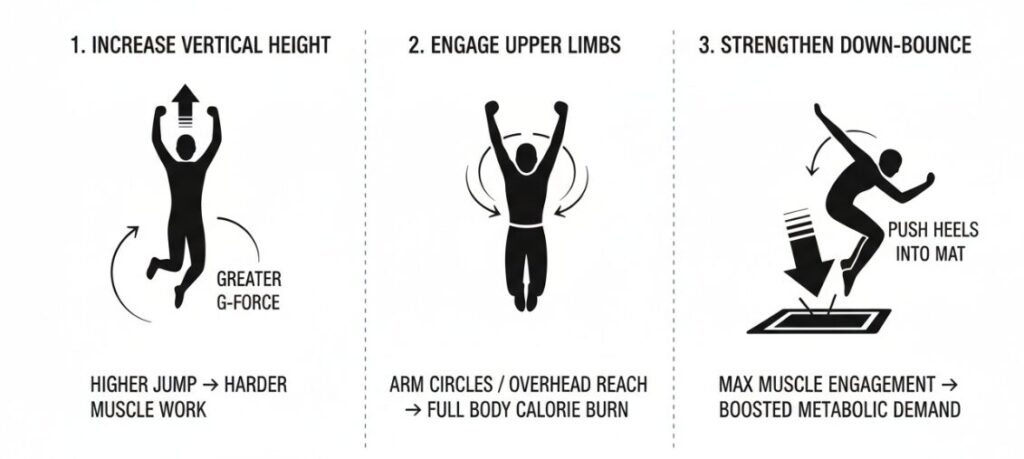
If you want to sprint above the upper limit of 300 calories in 30 minutes, according to the “G force” principle, I suggest you focus on the following points:
Author : Sarah Miller
“Hi, I’m a certified fitness specialist dedicated to helping people find efficient, science-backed ways to stay fit. I am a firm believer in the power of ‘HILIT’ (High-Intensity, Low-Impact Training). After years of studying the physics of G-force and metabolic demand, I’ve become a passionate advocate for rebounding. “