 Mimu Play









ürün arama
Kapalı Oyun AlanıNinja SavaşçısıAçık Oyun AlanıTrambolin
arama
The truly top-tier indoor trampoline park contractors rely on robust heavy-duty steel structures to create customized entertainment spaces; and the genuine original‑source manufacturers meticulously produce every spring, every jumping mat, and every padding component right in their own workshops. Many investors, lured by low prices, split the “equipment procurement” and “on-site installation” into separate contracts, commissioning overseas trading firms to supply components and then hiring a local construction crew that lacks expertise in dynamic loads to assemble them—creating a fatal black hole of blame-shifting. Once an incident occurs, the insurance company may deny coverage, the vehicle may fail inspection, and the steel frame could even be bent out of shape. Today, let’s get everything straight: from steel‑plate thickness standards and the mandatory ASTM F2970 certification to how to identify the genuine original‑source manufacturers, we’ll walk you through every step of setting up a trampoline park that’s both profitable and free from the risk of joint‑liability lawsuits.
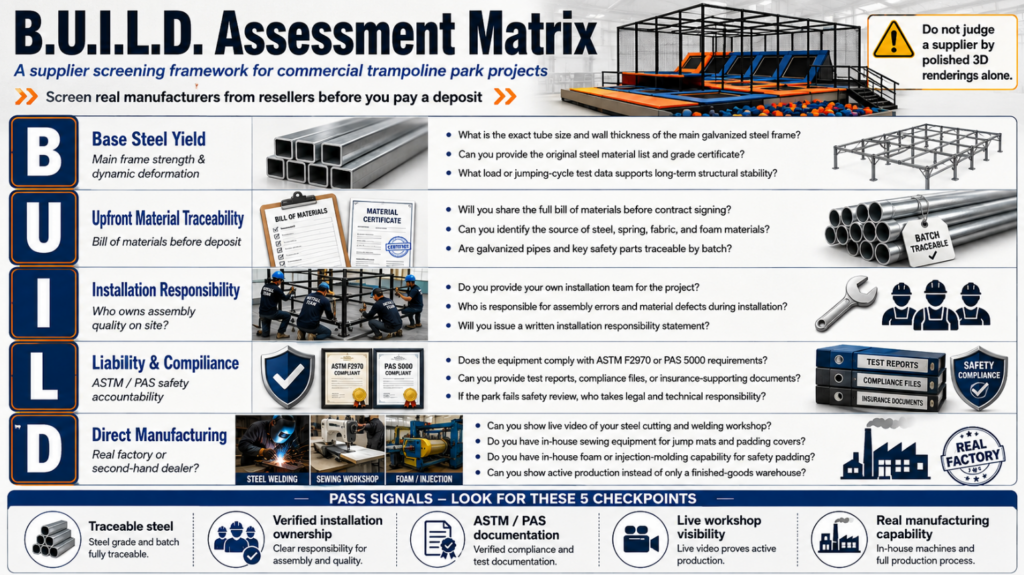
The project manager must not just look at a few exquisite 3D renderings and make a decision to pay. You have to use this B .U. I .L.D. matrix to knock every supplier to see if they are real factories or second-hand dealers.
“”TuPian ChaRu”” (Note: Insert an infographic of the B.U.I.L.D. matrix assessment here. The left column lists the five assessment dimensions, while the right column lists the specific questions investors ask suppliers corresponding to each dimension.
Many investors ignore the overall compatibility of the structure in order to lower the price of the equipment, resulting in a loss of money. The routine is to buy springs from factory a, jump noodles from factory B and steel frames from factory c. Once these few containers are delivered to your site, you’ll find, to your dismay, that the tension‑tie hooks on the container floor simply don’t align with the laser‑cut holes in the steel frame.
No way, the local construction team can only use electric drills to punch new holes in the steel truss on the spot and force the accessories to gather up. This is nonsense! Once the galvanized layer is damaged by on-site drilling, the anti-rust function will be directly scrapped.
Moreover, random drilling will create a large number of stress concentration points and completely destroy the bearing capacity of the steel frame. The real source contractor will use laser to open all the holes in his factory, and even pre-assemble the whole steel frame 1 times in the workshop to confirm that all spring tensions are perfectly aligned before dismantling and delivering goods.
Today, trampoline parks rely on “gamified” experiences featuring obstacle courses and monster‑battling to turn a profit, which in turn demands a complete overhaul of their underlying infrastructure. Traditional trampoline frames simply can’t support the bulky cables, impact sensors, and digital display screens required for interactive ninja‑themed zones or RFID‑tracked scoring areas.
The top contractors are now working on modular steel frames with internal threading pipes. Before leaving the factory, they pre-embedded the LED strip and the low-voltage cables for the interactive sensors directly inside the steel conduit. This factory‑prewired approach not only eliminates messy, exposed wiring—significantly reducing tripping and fire hazards—but also cuts on‑site cable‑laying and electrical‑installation time by more than 30%.
| Specification | Broker / Trading Company | True Direct Builder |
|---|---|---|
| Frame Steel Thickness | 1.5mm steel frame; focused on reducing initial cost with lower material standards | 3.0mm+ heavy-duty steel frame; optimized for structural strength, durability, and long-term safety |
| Component Compatibility | Sources springs, jump mats, and steel frames from different suppliers; high risk of dimensional mismatch | Controls the complete supply chain; ensures all components are designed and manufactured as an integrated system |
| Hook & Hole Alignment | No factory verification; tension-tie hooks may not align with laser-cut frame holes after delivery | Precision laser-cut holes completed in the factory with accurate component matching before shipment |
| On-Site Modification | Requires drilling new holes during installation; may damage galvanized protection and reduce structural integrity | No field drilling required; all connection points are verified before delivery |
| Anti-Corrosion Protection | On-site modifications can damage galvanized layers and expose steel to rust risk | Factory-controlled surface treatment maintains complete corrosion protection |
| Structural Safety | Random drilling creates stress concentration points and may weaken load-bearing capacity | Engineered connections maintain designed strength and load performance |
| Pre-Assembly Check | None; components are shipped directly without full system testing | 100% factory assembled and tested before dismantling and transportation |
| Spring Tension Alignment | Alignment problems discovered only during site installation | Spring tension and frame geometry verified during factory pre-assembly |
| Electrical Integration | Exposed wiring for LED strips and interactive sensors; higher trip and safety risks | Pre-wired internal conduit system with embedded low-voltage cables and LED wiring |
| Smart Playground Compatibility | Limited ability to support interactive zones, RFID scoring, and digital displays | Modular steel frames designed for smart playground systems and interactive equipment |
| Installation Efficiency | Longer on-site installation time due to adjustments and electrical cable routing | Factory pre-wiring reduces cable installation work and can cut electrical installation time by more than 30% |
In Texas, an investment team found itself just under two weeks away from the park’s opening—only to see the entire project abruptly shut down. During a routine stress test involving 50 participants, the local construction team observed that the steel frame in the main free-jump area was swaying violently from side to side!
Only after an investigation did we discover that they had purchased equipment from an overseas trading company with an unclear background, and the load-bearing calculation reports provided by the other party were all forged. Our engineers rushed to the site and were dismayed to find that the supplier had actually used substandard steel pipes with a thickness of only 2.0mm! This type of pipe is normally used only to construct a canopy for stationary outdoor playground equipment; it simply cannot withstand the dynamic impact of dozens of people falling onto it at the same time.
How we saved the day: We swiftly dispatched a set of factory‑manufactured reinforced mesh supports. Cross bracing was added to the existing structure using custom-made 4-mm galvanized steel plates, and all the low‑quality springs were replaced with high‑strength piano wire springs. After re-tuning, the lateral tensile force borne by the steel frame was reduced by 20% directly.
Result: Less than 48 hours after the renovation, the amusement park successfully passed the stringent ASTM F2970 review. Although the client lost 60,000 US dollars due to the delayed opening, they successfully avoided a structural collapse lawsuit that could have led to financial ruin. This real‑world example proves that partnering with a large, integrated “production‑construction” original‑source manufacturer is the only way to prevent construction disasters.
Q: How much does it cost to build an indoor trampoline park on average per square foot?
A: Looking at the manufacturing cost of equipment and steel structures alone, it’s probably between $40 and $80 per square foot. The difference is so large, it mainly depends on how many high-tech items you have stuffed, such as RFID game screens, mechanical sweeping sticks, or professional competitive trampolines. If you only do ordinary free jump area, the cost is much lower.
Q: How long is the delivery time for buying equipment from the source factory?
A: It usually takes 3 to 5 weeks for a regular source factory to customize the production for you. Plus the shipping time floating at sea, it will take another 4 to 6 weeks (depending on which country you are in). After the goods arrive, if it is installed by the factory’s own professional team, it usually takes 2 to 4 weeks to complete them.
Q: Why must trampoline park contractors have ASTM F2970 certification?
A:ASTM F2970 is the core standard for the design, manufacture, installation and operation of trampoline venues. If your contractor can’t come up with the structural calculation and soft bag thickness certificate that meet this standard, the commercial insurance company will definitely refuse to cover your liability insurance, and then the venue will not open at all.
Q: How long is the life of the commercial trampoline surface and spring?
A: Under the trampling of high-intensity passenger flow every day, commercial jumping noodles can generally last for 2 to 3 years. Because the spring is subjected to dynamic stretching every day, the metal is very easy to fatigue, usually every 12 to 18 months to change a batch. The reliable contractor will provide you with a maintenance package and remind you to change the spring on time. It will never wait until something happens to the jumping surface.
Q: Can I hire a local contractor to install the trampoline equipment?
A: Yes, but the risk is great. The local contractor understands “static loads” (such as wall building), but often knows nothing about “dynamic loads” such as trampolines. In case of an accident, the contractor will say that the manufacturer’s equipment is not good, and the manufacturer will insist that the contractor’s installation is crooked. Find those contractors who bring their own installation teams, and find their family if something goes wrong. The responsibility lies with them and they will never wrangle.
Q: How can we find out if the supplier is the real source?
A: I want their ISO 9001 certificate directly and ask them to open a live video inspection factory during their working hours. You have to see if their laser machine for cutting steel pipes, welding position and sponge cutting machine are working at the same time. If they find excuses not to answer the video, or if they can only see 1 stacked cardboard boxes in the video, there is no doubt that it is a leather bag trading company.
Ortalama Trambolinler 150-250 Lbs Ağırlığındadır. Boyuta Göre Belirli Ağırlıklar, Kutu Sayıları ve Teslim Alma İçin Araç İpuçlarına Bakın.
Detayları görüntüle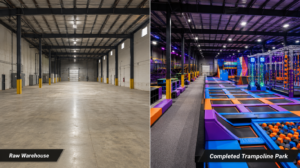
Find Indoor Trampoline Park Builders. Explore Turnkey Solutions, Exact Fees, And Avoid Hidden Installation Traps.
Detayları görüntüle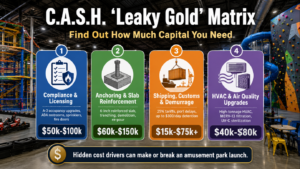
Master Indoor Playground Business Cost. Avoid Hidden Fees And Reduce Your Final Indoor Playground Cost.
Detayları görüntüle
Plan An Active Indoor Park Around Age Groups, Activity Flow, Sightlines, Capacity, And Practical Daily Operation.
Detayları görüntüle