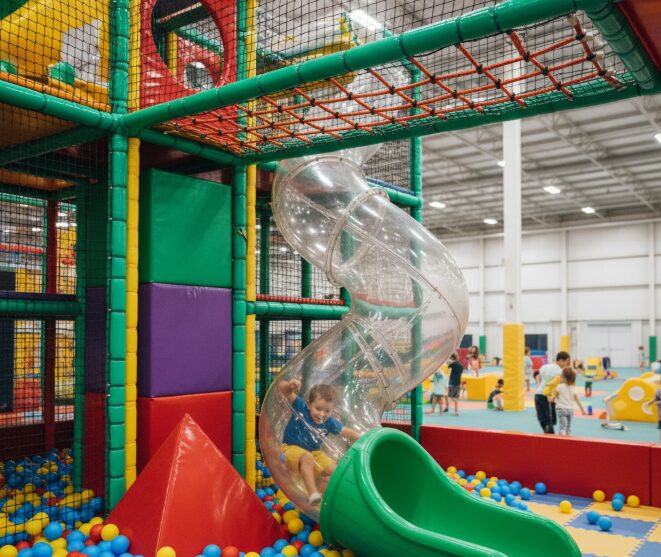
Are Indoor Playgrounds Profitable: Business Analysis By 2025.
The answer is yes, but this is not an easy “lying down” business. In the current market environment, especially in 2025, when rents and labor costs are rising, this is an industry with high capital expenditure and high operational risk. It requires refined operational management and a solid business model.
How does the Indoor playgrounds make money?
The profitability of an indoor playground essentially depends on the degree of diversification of its revenue and the ability to control fixed costs.
Overview of profit model
From my consulting experience, the profit model of a healthy indoor playground should not only rely on ticket revenue, but must build a “core + auxiliary + high profit” structure:
Ticket revenue (core basis): This is the most basic source of cash flow, including single admission tickets, timed tickets or multi-day packages. This part of revenue should account for 50% to 65% of total revenue, maintaining a stable base of people.
Birthday parties/group events (high margins): This segment is the gold business that achieves high gross margins. Because they can be booked in advance, lock in venue time, and usually include catering and additional service packages, their profit margins are often higher than those of everyday casual guests. Successful playgrounds can usually increase this revenue to 15% to 25% of total revenue.
Catering and retail (high-frequency secondary assistance): Providing light food, beverages, light meals and peripheral goods is the key to increasing the length of stay and the unit price (Ticket Size) of customers. Although the gross margin of food and beverage is limited by cost, it can be effectively converted into stable cash flow.
Cost structure analysis
Understanding the cost structure is the first step in assessing profitability, and costs are usually divided into the following three categories.
Fixed cost
Rent: This is usually the biggest expense, and it is recommended to keep the rent (including property fees) within 15% to 20% of total revenue, otherwise the pressure will be very high.
Equipment depreciation and maintenance: the initial investment of amusement facilities is huge, and reasonable depreciation must be carried out according to the contract life.
Insurance and Licensing: As child safety is involved, the cost of insurance is a mandatory and incompressible compliance cost.
Variable cost
Labor costs: including employee salaries, insurance, etc. High turnover of good employees is a common problem, especially on weekends and holidays, where manpower deployment and overtime pay are the focus of controlling variable costs.
Water and electricity consumption: air conditioning and lighting are the main energy consumption sources.
Initial capital expenditure
Mainly refers to the purchase of amusement facilities, decoration projects, safety mats, etc., this part is the key to determine the return on investment cycle (ROI).
What aspects need to be considered to carry out the Indoor playground business?
Location and market analysis
Location is more than just finding an empty berth, it requires in-depth market analysis:
Target customer analysis: What age group are your main customers? What is their family spending power?
Surrounding competitive environment: Are there other indoor playgrounds nearby? What are their characteristics and advantages and disadvantages?
Population density and accessibility: number of children in the area, community distribution, availability of public transportation or parking.
Business Circle Synergy: Can shopping centers, supermarkets, cinemas and other surrounding formats bring synergy?
A good location can make you more effective.
Rent with indoor playground equipment
Rent negotiation: When signing a long-term lease (more than 5 years), be sure to strive for a reasonable rent-free period and an increasing rent cap year by year. Locking rent pressure in advance is the key to controlling future operational risks.
Indoor playground equipment: In the procurement of facilities, the initial cost savings in non-core areas can be moderate, but safety certification, environmentally friendly materials and durability are absolutely not compromised capital expenditures. Security compliance is more important than any low-price temptation.
Pricing
Pricing is the core link of testing business wisdom. It is not a random number set by feeling, but based on the comprehensive evaluation of cost, market competition and customer value.
A “peak/trough” strategy is recommended. On weekdays (such as Monday to Friday afternoon), lower entry prices should be adopted or longer packages should be launched to increase the utilization of idle resources.
On weekends, summer and winter vacations or public holidays (peak hours), a premium strategy is adopted to maximize revenue.
At the same time, membership cards and annual cards are the core tools to improve customer stickiness and lock in future cash flow. But the focus is not on the strength of the discount, but on the value of the lock.
Marketing
Content and word of mouth: Marketing now focuses on Social Proof and local community. I usually recommend low-cost and efficient customer acquisition through local KOL and community cooperation (e. g. joint promotion with kindergartens/early childhood education institutions).
Data-driven: The use of CRM systems to analyze customers’ consumption frequency, preferences and churn rates is the basis for precision marketing.
Risk factors affecting profitability and responses
Seasonal fluctuations: winter and summer vacations, holidays are the peak season, working days and non-holidays are off-season. Offers, themed events or cooperation with other agencies can be launched in the off-season.
Security Incidents: This is the biggest risk. Safety rules and regulations must be strictly enforced, equipment must be checked regularly, and commercial insurance must be purchased.
Market competition intensifies: continuous innovation, improve service quality, create characteristic themes, and form their own core competitiveness.
Changes in consumer preferences: pay attention to market trends, adjust amusement content and activities in a timely manner, and maintain attractiveness.
In the face of these risks, it is recommended to establish a sound risk management system and maintain a keen market insight and be ready to adjust strategies at any time.
The indoor playground can not only be profitable, but through sufficient market research, refined operation and continuous innovation, it can achieve a higher return on investment than the industry average.
Success is not accidental. It comes from a deep understanding and execution of the business model. This is not an easy “get rich quick” program, but a physical service industry that requires professional management.
Before initiating any major capital expenditure, it is important to consult a professional business advisor for due diligence and financial modeling to ensure that your investment direction is based on solid data, not good imagination.
Expand more!
Welcome
Demo Description
Send Us a Message
Creating the Playground of Children’s Dreams
Please leave your contact details, and our professional consultants will provide you with a complimentary site measurement and 3D design proposal.
Send Us a Message
Please fill in your email address, and our manager will contact you to confirm your mailing address and mail you samples and material certificates (MSDS/COA) free of charge.
 Mimu Play