 Mimu Play


product search
Indoor PlaygroundNinja WarriorOutdoor PlaygroundTrampoline
search

Trampoline transportation must first make a choice between “self-assembly transportation” (suitable for short-distance and trailer transportation) and “disassembly transportation” (suitable for high-speed and small vehicles).
If you plan to carry the whole assembly: first you must remove the safety net and surround bars to reduce wind resistance; then lift the frame onto a flatbed trailer or spacious truck bucket; finally, be sure to use at least 4 heavy ratchet straps to fix the frame to the anchor point of the trailer.
If you choose to disassemble and transport: the spring must be disassembled in a “star-shaped diagonal” order to prevent uneven deformation of the frame under force; The rods should be tied with wrapping film. Screw fittings are put into labeled bags.
Here I have to throw out a serious warning: never try to transport a complete trampoline with a safety net on the highway. Wind resistance will not only ruin your trampoline frame, but may also cause traffic accidents.
Before you start, the most critical step is to evaluate your shipping conditions. It all depends on how far you have to run and what car you have on hand.
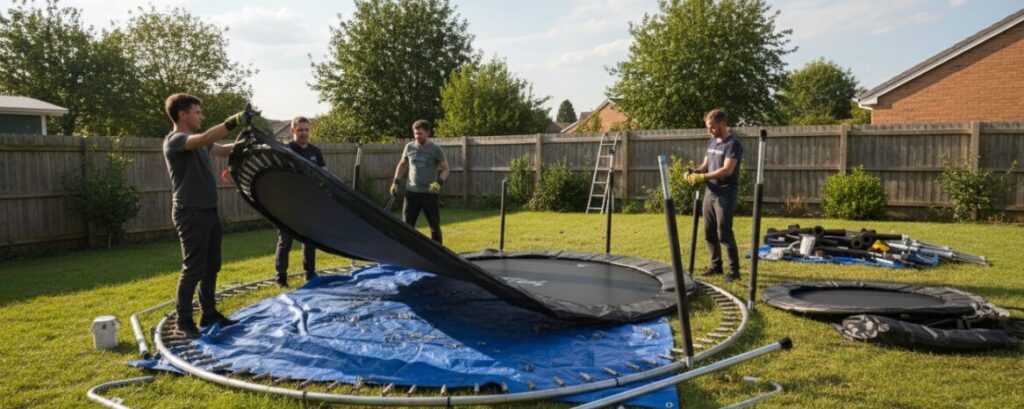
If you are sure that the distance is short enough and there is a trailer, you can carry it in full, but this does not mean that you can just throw it in the car and leave. To make sure the structure doesn’t fall apart, you have to play by the rules.
Even if it is only a short distance, you must remove the safety net and the fence. Don’t tear down the net on the road, the net in the wind like a sail, the force area is huge.
Removing them can significantly reduce wind resistance-in my career, wind resistance is the number one killer of trampoline damage in transportation.
You have to rely on manpower to carry this thing. Find 2 to 4 people to keep the force even.
Gravity alone can’t hold down a trampoline. You need active reinforcement to prevent it from jumping or shifting.
For high-speed travel or the use of small vehicles, complete disassembly is the only safe way. There is a technical difficulty in this process, and many people are easily mistaken.
When disassembling a trampoline, the most common mistake is to disassemble the springs one by one along the circle. This kind of operation will lead to extremely uneven tension distribution, directly pulling the metal frame and deforming it. When you arrive at your new home, you will find that you cannot put it back at all.
Star Disassembly Technology :
This ensures that the frame always remains perfectly round.
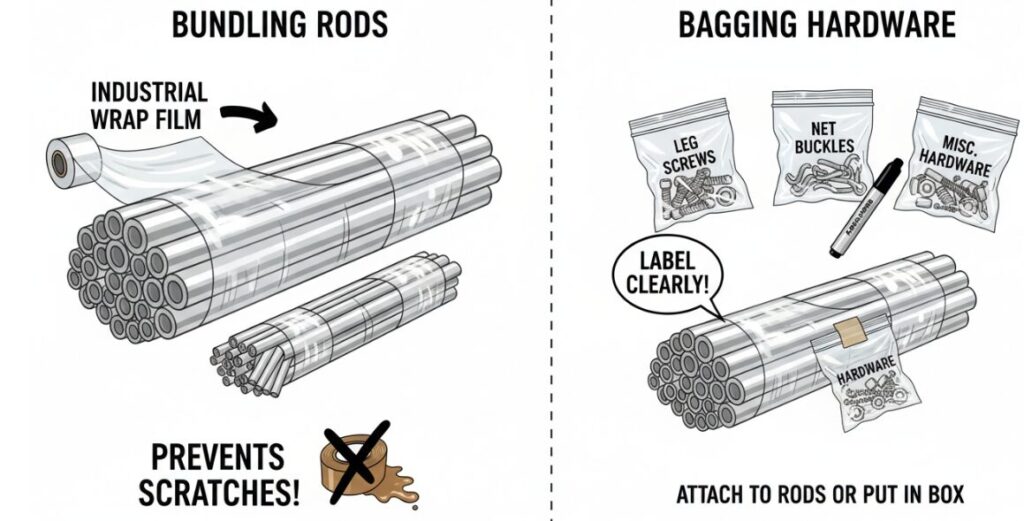
After the frame is disassembled, you will get 1 piles of metal tubes (leg tubes and surround rods).
There are dozens of nuts, bolts, washers and washers on the trampoline. Even if you lose one, it will make you crazy when you reinstall it.
It is strictly forbidden to transport a self-contained trampoline with a safety net on the highway.
Many trampoline frames use light steel and are designed to withstand vertical jumping gravity rather than horizontal winds. At high speeds (above 55 mph), the wind resistance acting on the safety net can generate hundreds of pounds of force.
The consequences are often disastrous:
Safety first, please be sure to disassemble honestly before getting on the highway.
Author:Mark Stevenson
With over 15 years of experience in professional moving and logistics, I’ve helped hundreds of families relocate their backyard equipment safely. I specialize in heavy load security and proper disassembly techniques to ensure your gear arrives in perfect condition.”
提交产品咨询
我们将会在24小时内联系您