


...

product search

How To Keep A Trampoline From Blowing Away

huishou 3530

To prevent the trampoline from being blown away by strong winds, the most effective method is to permanently secure the frame with heavy-duty spiral studs (Auger-style) using high-strength nylon straps.

For ordinary soil or grass, you need to prepare four 10-inch galvanized steel screw anchors—one for each supporting leg—and then screw them completely into the soil. The key point is the connection method: the belt must be directly buckled on the top of the trampoline round rail, do not buckle only the bottom leg, and the belt should be completely tightened, leaving no margin.

If you live in a place full of hard clay or gravel and the nails can’t get in, you’ll have to rely on “gravity suppression”: at least 40 pounds of sandbags or cement blocks on each leg.

As for the extreme case of a hurricane, it is not enough to fix it alone. You have to remove the safety net and jumping mat to eliminate wind resistance (that is, aerodynamic lift), otherwise you will not be able to pull any anchor.

Why Must We Use Auger-Style?

The structural design of the ground anchor is the key to fixing the trampoline on ordinary soil. The spiral ground nails are absolutely excellent in performance. The in-line ground nails (similar to the ground nails used in tents). Straight nails work purely by friction with the soil. Once the ground is watered through by heavy rain, the soil becomes soft and the friction goes to zero directly—which is why many trampolines fail in storms.
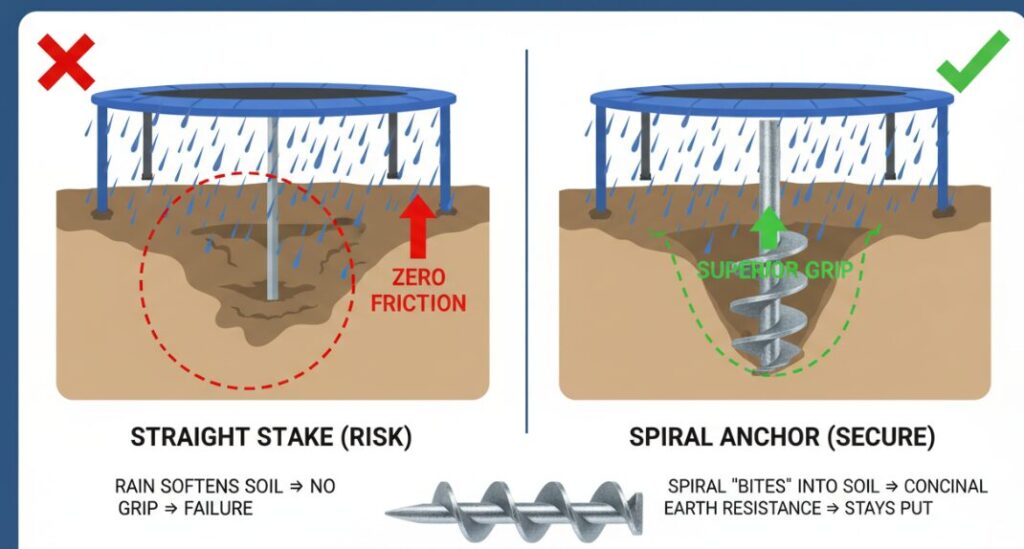
  • Grip: The spiral anchor is designed to “bite” into the soil. In order for the wind to pull it out, it must tear out an entire conical piece of earth within the diameter of the spiral, which provides a grip that is not an order of magnitude at all.
  • Material To Be Right: Stare at the 10-inch galvanized steel anchor. The galvanized layer can prevent rust, which can ensure that the nail will not be corroded and broken due to long-term soaking in wet soil.
It needs to be secured with spiral ground stakes.

Correct Installation

For stability, each supporting leg section must be equipped with an anchor. Screw it completely into the ground until only the buttonholes are exposed on the grass. On the one hand, this is to prevent the child from tripping, on the other hand, it is to ensure that it is deep enough to maximize the grip.

  • The Binding Position Is Very Exquisite: The Top Circle Must Be Connected: The most common mistake people make is tying the straps only to the bottom of the trampoline legs. To be honest, this is useless, because when strong winds come, the base and the frame abovemay be separated. To lock the structure, you must attach a high-strength nylon strap directly to the top circular guardrail.
  • Structural Integrity: By passing the strap around the top ring (the ring on which the spring is hung), you are actually anchoring the “body” of the trampoline to the ground. This creates a downward pulling force that holds the entire frame firmly together.
  • Refuse To Be Loose: After the connection, the belt must be pulled tight and no room can be left. As long as there is a little looseness, the trampoline will generate momentum when it shakes in the wind. At this time, the instantaneous impact force can break the belt or directly pull the ground nail out of the soil.

How To Fix Hard Or Gravel?

If you live in a place where the ground is as hard as iron—such as hard clay, gravel, or you simply put the trampoline on the concrete floor—the screw will not go down. At this time, we have to change our thinking and put on the counterweight system.
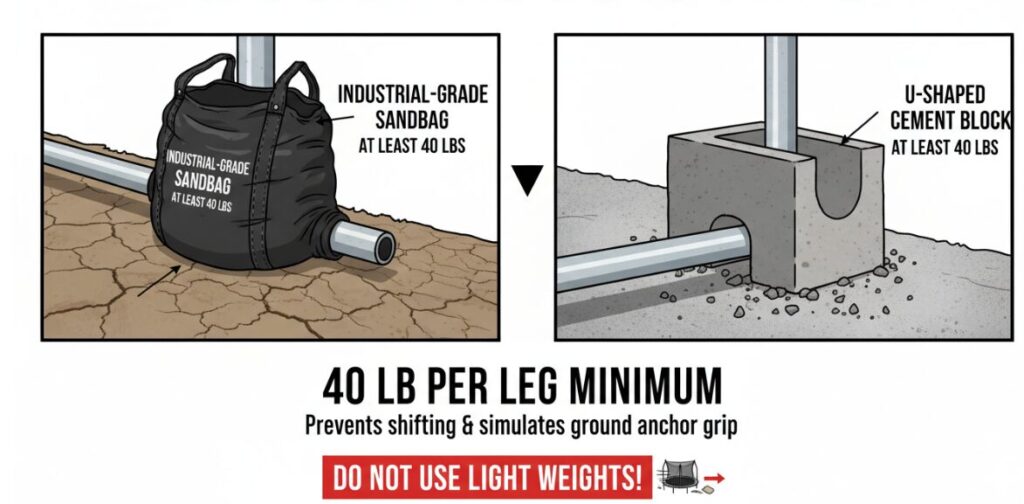
  • Sandbags: Use the kind of heavy-duty sandbags, preferably industrial grade or outdoor furniture. Press directly on the leg seats at the trampoline level.
  • Cement Block: Or use U-shaped cement block, directly stuck on the leg.
  • The 40 LB Rule: This is a hard metric: at least 40 pounds per leg. Light words, the wind blows trampoline vibration, heavy objects will shift slip. Only by reaching this heavyweight (or even heavier) can the grip of the ground nail be simulated.
How to secure a trampoline with rocks or gravel?

Facing Extreme Weather

In the event of a hurricane or tornado, as long as the jumping mat is still there, I can’t guarantee how many nails I hit. A trampoline is essentially a huge wing; strong winds pour in from under the mat, creating aerodynamic lift that can uproot the deepest ground nails. In order to keep your trampoline under extreme conditions, you must change its aerodynamic characteristics:

  • Remove The Safety Net: The purse seine is like a sail, especially for a ride, which will greatly increase the resistance of the frame. Removing it can significantly reduce the wind area.
  • Remove The Jump Mat: This is the most critical step. Remove the mat and the “wing effect” is eliminated. The wind will pass directly through the remaining empty shelf, and the force acting on the anchor point will fall precipitously.
  • In summary, the combination of the right anchoring hardware and the removal strategy in extreme weather can ensure that your trampoline stays in place.

Author: Alex

As an outdoor equipment safety specialist. With over a decade of experience in backyard assembly, I specialize in weatherproofing structures against severe elements. I’ve tested everything from galvanized corkscrew anchors to heavy-duty sandbag systems to determine exactly what keeps a trampoline grounded during high winds and hurricanes.”

Expand more!

*
*
*
Submitting…
Submitted successfully!
Submission failed!
Invalid email address!
Invalid phone number!

Creating the Playground of Children’s Dreams

Send Us a Message

*
*
*
Submitting…
Submitted successfully!
Submission failed!
Invalid email address!
Invalid phone number!

This will close in 0 seconds