 Mimu Play








product search
Indoor PlaygroundNinja WarriorOutdoor PlaygroundTrampoline
search

To determine exactly how much weight you need to hold down a trampoline, you must apply a specific load based on the diameter of the trampoline and the surface area of the jumping mat.
When dealing with wind speeds up to 40 mph (about 64 km/h), the general safety standards I usually enforce are: small trampolines (under 10 feet) require at least 30 pounds (13kg) of counterweight per leg; standard medium trampolines (10-12 feet) require 40 pounds (18kg) per leg; and for large or rectangular trampolines (14 feet and above), each leg must reach 50-60 pounds (23-27kg).
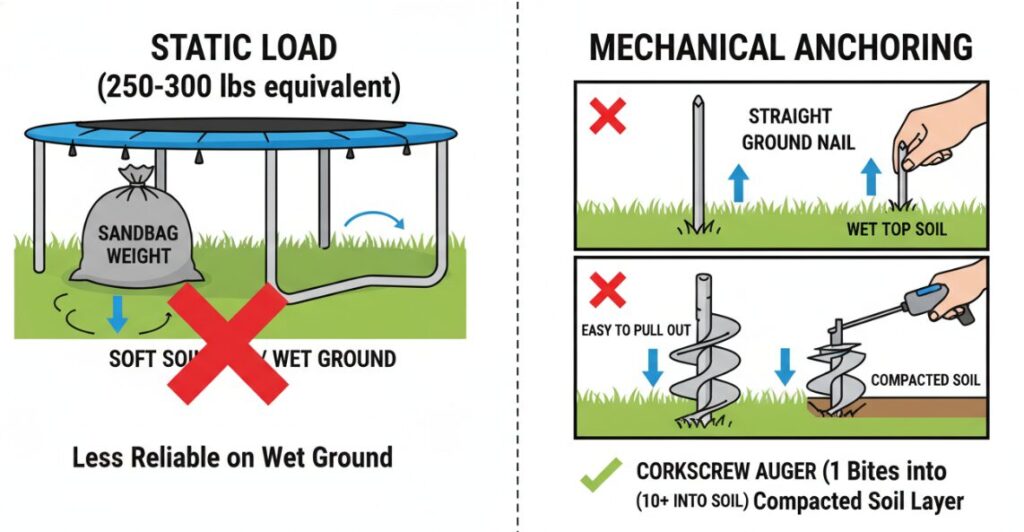
If you are installing on grass and plan to use windproof ground nails (anchors) instead of sandbags, you must use corkscrew-style augers and drill to a depth of at least 10 inches. Only in this way can a grip equivalent to a static load of 250-300 pounds be obtained.
For homeowners who install on concrete or terraces, the situation is more severe because there is no ground friction to help. The iron rule here is that the total weight must be more than 50% of the weight of the frame-meaning, for a typical 200-pound trampoline, you need a total of 300 pounds of sandbag weight evenly distributed across each leg to prevent it from sliding or rollover.
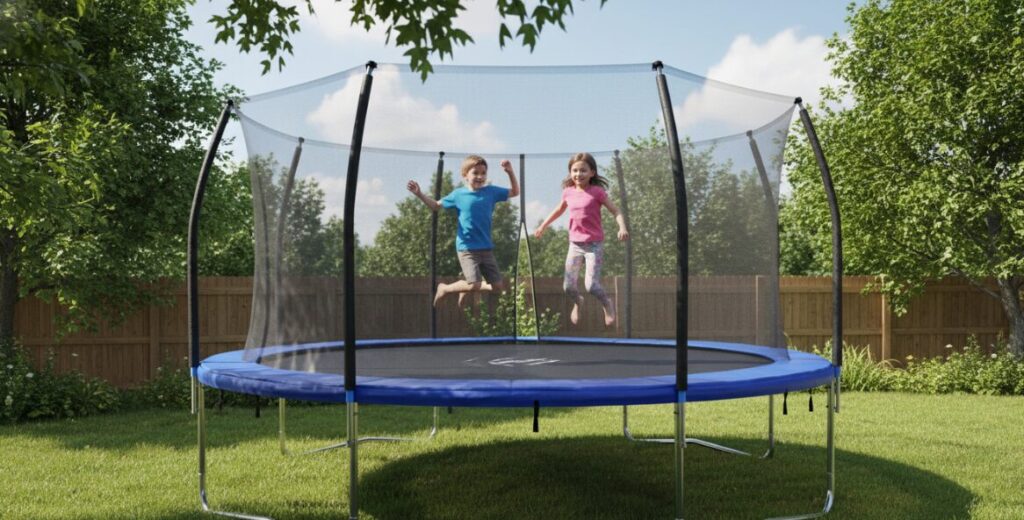
The weight required to fix the trampoline is directly linked to the diameter of the trampoline and the surface area of the jumping mat. In actual installation, the large-sized jumping mat is like a huge sail, which will hold more air in the storm and generate extremely high wind lift. In order to counter this aerodynamic force, be sure to apply a specific load according to the following frame dimensions:
Discover endless fun and spark imagination! Our indoor playground products create a safe, exciting paradise for children. Experience boundless joy now!
Embrace adventure and fresh air! Our outdoor playground products offer thrilling, safe experiences for kids to explore, play, and grow. Unleash the fun outside!
When you install a trampoline on a soft surface like grass, you can choose mechanical anchoring (ground nails) instead of pure static weight (sandbags). However, I want to remind that not all ground nails can provide the necessary grip.
To replicate the stability of heavy ballast, you must use corkscrew-style augers. This is different from those in-line nails-straight nails are easy to pull out when the ground is wet, which is not reliable at all-while spiral nails can bite the soil to death.
To achieve a safety standard equivalent to a static load of 250-300 pounds, these screw ground nails must be drilled at least 10 inches into the soil. This depth ensures that the anchor engages the compacted soil layer below the topsoil, providing sufficient resistance to resist upward lift.
Installing a trampoline on concrete, patios or decks is a unique challenge because there is no ground friction to help fix the legs and you cannot use ground nails. In this case, the total weight of the sandbag becomes your only line of defense against the trampoline sliding and flipping.
To calculate how much weight is needed on a hard surface, I strongly recommend following the “150 percent rule”:
Practical application: If your trampoline weighs 200 pounds, you need a total of 300 pounds of sandbag weight (200 pounds + 50%). Most importantly, this total weight must be evenly distributed across all legs. If only the weight is concentrated on one side, when the strong wind strikes, there is no way to prevent the trampoline from tipping over. Only by strictly observing the ratio of this weight to the frame can we effectively offset the lack of ground friction and prevent the entire structure from becoming a “trapeze”.
Author: Mark Davis.
“As a safety specialist focused on structural stability, I wrote this guide to help you calculate the precise load needed to counteract wind lift. Whether you are installing on grass with 10-inch augers or on concrete using the 150% ballast rule”
This will close in 0 seconds