 Mimu Play








product search
Indoor PlaygroundNinja WarriorOutdoor PlaygroundTrampoline
search

This figure is actually a calculation of the dynamic load. It is to ensure that when the spring and the jumping pad absorb the huge impact generated by the fall, the user will not directly hit the ground under the bottom—that is, we often say “touch the bottom”.
When the manufacturer sets this index, it will comprehensively test the tensile strength of the spring, the wall thickness of the steel frame and the elasticity of the jumping pad. The purpose is to ensure that when a user who has reached the maximum weight limit falls at full speed, the cushion can stop the car at a safe height, and at the same time will not cause permanent deformation of the spring, nor will it destroy the structural integrity of the frame. So, the number you see is a “red line” for safe operation when a single person jumps, not a static breaking point.
To really understand the trampoline weight limit logic, you have to distinguish between static weight and dynamic load. The limit is dynamic load.
Static weight is well understood as the weight of a 200-pound stone that you put in the center of the mat and it stands still.
The dynamic load is the force of this “stone” after it moves. Under the action of gravity and acceleration, when you jump up and fall, reaching the lowest point of rebound, the force exerted on the trampoline is several times your weight (ie G-force).
We set the weight limit at design time to deal with this multiplying force. If a trampoline is limited to 250 pounds, this means that its engineering design standard is to withstand the dynamic impact of a 250-pound person falling from a standard height, and the instantaneous downward force is far more than 250 pounds.
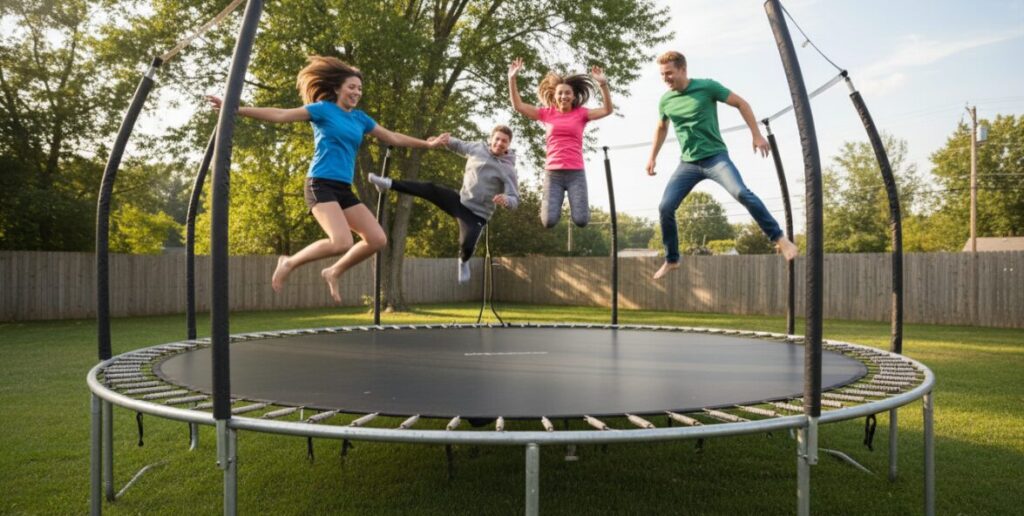
The most direct safety goal of weight limit is to prevent “bottoming out”. This is also the most direct physical consequences of overweight.
When the dynamic load exceeds the design absorption capacity of the trampoline, the spring will be stretched to the limit, causing the jumping mat to sink too low. If the mat hits the ground (or the steel legs of the trampoline) during your landing cushion, the original deceleration process will instantly become a “hard landing”. This momentary emergency stop completely offsets the shock absorption function of the trampoline. A lot of serious leg fractures, ankle injuries and even spinal injuries happen.
Therefore, the weight limit is essentially a safety buffer to ensure that when you have the greatest impact, there is enough clearance between the mat and the ground.
Discover endless fun and spark imagination! Our indoor playground products create a safe, exciting paradise for children. Experience boundless joy now!
Embrace adventure and fresh air! Our outdoor playground products offer thrilling, safe experiences for kids to explore, play, and grow. Unleash the fun outside!
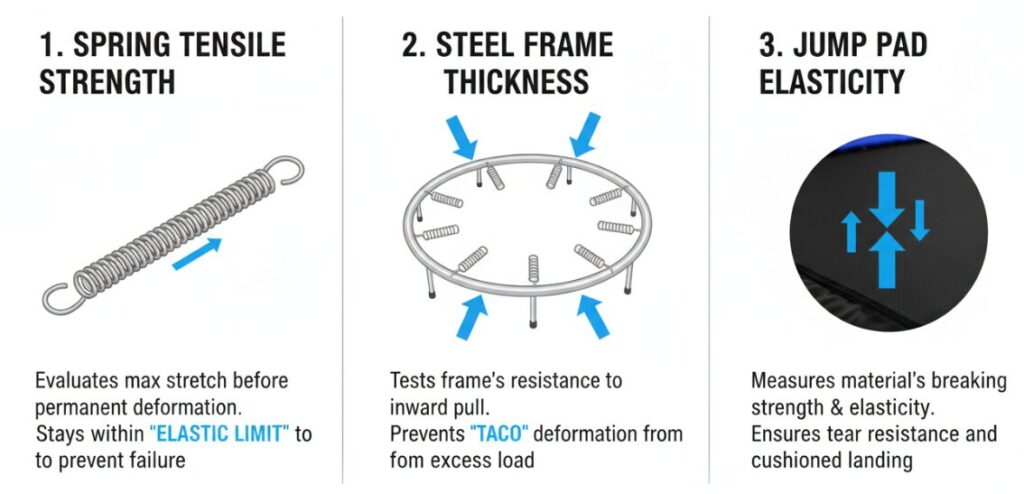
When determining the weight limit, we mainly look at the interaction of 3 hardware components: the spring, the frame and the jump pad.
The spring is the engine of the trampoline. We evaluate a spring primarily by its tensile strength—that is, how long it can stretch before it can be restored. The weight limit is calculated to ensure that the spring always operates within the “elastic limit. If the dynamic load is too large, the spring will undergo plastic deformation, that is, it is permanently elongated. At this time, the spring is dead, and the trampoline loses its safety.
The frame must provide a rigid anchor for the spring. We test the gauge of the steel to make sure it can withstand the inward pull that occurs when jumping. If you are overweight, the huge inward pull will cause the frame to deform, and even the phenomenon we commonly call “taco” (folded inward like a taco). The weight limit marks the maximum tensile force that the frame can resist while maintaining the geometry without deformation.
The mat itself also participates in the deceleration. We test the breaking strength and elasticity of woven materials (usually polypropylene). The weight limit is to ensure that the cushion will not tear under the instantaneous high pressure, but also have enough air permeability and ductility to cushion the landing.
In addition to preventing direct injury, the weight limit is also to protect the life of the equipment.
Even if overweight use does not cause catastrophic instantaneous damage (such as the frame breaking in two on the spot), it often causes invisible cumulative damage.
Therefore, the weight limit is observed not only to avoid injury, but also to prevent slow degradation of equipment components.
Finally, it must be emphasized that the weight limit is calculated on the basis of the dynamic impact of the “single” jump.
This computational model assumes that the force is acting at the center of the mat. Too many people jumping at the same time in the field, which introduces risks that two computational models cannot cover:
Superimposed dynamic load: Even if the combined weight of the two children does not exceed the standard, if they fall to the ground simultaneously, the instantaneous superimposed dynamic load is likely to exceed the limit.
Uneven force: Multiple people jumping often means that someone will fall in a non-central area, which will cause the local spring and frame to bear extremely uneven tension. Even if the total weight is within the range, it is easy to cause the frame to twist.
Author: Alex Mercer
“I’m a structural safety analyst with a decade of experience in sports equipment testing. I specialize in breaking down the mechanics of gear—focusing on dynamic load and material limits—to help you understand the physics that keep your family safe.”
This will close in 0 seconds