 Mimu Play









recherche de produits
Terrain de jeux intérieurNinja WarriorAire de jeux extérieureTrampoline
recherche
Looking for a trampoline park manufacturer that can “turn the key” (all-inclusive), from drawing, making equipment to on-site assembly, it will cost about $35 to $65 per square foot. 1 the whole stadium is built, the urban store with a makeshift area will start at about $150000. If it is a large-scale comprehensive hall with ninja entry and digital interactive games, it is normal to work for more than $800000. In this stage of throwing a lot of money, whether it is the owner or franchisee with an empty plant, will face a deadly multiple-choice question: is it their own patchwork to find a 1 pile of cheap suppliers, or simply package to an all-inclusive manufacturer? Practical experience tells us that looking for a 1 pile of construction teams that do not tie up with each other, and eventually often in the fire acceptance and structural quality inspection of each other, stuck neck. Today, let’s make a disclosure, pick up the specific charge details of the whole package, expose some of the most cheat people’s installation traps, and give you a set of hard-core engineering evaluation standards to help you close the next trampoline manufacturer.
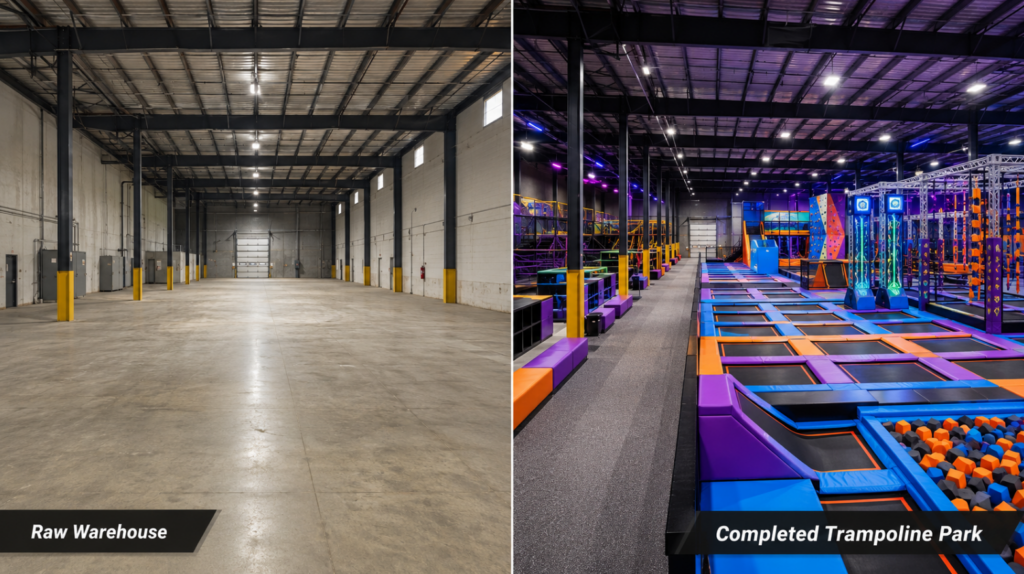
Smart franchisees look at the manufacturers, never look at those rotten street product albums, but directly on the “D.M.I.” evaluation system. This set of standards can ensure that the final landing venue can not only withstand the peak passenger flow, but also fully meet the strict municipal building codes.
For a professional site blueprint, the ceiling height and the pipe direction of the central air conditioner must be clearly arranged before the factory blanking and cutting steel pipes. In accordance with ASTM safety standards, a minimum clear height of 17 feet (5.2 meters) is allowed from the trampoline surface to the lowest barrier on the ceiling. The reliable all-inclusive design team will directly use the 3D scanner to make a thorough 3D modeling of your factory building to ensure that the original load-bearing columns can be cleverly wrapped into the rest area instead of standing upright in the dangerous jumping area.
Whether commercial venues can last for a long time depends on whether the steel is resistant or not and whether the springs are tough enough. The main frame of the head factory is all welded out of galvanized steel pipe (Q345 grade) with a thickness of at least 3mm and a 80mm x 80mm. In order to save money, some cheap manufacturers fighting price wars use thinner Q235 steel and encounter adults jumping violently every day. A year and a half later, the steel frame is full of micro-cracks that you cannot see. In addition, the spring must be made of anti-rust galvanized piano wire grade material, otherwise the venue will soon be filled with crunching noises, the bed surface will collapse seriously, and the customer experience will be directly ruined.
Whether the venue can open as scheduled depends on the last municipal acceptance. Regular all-inclusive manufacturers will send qualified shift foremen to the site to keep a close eye on local workers to ensure that the depth of the sponge pool and the tightness of the protective net, even 1 structural screws, strictly comply with ASTM F2970 or European EN 11142 standards. Without this compliance inspection form, commercial insurance companies will not look at you and refuse insurance directly.
Don’t just look at the ex-factory price when calculating the general ledger. For those in charge of procurement, the total labor costs for equipment manufacturing, shipping volume (CBM) and on-site installation should be added up. In many cases, the ridiculously low factory quotation is often to cover up the invisible back-end charges behind the cannibalies.
| Venue Area | Average All-Inclusive Cost (USD) | Installation Cycle | Recommended Minimum Capacity |
|---|---|---|---|
| 5,000 sq ft | $220,000–$375,000 | 3–4 weeks | 80–120 guests |
| 10,000 sq ft | $440,000–$750,000 | 3–5 weeks | 160–240 guests |
| 15,000 sq ft | $660,000–$1,125,000 | 4–5 weeks | 240–360 guests |
| 20,000 sq ft | $880,000–$1,500,000 | 4–6 weeks | 320–480 guests |
| 30,000 sq ft | $1,320,000–$2,250,000 | 5–7 weeks | 480–720 guests |
| 40,000 sq ft | $1,760,000–$3,000,000 | 6–8 weeks | 640–960 guests |
| Cost Component | Typical Cost |
|---|---|
| Equipment Manufacturing | $25–$45 per sq ft |
| On-Site Installation Labor | $15–$20 per sq ft |
| Freight and Port Clearance | 10%–15% of equipment cost |
| Interactive Game Upgrade | Additional $15,000–$45,000 per project |
Many owners who are engaged in venues for the first time are bleeding at the beginning because they did not pick the words in the international procurement contract. If you want to pay less tuition, you must take a magnifying glass to check the following 3 commercial traps.
Many overseas manufacturers have sent the original galvanized steel frame without fireproof expansion paint. As long as the fire brigade around the main steel structure can not reach the local fire rating, immediately ordered to stop work. At this time, the boss can only be forced to pay a high price to invite the local engineering team to spray fireproof paint on the already built shelf. This 1 the ordeal, the opening was delayed for at least several weeks, and nearly $20000 was paid in vain.
Some manufacturers will press the equipment money very low on the quotation, and then secretly bury the sky-high travel expenses of the installation team in the small print of the contract. The buyer signed in a muddle-headed way and finally found out that he had to reimburse 3 overseas engineers for business class air tickets, stay in five-star hotels, and pay an extra $500 a day for travel subsidies. Remember, the cap on labor and travel expenses must be completely sealed in black and white in the initial all-inclusive contract.
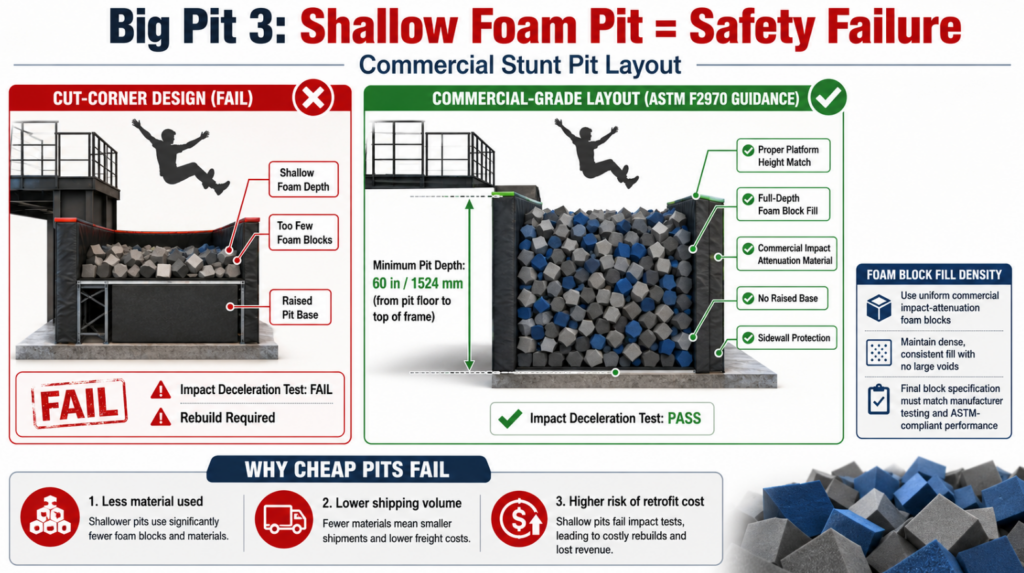
Municipal regulations have rigid requirements for the depth of the sponge pool, which is directly linked to the height of your platform. Those cheap manufacturers deliberately set the pool base very high and very shallow in order to save material and send less sponge pieces. When a third-party safety officer does the impact deceleration test, the test will fail. The result is that the boss can only dismantle the whole sponge pool and redo it from scratch.
What are the bottom line requirements for floor height in indoor trampoline parks?
The municipal side is very dead to the net height card. A minimum clear height of 17 feet (5.2 meters) from the paved floor to the lowest hanging on the ceiling (e. g., lamps, air conditioning ducts, fire sprinklers) is required to legally operate the main trampoline area. If you want to build an Olympic-level professional high-bounce trampoline, that floor must be 21 feet (6.4 meters) high.
How long does it take to build an indoor trampoline hall?
From the day when the contract is signed and the money is paid, the all-inclusive project usually takes 4 to 6 months. It takes about 3 weeks for space design and engineering drawing, 6 to 8 weeks for factory production line manufacturing, 4 weeks for sea transportation across the sea, and 3 to 5 weeks for manual assembly at your site.
Will the manufacturer provide non-slip socks with their Logo?
I will. Major factories have their own matching accessories departments, such as customized anti-skid socks, RFID smart bracelets and employee uniforms, which are usually packaged and sent to you together in the franchise start-up gift bag.
What exactly is the standard called ASTM F2970 and why do you have to watch it?
ASTM F2970 is a set of standards for trampoline site design, manufacture, installation and operation in the United States. Before the insurance company grants you commercial liability insurance, it must see the evidence issued by the manufacturer that the equipment has 100% passed the load and impact test, otherwise it will not underwrite you at all.
In order to save money, can I find local workers to install trampoline equipment?
If you install it yourself, your protective umbrella will be completely broken. Commercial insurance companies will require an affidavit signed by a certified professional installer. If you just find a local guerrilla to “DIY”, the manufacturer’s warranty will be invalidated instantly. If there is a safety accident, the sky-high claim lawsuit will definitely make you bankrupt.
How often do commercial trampoline surfaces and springs need to be changed?
Under the high-intensity use of full every day, the tension spring in the main trampoline area usually takes 12 to 18 months to exchange blood. The black jumping surface depends on the pedaling frequency, and the service life is about 2 to 3 years. The color safety soft bag with relatively large friction force, because the PVC skin on the surface is easy to wear, usually has to be replaced every 18 months.
Discover How To Build A Safe Ninja Warrior Obstacle Course With Pro Hardware And Our Expert Rigging Guide.
Voir les détails
Top Custom Indoor Playground Trampoline Park Manufacturers. Maximize Roi With Expert Layouts And Proven Safety Guides.
Voir les détails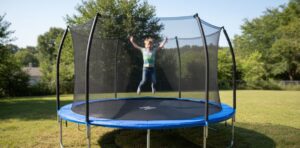
Les trampolines moyens pèsent entre 150 et 250 livres. Voir les poids spécifiques par taille, le nombre de boîtes et les conseils pour le ramassage.
Voir les détails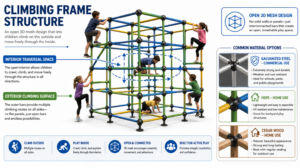
Discover What Is A Jungle Gym. Explore Top Playground Uses, Key CSS Benefits, And Hidden Safety Traps To Avoid.
Voir les détails