 Mimu Play









recherche de produits
Terrain de jeux intérieurNinja WarriorAire de jeux extérieureTrampoline
recherche
Figuring out exactly how to open an indoor playground business requires executing seven non-negotiable steps: conducting demographic heat-map analysis, securing a high-clearance commercial lease, obtaining municipal assembly zoning permits, sourcing ASTM-certified interactive equipment, engineering commercial HVAC systems, establishing multi-tier revenue software, and passing strict fire marshal safety audits. Relying on generic business plans will bankrupt your project during the build-out phase. Many entrepreneurs sign a cheap warehouse lease only to discover the ceiling height cannot accommodate multi-level structures, or the local zoning board demands a $50,000 parking lot expansion. The operational blueprint and structural frameworks detailed below provide exact, battle-tested protocols to help you navigate commercial real estate traps and launch a highly profitable family entertainment center.
Executing a commercial build-out requires rigid sequencing. Applying the P.L.A.Y. Framework (Permitting, Leasing, Attractions, Yield-operations) ensures you never commit capital to equipment before securing the legal right to operate the space.
You must select a location based on drive-time data, not simple geographic mileage. A profitable facility requires a primary trade area containing at least 15,000 children aged 1 to 10 within a 15-minute drive. Real estate analysts use GIS heat-mapping to verify the local median household income exceeds $75,000, ensuring the target demographic possesses sufficient discretionary income for $30 weekend admission tickets and premium birthday party packages. Avoid locations situated behind major traffic bottlenecks, as parents will abandon the trip if weekend traffic is notoriously dense.
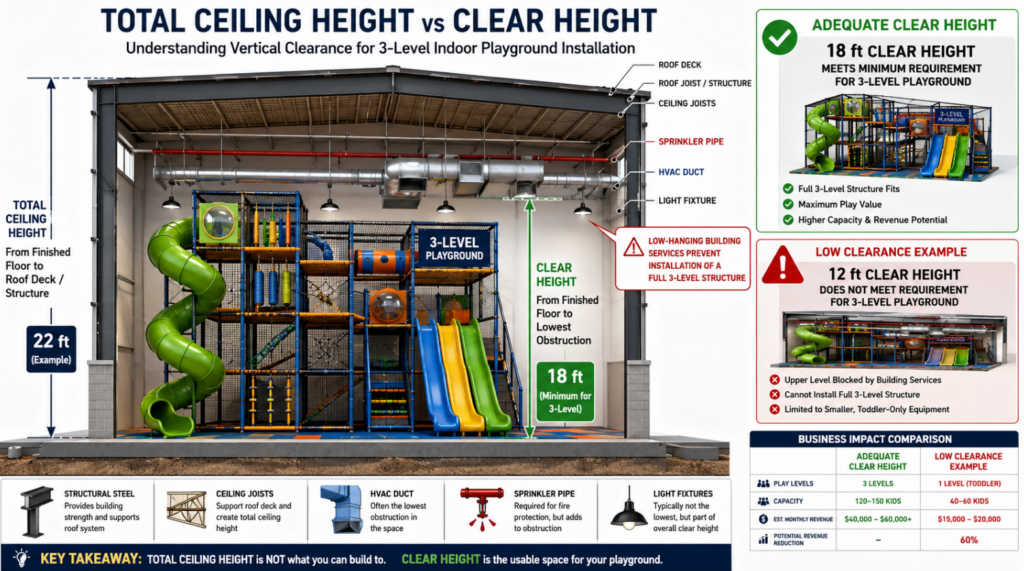
Industrial warehouses appear financially attractive but frequently hide fatal structural limitations. You must verify the building’s “clear height”—the distance from the floor to the lowest hanging ceiling joist or fire sprinkler pipe. You need an absolute minimum of 18 feet of clear height to install a lucrative three-level play structure. Signing a lease on a building with a 12-foot ceiling restricts you to toddler-only equipment, immediately cutting your potential revenue by 60%.
Municipalities categorize indoor playgrounds under strict “Assembly” use codes, subjecting them to the same building regulations as movie theaters. If you attempt to learn how to open a indoor playground in a building previously zoned for standard “Retail” or “Warehouse,” you must apply for a zoning variance. Assembly codes dictate you provide a significantly higher ratio of parking spots (typically 1 spot per 3 occupants) and mandate the installation of panic-bar exit doors and heavy-duty fire suppression systems. You must hire a local commercial architect to draft your change-of-use application before signing any binding lease.
Purchasing basic foam blocks and static plastic slides guarantees obsolescence in the modern entertainment market. Top-tier facility owners currently learning how to open indoor playground business models prioritize “Phygital” (Physical + Digital) integration. You must source RFID-enabled ninja courses, augmented reality (AR) interactive trampolines, and gamified climbing walls. This technology automatically tracks scores via wearable wristbands, keeping 8-to-12-year-olds heavily engaged and justifying a higher entry price point compared to free municipal parks.
A facility packed with 200 sprinting children generates massive thermal loads. Standard retail HVAC systems fail instantly in this environment, resulting in a humid, foul-smelling facility. You must upgrade the HVAC capacity to 1 ton of cooling per 250 square feet of play area. Layout design dictates crowd control; you must physically barricade the toddler zone (ages 0-3) away from the main multi-level structure to prevent high-speed collisions, ensuring parents feel their youngest children are entirely safe.
Relying solely on front-door admission fees leaves massive revenue on the table. You must implement a cloud-based Point of Sale (POS) system capable of processing online digital waivers, booking private birthday party rooms, and managing automated self-serve kiosks. Birthday parties typically generate 40% to 50% of the total facility profit. Your software must allow parents to book 60 days in advance, automatically upselling food packages, grip socks, and dedicated party hosts during the online checkout process.
| Revenue Type | Target Percentage of Total Revenue | Average Profit Margin |
|---|---|---|
| General Admission | 35%–45% | 35%–50% |
| Birthday Parties | 30%–40% | 50%–70% |
| Cafe/Concessions | 15%–20% | 45%–65% |
| Merchandise/Socks | 5%–10% | 60%–80% |
Failing the final municipal safety inspection delays your grand opening and drains your operating reserves. Do not rely entirely on the city inspector to catch safety hazards. You must hire an independent, ASTM-certified playground safety inspector to conduct a private audit two weeks before your launch. They will verify net tension, measure impact attenuation on the safety flooring (Critical Fall Height tests), and check for any entrapment hazards within the steel framing. Once cleared, execute a “soft launch” with friends and family to pressure-test your POS system and kitchen operations under a controlled load.
A commercial developer in Texas finalized their business plan on how to open an indoor playground and leased a 6,000 sq ft former retail clothing store. They allocated $150,000 for customized play structures but entirely ignored the existing HVAC infrastructure.
During their August soft launch, the indoor temperature spiked to 84°F (29°C) within two hours of reaching a 100-person capacity. The heavy physical activity overloaded the existing 10-ton retail air conditioning unit.
The Resolution: They were forced to halt operations for two weeks. They contracted structural engineers to reinforce the roof and craned in two additional 10-ton commercial HVAC units at an emergency cost of $42,000. This real-world failure proves that investigating the mechanical, electrical, and plumbing (MEP) infrastructure during the leasing phase is just as critical as selecting the playground equipment.
What is the minimum budget required to open an indoor playground?
A commercial-scale facility typically requires a minimum startup capital of $250,000 to $500,000. This budget covers the first and last month’s commercial lease, architectural zoning permits, customized equipment procurement, safety flooring, HVAC upgrades, liability insurance, and initial marketing campaigns.
How do you find the right building when learning how to open an indoor playground business?
You must hunt for commercial properties offering an open-span layout with minimal support columns and a clear ceiling height of at least 18 feet. Former big-box retail stores, empty grocery stores, or light industrial warehouses situated near heavy residential zones offer the best structural foundations for this specific business model.
Do I need special insurance for an indoor playground?
Yes. You must secure specialized commercial general liability insurance specifically underwritten for family entertainment centers. Standard retail liability policies explicitly exclude coverage for trampoline injuries or climbing wall accidents. You also require property insurance, workers’ compensation, and cyber liability insurance to protect your digital customer waiver database.
What is the most profitable revenue stream in this business?
Private birthday party packages generate the highest profit margins. While daily admission pays the rent, charging $300 to $600 for a two-hour private room rental—which includes cheap bulk-purchased pizza and paper goods—yields margins frequently exceeding 70%.
How long does it typically take to open a facility from start to finish?
The entire process generally takes 8 to 12 months. Finding the location and negotiating the lease consumes 2 months. Securing municipal permits and zoning variances takes 3 to 4 months. Manufacturing and shipping the customized equipment from overseas takes 60 to 90 days, followed by 3 weeks of physical installation and safety inspections.
Why is an ASTM-certified playground inspector necessary?
An independent inspector protects you from massive legal liability. They utilize specific calibrated tools to ensure no gaps exist where a child’s head or fingers could get trapped. Having a signed certificate from an ASTM-certified professional proves to your insurance company and the local fire marshal that you have met the highest federal safety standards.
Apprendre à transporter un trampoline en toute sécurité. Guide pour le déplacer assemblé sur une remorque ou démonté pour les déplacements sur route.
Voir les détails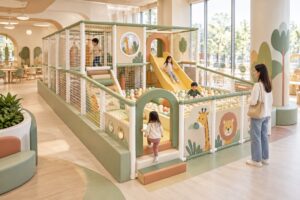
Concevez une aire de jeux intérieure esthétique, avec une palette de couleurs harmonieuse, des zones de jeu clairement délimitées, une bonne visibilité et un entretien facile.
Voir les détails
Les trampolines rectangulaires sont-ils meilleurs ? Comparez la qualité des rebonds, la sécurité et l'espace pour trouver le trampoline idéal pour votre maison.
Voir les détails
Choisissez les meilleurs équipements de jeux souples en vérifiant la sécurité, la mousse durable, les couvertures faciles à nettoyer et les jeux souples adaptés à l'âge des enfants.
Voir les détails