 Juego Mimu









búsqueda de productos
Parque infantil cubiertoGuerrero NinjaParque infantil al aire libreTrampolín
busque en
Select the top indoor custom playground and trampoline park manufacturers, and never just look at the surface. You must hardcore evaluate their ASTM F2970 compliance, space return on investment (ROI) design level, and the durability of the equipment structure. Remember, you’re not buying a 1 pile of steel frames and jumping noodles, you’re investing in a high-traffic revenue engine. Many developers lost up to 30% of their total revenue in the first year of business. In the final analysis, it was because the initial regional planning was too bad and the amusement projects were nothing new. Smart buyers will work directly with indoor trampoline manufacturers that can provide a one-stop turnkey solution to perfectly integrate high-throughput soft rides with interactive trampolines. Next, we will show you the core elements that determine whether your amusement center can make money-engineering standards, spatial architecture, and hidden compliance traps.
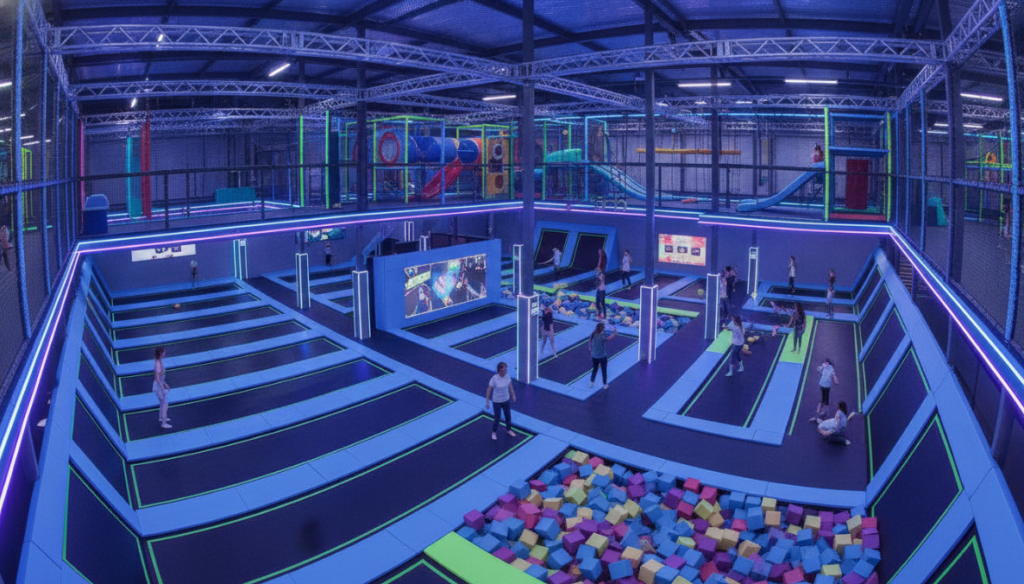
The real money-making amusement centers have long abandoned that stereotypical floor plan, playing with the “R.A.S.(revenue-space-security) pyramid” framework. This unique layout matrix can force every inch of your stadium to be realized. Ordinary suppliers will only fill your venue with the basic trampoline area. However, advanced customized manufacturers know how to design “psychological movement lines” to guide players to naturally transition from high-energy sports areas to low-intensity dining and rest areas, thus bringing the guests’ stay time and secondary consumption to full capacity.
Dividing venues by age group and play intensity can most directly boost customer retention and ticket sales. Preparing exclusive indoor soft play areas for young children can keep families with second children and prevent them from leaving early. Ninjas entering the customs and avoiding the stadium are sharp weapons for young people and hard-core players. To integrate these different groups of people in one venue requires not only accurate acoustic planning, but also visual physical separation.
Want to double the capacity of the venue without rent? Building up (vertical expansion) is the fastest shortcut. Build a multi-storey amusement structure above those inactive areas to make full use of the unused half-empty area. Top manufacturers will use self-supporting truss systems to erect observation platforms, high-altitude rope extension areas or suspended soft-bag tunnels directly above the standard trampoline matrix.
Meeting ASTM F2970 and F2970-20 standards is only the legal bottom line and is definitely not a marketing selling point to brag about. True engineering safety requires a dynamic load test 1 every spring and every structural joint. We need to accurately calculate the dynamic impact force when the venue is fully loaded, and use this to strengthen the main steel frame chassis in all directions.
Buyers who don’t know how to do it often suffer big losses-project delays and penalties for violations, just because they prefer to believe in a few good-looking plan renderings rather than make a detailed construction feasibility assessment. Many overseas suppliers have no idea about your local municipal building code. Find a professional indoor trampoline park manufacturer to cooperate deeply to ensure that your drawings are in line with local fire safety and building structure regulations.
Many developers just stare at the ground area to make plans, but ignore the vertical safety distance that must be reserved between the jumping surface and the overhead air-conditioning pipes. As a result, the municipal fire protection inspection was directly stuck. Professional manufacturers will comprehensively map the ceiling topography, accurately locate each ventilation pipe, fire sprinkler head and load-bearing beam, and keep the take-off clearance height of at least 17 feet (about 5.2 meters) to help you completely save the unjust money for the later closure and rectification.
In order to figure cheaply choose non-certified galvanized springs? This is equivalent to burying mines in the venue. Low-quality steel alloys in commercial high-frequency use, at most 3 months will lose tensile strength, at any time may occur catastrophic collapse and lead to huge claims. Industry leaders usually specify the use of high carbon piano wire steel springs with tapered ends. This spring force distribution is more uniform, can directly extend the life of accessories by 400.
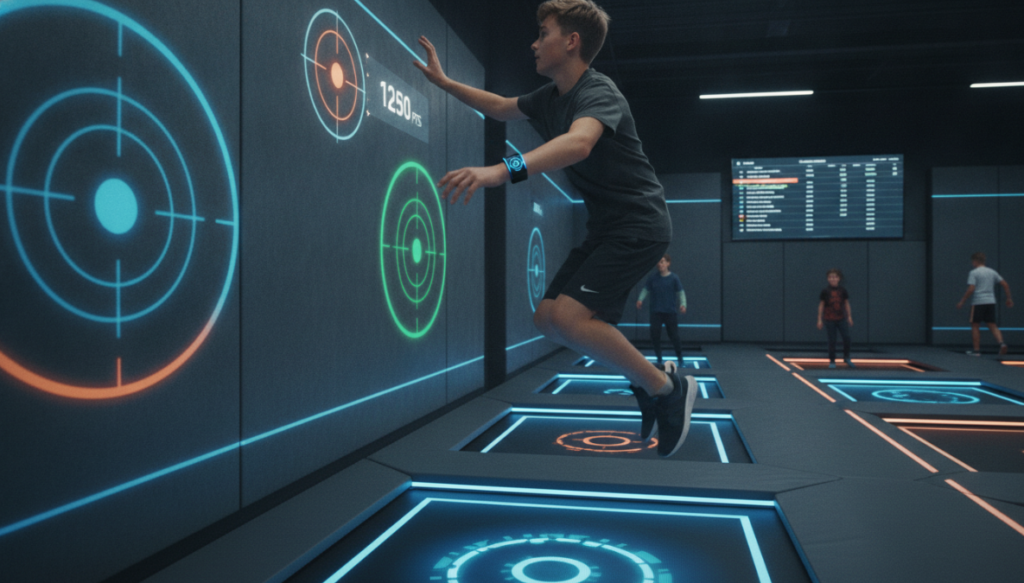
The direct implantation of augmented reality (AR) projection and RFID smart bracelet into the trampoline area can increase the return rate of customers by 45% on average. Now the appetite of consumers has changed. What they want is a “gamified” physical experience. The top custom manufacturers have been able to embed interactive target games directly on jumping mattresses and walls. Players can record the jump height in real time, hit the projection target, and send the high score list to social media to show off. This gamification strategy directly turns the traditional sports of sweating into an offline arcade experience that makes people go up and has great communication power.
Objective hardware data determines the true life of your investment and post-maintenance costs. Before signing the purchase contract, you must stick to the precise material specifications. A good comparison: what is the diameter and thickness of the steel? What is the density of the safety soft bag? Where is the origin of the trampoline fabric?
| Feature | Generic Suppliers | Elite Manufacturers | Business Impact |
| Frame Steel Grade | Thin gauge steel (e.g., 2.0mm thickness), standard paint or untreated interior. | Heavy-duty galvanized structural steel (e.g., 3.0mm+ thickness), rust-resistant inside and out. | Determines structural integrity; prevents frame buckling and early rusting, significantly extending investment lifespan. |
| Padding Material | Low-density EPE foam with thin, easily torn PVC covering. | High-density, closed-cell foam with heavy-duty, fire-retardant vinyl covering. | Directly affects jumper safety and liability risks; reduces maintenance overhead by avoiding frequent replacements. |
| Spring Type | Standard piano wire springs, shorter length, prone to overstretching and sagging. | High-tensile, custom-tapered galvanized steel springs, engineered for high cycle counts. | Dictates the bounce quality and user experience; minimizes the downtime and cost of constant spring replacements. |
| Warranty Terms | 1-2 years limited warranty, often full of loopholes for wear-and-tear. | 5-10 years on steel frames, 2+ years on mats and springs with comprehensive coverage. | Protects the procurement investment and guarantees long-term operational peace of mind without hidden repair costs. |
The Texas AeroPlay complex transformed a dead retail space into a hybrid trampoline park, recouping its full investment (ROI) in just 14 months. We have customized a 25,000 square foot (about 2322 square meters) venue for it, which combines a three-storey indoor playground, a set of modular ninja entry routes, and AR interactive trampoline.
“The layman simply cannot see the fatigue loss of the trampoline steel frame. Therefore, before we send the steel pipe into the production line, we must use dynamic load simulation to measure all stress points,” said David Chen, chief structural engineer of the commercial amusement equipment system (Commercial Play Systems). “In AeroPlay project, we strengthened the main chassis to a standard exceeding the local maximum capacity of 30%. Because of this, they in the busiest holiday peak, the equipment also achieved zero failure downtime.”
Statistics show that compared with the traditional family entertainment center in the same location, the weekend traffic of this venue soared by 60%. What’s more, they set up the children’s soft play area directly next to the coffee shop. The layout of this 1 alone will increase the weekly catering flow by 4,200 US dollars.
That’s about $40 to $80 per square foot, depending on how sophisticated you want to customize the functionality and structure. For a standard 20,000-square-foot venue, the initial total investment is typically around $1.5 million to $2.5 million, including equipment, hard-fitting, licensing and upfront marketing costs.
There must be no obstacles above the commercial trampoline and indoor playground, and the clear height must reach 17 to 20 feet. The overall floor space is recommended to be at least 10,000 square feet, so as to leave enough space for trampolines, safety buffers, party boxes and infrastructure facilities to ensure the profitability of the venue.
As long as the maintenance is in place, the main steel frame structure can be easily supported for 15 to 20 years. However, high-frequency loss parts have to be changed frequently: the general life of the jumping surface is 2 to 3 years, and the safety cushion has to be replaced in 1 to 2 years; As for the spring, it must be checked every month. Once the tension is found to be attenuated, it must be replaced immediately.
Elite-level manufacturers will directly send dedicated engineering teams to field installations or on-site supervision around the world. This ensures that the assembly process meets strict safety tolerance standards exactly, and only then does the structural warranty commitment given by the factory count.
ASTM F2970 Certification (Standard Specification for Design, Manufacture, Installation, Operation, Maintenance, Inspection and Major Renovation of Trampoline Venues). If you are operating in Europe, keep an eye on the CE mark and TUV certification to ensure that the structural strength and material safety of the equipment have passed the test of EN standards.
Not only can, but this is the 1 kind of money-sucking hybrid home entertainment center model. This trick can eat a wider crowd: children can play in the soft play area at ease, while older children and teenagers go to the high-intensity trampoline area to vent their energy.
As long as there is nothing wrong with the site and the operation is proper, it can usually be fully recovered within 12 to 18 months. If you want to run out of this speed, you have to push the high-profit party package online and do a good job in local marketing. At the same time, the layout of the venue must be the perfect combination of “maximizing passenger flow capacity + minimizing operating losses.”
Conozca los limites de peso de las camas elasticas, peso maximo de la cama elastica, peso estatico vs dinamico y capacidad de las camas elasticas para ninos de interior y de 12 pies.
Ver detalles
Maximize FEC Profits With Premium Indoor Football Play Area & Play Slide Options. Discover Smart Space Design.
Ver detalles
Plan Adventure Park Apparatus For Indoors Around Activity Zones, Access, Fall Protection, And Site Checks.
Ver detalles
What Are Some Indoor Play Slide Options? Build Your Slides Indoor Playground With Top ROI And Safety Standards.
Ver detalles