 Juego Mimu









búsqueda de productos
Parque infantil cubiertoGuerrero NinjaParque infantil al aire libreTrampolín
busque en
Adult Indoor Adventure Park Setup Ideas and Secrets
Setting up a profitable indoor adventure park for adults requires prioritizing cubic volume utilization, structural load capacities designed for adult biomechanics, and RFID-driven competitive gamification. Most commercial space conversions fail quickly because operators simply buy upsized children’s equipment and apply standard square-foot revenue models. You will learn the exact spatial frameworks, technology integrations, and physical layout secrets necessary to transform an empty warehouse into a high-yield adult playground without burning capital on dead zones. Below is the technical blueprint for planning your facility.
The Core Difference: Engineering for Adult Biomechanics and Social Friction
Adult adventure facilities demand industrial-grade infrastructure and distinct social zoning. You cannot expect a high return on investment by treating an adult indoor adventure park like a standard family entertainment center. Adults generate higher kinetic forces on equipment and expect frictionless transitions between physical exertion and social relaxation. Your layout must separate high-intensity obstacle zones from low-intensity food and beverage areas using strategic sound dampening and sightline management.
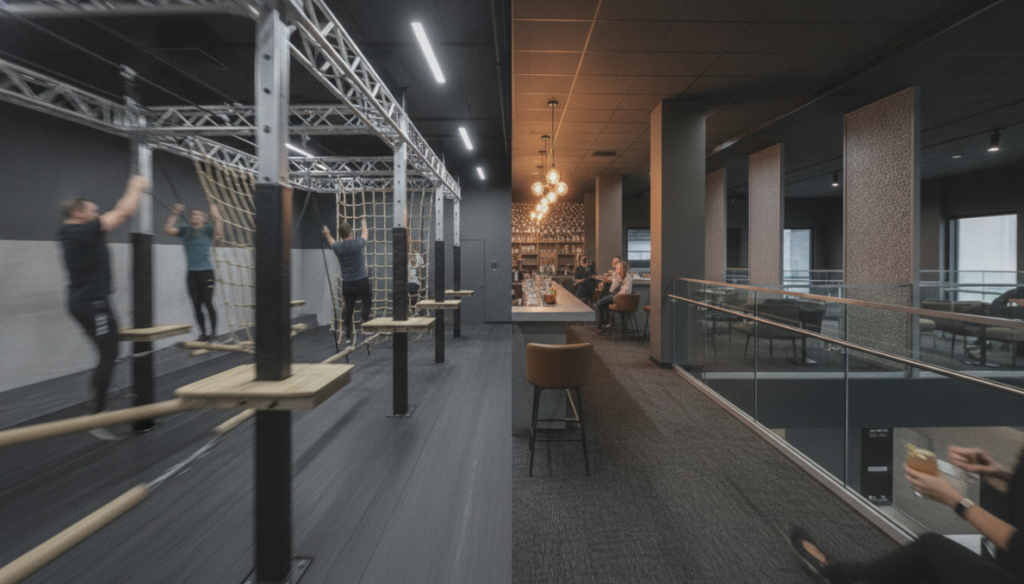
Profitable park operators calculate revenue capacity by cubic volume rather than square footage. The Z-Axis Space Maximization Model (Z-SMM) forces you to stack attractions vertically, turning a single 20,000 square foot footprint into 40,000 square feet of usable revenue space. We developed this framework after auditing 30 underperforming parks that wasted their 30-foot ceiling clearances.
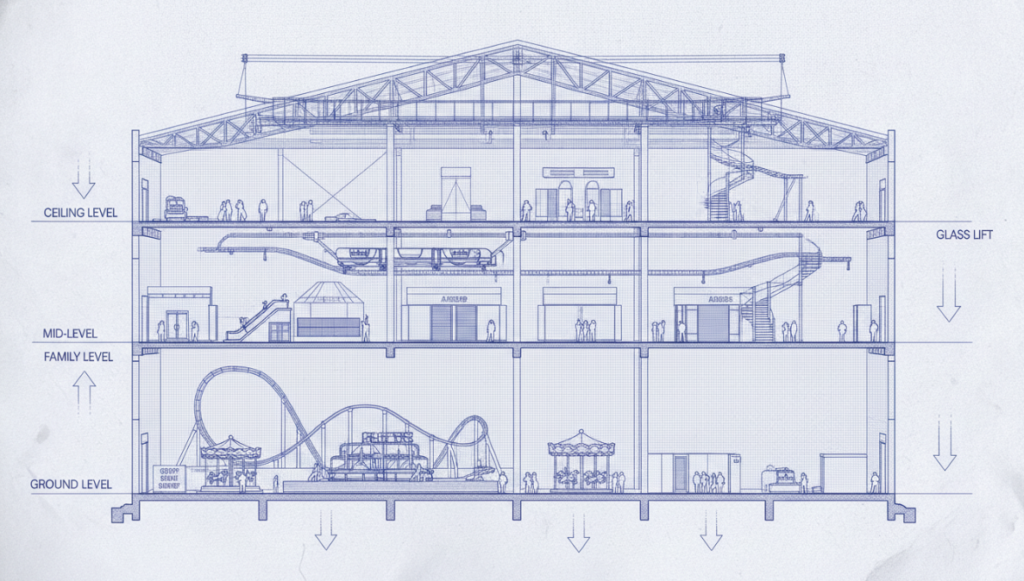
Your ground floor must house the heaviest, fastest-turnaround activities. Anchor attractions like modular ninja warrior courses, warped walls, and parkour arenas require solid concrete foundations to absorb constant adult impact. Keep these activities clustered near the entrance to immediately showcase the energy of the facility.
Rest periods are primary monetization windows. The mid-level space (usually built as a structural mezzanine at the 12-to-15-foot mark) serves as a viewing deck and beverage center. Adults want to watch their peers fail and succeed on the obstacles below while purchasing premium food and drinks.
High ropes courses and indoor zip lines belong in the ceiling trusses. Utilizing the space above 18 feet ensures that slower-paced, harnessed activities do not disrupt the rapid flow of ground-level foot traffic.
| Vertical Tier | Recommended Attractions | Expected Dwell Time | Primary Revenue Type |
| Ceiling Level (>18 ft) | High ropes courses, indoor zip lines | 45 – 90 minutes | Premium / Add-on Ticket |
| Mezzanine Level (10-18 ft) | Ninja warrior courses, climbing walls, viewing decks | 30 – 60 minutes | General Admission |
| Ground Level (0-10 ft) | Arcades, trampolines, toddler zones, F&B | 90 – 120+ minutes | Core Ticket / Pay-per-play |
Technology integration drives adult retention far more than physical padding or bright colors. A successful indoor adult adventure park setup relies on tracking data and competitive progression.
Adults demand measurable proof of their athletic performance. Integrating RFID wristbands with your obstacle courses allows participants to tap in at the start line and tap out at the finish. Monitors display live leaderboards throughout the facility, instantly transforming a standard physical challenge into a highly competitive social event.
Traditional rock walls suffer from low replay value. AR climbing walls project interactive games—such as digital ping-pong or territory capture—directly onto the climbing surface. Two adults can compete simultaneously on the same wall, doubling your throughput and encouraging immediate rematches.
Converting industrial real estate into an active entertainment venue exposes operators to severe structural and code-compliance risks. You must evaluate the building’s mechanical footprint before signing a lease.
Commercial warehouses feature suspended mechanical, electrical, and plumbing (MEP) lines that drastically reduce usable ceiling height. A building advertised with a 25-foot ceiling might only offer 19 feet of clearance once you account for massive HVAC ducts and fire sprinkler heads. Installing aerial attractions without mapping these drop-downs triggers costly mid-construction redesigns and failed fire marshal inspections.
Harnessing stations dictate the maximum hourly capacity of your aerial attractions. Operators frequently allocate too little square footage to the gearing-up zones. You must design parallel harnessing tracks where staff can equip Group B while Group A is completing their safety briefing.
Mitigating risk requires proactive digital systems rather than reactive paper trails. Adult bodies are less resilient than children’s bodies, meaning injury claims pose a constant threat. Implement a digital waiver system tied directly to your point-of-sale (POS) software, requiring a mandatory safety video sign-off before a ticket is even printed. We eliminated a client’s insurance premium hike entirely by proving their POS system physically locked operators out of selling wristbands until the biometric signature on the safety briefing was verified.
How much ceiling height is required for an adult indoor adventure park?
You need a minimum clear ceiling height of 22 to 25 feet. This measurement must account for the lowest hanging HVAC ducts, lighting fixtures, and fire sprinklers, allowing enough clearance for both ground-level obstacles and aerial ropes courses.
What is the average startup cost for a commercial indoor adult adventure park?
Capital requirements typically range from $1.5 million to $3 million. This includes leasehold improvements, structural steel reinforcements, customized attraction fabrication, and specialized liability insurance down payments.
How do you handle liability for adult obstacle courses?
Liability management requires mandatory, legally binding digital waivers and documented video safety briefings. Your insurance carrier will mandate routine daily equipment inspections logged into a verifiable digital maintenance system.
Which attractions generate the highest ROI in adult adventure parks?
RFID-timed ninja courses and AR climbing walls generate the highest ROI. They require minimal floor space, offer massive throughput, and drive repeat visits through competitive gamification and digital leaderboards.
How long does it take to convert a commercial warehouse into an adventure park?
Expect a timeline of 9 to 14 months. City permitting, structural engineering approvals, and custom equipment manufacturing consume the first 6 months, followed by 3 to 8 months of physical build-out.
Can alcohol be served at an indoor adventure park for adults?
Yes, but strict operational boundaries are required. You must utilize a multi-zone layout where alcohol is restricted to observation decks, and implement a wristband removal policy preventing guests from returning to the obstacles after consuming beverages.
What are the specific weight capacity requirements for adult park equipment?
Adult equipment must be engineered for dynamic loads, not just static weight. While a static rating of 300 lbs per person is standard, the anchor points and structural steel must withstand the multiplier effect of adult kinetic impact during falls and swings.
¿Te cuesta segar bajo una cama elástica? Descubra 5 métodos fáciles, desde ruedas retráctiles hasta sencillos trucos de jardinería.
Ver detalles
Entienda Cómo Anclar Un Trampoline. Encuentre La Mejor Manera De Anclar Un Trampoline Usando Las Anclas Apropiadas Del Trampoline.
Ver detalles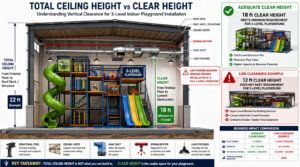
Learn How To Open An Indoor Playground Business With 7 Key Steps. Avoid Commercial Lease Traps And Maximize Profits.
Ver detalles
Plan A Jungle Gym By Checking Age Range, Climbing Structure, Fall Zones, Surfacing, Access, And Daily Inspections.
Ver detalles