 Mimu spielen









Produktsuche
Indoor-SpielplatzNinja-KriegerSpielplatz im FreienTrampolin
Suche
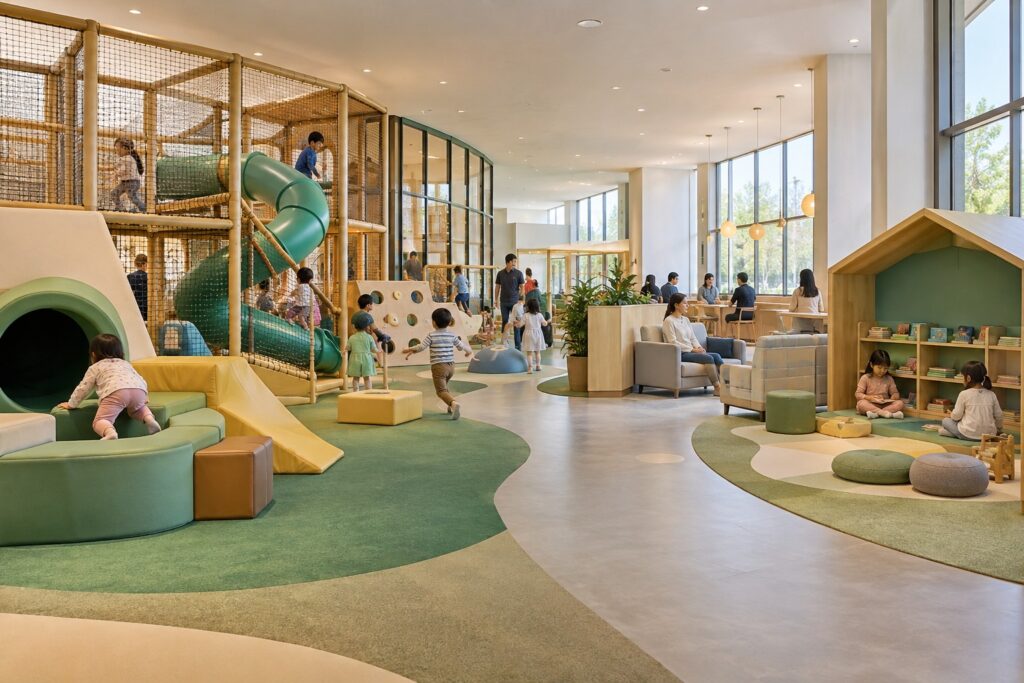
When you take your children to an indoor playground, you will find a very common phenomenon: as soon as the children enter, they run to the climbing area, and the first reaction of parents is often to find a location with a good view and a good eye on the entrance and exit.
For venue owners, to make a good amusement park, it is not as simple as filling all the open spaces with equipment. For true hardcore design, children must be able to play with it and people must flow freely, while parents must also keep a close eye on it. The so-called “vitality playground” cannot be just an empty propaganda slogan. The specific gameplay, how many people can be accommodated, and how to get in and out are the keys to determining the intensity of the activity.
When planning a venue, the first step is to clearly define who the zones are for. It is not enough to divide them by age group. After all, even children of the same age have great differences in balance, grip strength, safety awareness and whether they can exit the field on their own. If it is a mixed-age venue, then the specific indicators of each area must be carefully considered: how big a child is suitable, how big the equipment is, whether the pace of play is fast or slow, and how parents or staff take care of it. What I fear most is when a big guy and a small guy bump into each other in the same passage.
In addition, the hardware conditions of the site need to be “paved” first. First, list the various dead indicators: usable area, clear height limit, column location, foundation condition, as well as entrances and exits, fire evacuation passages, barrier-free facilities, and the maximum number of people the site can accommodate. After you’ve cut out the space that absolutely cannot be occupied by equipment, what’s left is the “clean land” you can use to line up your troops. Remember, a large venue does not mean you can mindlessly increase the number of equipment and people proportionally. If the entrance, parental care area and queue area are not planned well, they will become congestion bottlenecks every minute.
Climbing, sliding, drilling, jumping, even quietly exploring, are all different ways for children to exercise. When making a design plan, it is advisable to pull up a large table for each partition and clearly write: What category does the device belong to? How do I get in and out? How many people can play at the same time? Which way do people flow? Will you follow the area next to you “fight”? The number of equipment, types of gameplay, and number of people carrying the equipment are all independent indicators, and no one can replace anyone.
When designing challenging projects, you also have to leave a way out for your children. For example, when climbing a slide, you not only have to see whether the route into the platform is smooth, but also how to walk after sliding down. If there’s only one path you can climb, you have to wonder: Can children of the target age climb it? If I don’t want to play halfway through the climb, how do I step back? In fact, to make the playground more fun, you don’t have to work hard to raise and accelerate it. Providing children with options of varying difficulty so they can try again and again is the best way to maintain a sense of engagement.
High-speed and exciting activities, quiet play areas, entrance queue areas and main passageways-all of these have to be branched off. The area in front of the slide exit should never be a necessary route for other children to travel or stay; similarly, the climbing area should avoid the slide exit and the main road of the site as much as possible. Sufficient buffer zones must be left between adjacent activity areas. As for how to implement safety protection, it must be evaluated based on the child’s actual falling trajectory, the equipment’s rigidity requirements, and the floor mat material. Don’t just look at the blank space in the rendering and make up your own mind.
Don’t think that quiet areas are a waste of space. Some children need to catch their breath when they are tired of playing, or they are not naturally interested in too exciting environments. Preparing them a rest area with clear routes and free choice of seats can help them quickly adjust their state and get back into the game. This quiet zone must be connected to the overall flow. Never isolate these children with different personalities or abilities in forgotten corners. In addition, the barrier-free design is integrated into the entire process of entering, playing, staying and leaving. You can’t fool yourself just by making a barrier-free passage at the door.
Both parents and staff need to know where their children are and what they are playing at all times. Those huge amusement facilities, fences, pillars and corners are often blind spots, and they have to be checked one by one when looking at the floor plan. Equipment like pipes, closed tunnels or continuous turning slides, which cannot be seen from the outside, must be equipped with corresponding crowd control, release mechanisms, exit observation points, and must also think about how adults can go in and rescue in case of an accident.
It is important to clearly define who is responsible for what on the field. Age restrictions, maximum number of people, and play rules cannot be just empty words; they must be implemented in daily management. Operators must not use a single word “parental accompaniment” to shake off the blame, let alone try to make up for the damage in venue layout, buffer design or equipment maintenance by increasing manpower and marking.
When comparing the solutions of different suppliers, provide them with the exact same base map, target age, activity mix, capacity requirements, delivery boundaries, and market positioning. After receiving the plan, I went through the details one by one: equipment list, entrances and exits, buffer zones, care points, foundation requirements, construction drawings and the difficulty of subsequent maintenance. Fancy themes, colors, and decorations can indeed enhance the experience, but they should never be used to cover up structural and usage flaws.
After the equipment is installed, it must be reviewed on site with the approved drawings, and the equipment location, connections, safety protection, cushioning pads, markings and building joints must be closely monitored. Any deviations found must be recorded and rectified immediately. Daily inspections after opening are of paramount importance: whether screws are loose, parts are worn, there are cracks in the floor mats, and there are any obstacles in the passageways. Once a potential injury hazard is discovered, the area cable should be sealed immediately, repaired, and re-inspected to confirm that there is no problem before it can be reopened.
To put it bluntly, only an indoor playground planned according to this path can truly achieve a perfect fit between early design and later operation.
Explore 10 Small Toddler Indoor Play Area Ideas. Discover The Best Small Indoor Play Area Ideas For Tiny Apartments!
Details anzeigen
Erfahren Sie, wie Rebounding durch den Einsatz der Körpermitte Bauchfett verbrennt und mehr Kalorien verbrennt als Joggen.
Details anzeigen
Wenn Sie den Boden des Trampolin-Sicherheitsnetzes fest verankern und sicherstellen wollen, dass es keine Lücke in der Konstruktion gibt, ist der effektivste Weg, die "Webtechnik" zu verwenden. Um loszulegen, müssen Sie einen schweren Doppelknoten mit Ihrer Leine an der F...
Details anzeigen
Schützen Sie Ihr Trampolin in diesem Winter! Erfahren Sie, wie Sie Ihr Trampolin richtig reinigen, verankern und Schnee entfernen, um Rost und Schäden zu vermeiden.
Details anzeigen