 ميمو بلاي









البحث عن المنتج
ملعب داخليمحارب النينجاملعب خارجيالترامبولين
البحث
When it comes to indoor commercial amusement parks, slides are undoubtedly the star attraction. The seven most common configurations on the market are: multi-lane racing slides, fully enclosed spiral tubes, AR‑interactive projection slides, 90‑degree vertical “devil” slides, donut slides, barrel slides, and soft‑play climbing and sliding units for toddlers.
But if you stop at whether “this slide looks nice or not,” then you’re being quite naive. Truly knowledgeable buyers focus on hourly throughput, compliance with the ASTM F1918 safety standard, and the return on investment—specifically, how much profit can be generated per square meter. Many novice operators are immediately swayed by those flashy, oversized slides, splurging a fortune only to find that on weekends, the entire line is backed up with people waiting; or, in an effort to squeeze in more arcade machines, they shrink the safety buffer zone at the slide’s exit, leaving it unable to meet fire safety and security inspection standards. Today, we’ll break down everything for you—covering engineering parameters, the material differences between LLDPE and fiberglass-reinforced plastic, and the real‑world operational pain points of these seven slide models—to help you steer clear of common pitfalls and make a well‑informed investment.
When selecting equipment, never let personal preferences be your sole guide. Before finalizing the equipment, profitable amusement park owners always assess it using the “S.P.A.C.E. Matrix”: Safety (safety compliance), Playability (play value), Area (footprint), Capacity (throughput), and Engineering (materials and construction).
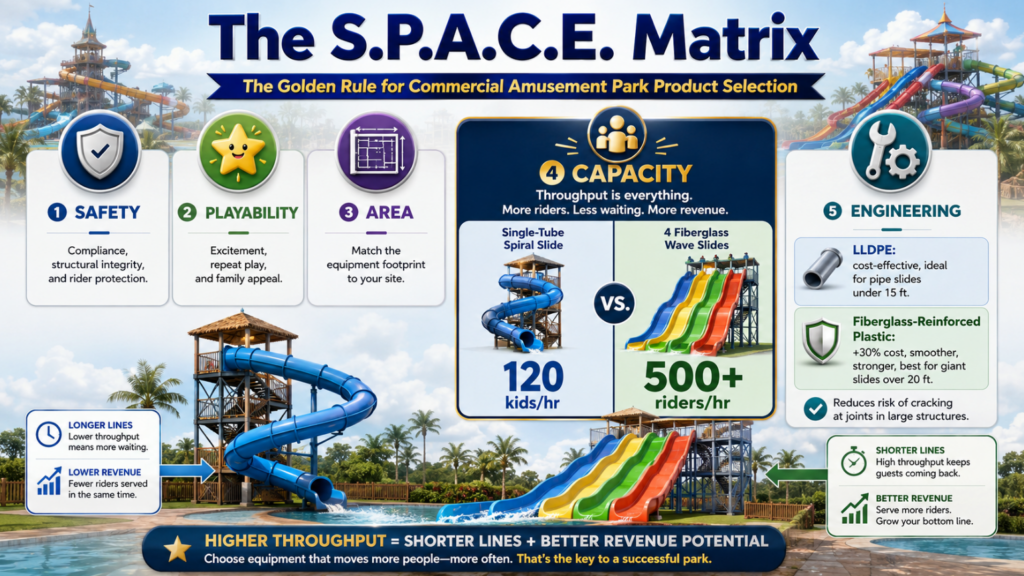
Children of different age groups have completely different needs for stimulation. How you combine these seven slides directly determines how long family guests will stay at your venue.
This is the absolute mainstay for handling peak periods. Three to six slides run side by side, so adults and children can race together. That undulating “wave”‑shaped design also delivers an exhilarating moment of weightlessness in mid‑air. Remember, for high‑frequency slides, you must use commercial‑grade gelcoat‑coated fiberglass; otherwise, with more users, static electricity builds up easily and can even cause abrasions on children’s skin.
Want to save the ground floor area? Choose it. A 20-foot-tall spiral slide lands on a cushion that’s less than 10 by 10 feet. To prevent the child from feeling stifled inside, it’s best to attach several sections of transparent polycarbonate (PC) tubing or run an LED strip around the interior. However, during installation, you must keep a close watch on the construction crew and ensure that the flanges at the LLDPE pipe joints are properly finished—there must be absolutely no plastic burrs that could snag clothing.
This thing turns manual labor into a video game. Radar sensors precisely detect a child’s descent, projecting effects such as splashing water, slicing fruit, or battling aliens directly onto the wide, smooth fiberglass slide. To break their own scoring records, the children will climb up again and again. Data show that implementing this system can boost replay rates by as much as 40%.
It’s specifically designed to pump adrenaline in older children and teenagers. A near-90-degree vertical drop, followed by a long, smooth deceleration phase. Because the descent speed is three times that of a standard spiral slide, the extra-thick, high-density impact‑absorbing pad at the exit must extend at least six feet beyond the slide’s end—this is absolutely essential and should not be compromised.
Grab a sturdy inflatable tire, glide down over the artificial turf or along the roller track, and enjoy the fun of tubing indoors any time of year. However, this project is rather labor-intensive: you’ll either need to assign a dedicated employee to collect the tires below, or invest in an automated conveyor belt to haul the heavy tires back to the launch pad.
The slide is constructed from hundreds or even thousands of PVC or stainless-steel rollers. Its greatest advantage is that it never generates static electricity, and it doesn’t affect your descent speed regardless of what material your clothing is made of. We strongly recommend incorporating it into the design of inclusive and accessible playgrounds, as it provides excellent tactile sensory‑integration feedback for children with autism and other special needs.
Infants aged 0–3 must be physically separated from older children. This slide designed for infants stands no more than 3 feet tall. It features a core of high-density polyurethane foam, encased in commercial-grade flame‑retardant PVC upholstery. The entire surface is completely free of sharp edges, so little ones can crawl and slide on it with ease—plus, even if they do fall, there’s no risk of injury.
| Slide Type | Best Target Age | Throughput (Kids/Hr) | Footprint Requirement | Estimated Cost Tier |
|---|---|---|---|---|
| Fiberglass Multi-Track Racing Slide | 5–14 years and adults | 180–360 | Large; requires multiple parallel lanes and an extended run-out area | عالية |
| Fully Enclosed Spiral Slide | 5–12 years | 60–120 | Compact; approximately 10 × 10 ft landing footprint | Medium–High |
| AR Interactive Projection Slide | 4–12 years | 50–100 | Medium; requires a wide slide surface and dedicated projection space | Very High |
| 90-Degree Vertical Drop Slide | 10–17 years | 40–80 | Medium–Large; requires a long deceleration zone and at least 6 ft of extended impact padding | عالية |
| Donut Slide | 6–16 years | 40–90 | Large; requires a long sliding track, tire-return route, and launch platform | High–Very High |
| Roller Slide | 3–14 years | 50–100 | Medium; depends on slide length and accessibility requirements | Medium–High |
| Soft Slider | 0–3 years | 30–60 | Small; must be installed inside a physically separated toddler zone | Low–Medium |
Many novice bosses who have just entered the industry cannot pass the security check and are often planted on the safe area (Runout Zone) at the exit of the slide. In order to place two more baby-grabbing machines, venue designers often secretly shorten the cushion at the tail of the slide.
Listen, the kinetic energy of a child rushing down a commercial slide is amazing! The ASTM F1918 safety standard stipulates in black and white that the slide itself must have a horizontal deceleration section, followed by a safety exit area without any obstacles (usually 6 to 8 feet) and covered with standard anti-collision floor mats. If you think about it, if the child wears an extremely silky chemical fiber dress and rushes down from the steep glass fiber reinforced plastic, the friction force is almost zero. At this time, if the buffer zone is too short, the child will fly out directly like a shell and hit the outer protective net or steel pipe column. Therefore, before finalizing the plan, the manufacturer must be forced to give you an accurate “export speed calculation”.
Dallas has a 20,000-square-foot indoor playground that used to turn into a disaster scene every weekend. Their signature attraction is a massive three-story, double-tube spiral slide. It looks impressive, but it can only process 200 children per hour, with wait times often reaching 25 minutes, leaving parents thoroughly dissatisfied.
After taking over, we immediately performed a major overhaul of the main architecture. One spiral slide was removed, and a set of four fiberglass racing slides with AR projection was installed at the front center.
The data speaks for itself: peak-hour throughput has surged from 200 passengers per hour to 650! The wait time has been cut to under three minutes. Moreover, the AR system has proven incredibly addictive, directly boosting weekend party‑package bookings at the park by 22%. In just four months, the改造费 was fully recouped thanks to increased sales of the party packages.
What are the ceiling height requirements for indoor commercial slides?
A standard multi-story play frame with a minimum clear ceiling of 15 feet. If you want to do that extremely exciting devil vertical slide or large multi-channel wave slide, the floor height must be at least 20 to 25 feet, counting the upper and lower slope and the safety barrier of the launch platform.
Indoor slide with what material is best?
For large, high‑traffic main slides, fiberglass is undoubtedly the first choice, as it is exceptionally durable, offers low friction, and can be seamlessly joined. For closed pipe slides, LLDPE (linear low density polyethylene) is the industry standard, because it is low cost for modular rotomolding and has strong impact resistance.
Plastic slide old electrostatic how to do?
The environment is too dry; when clothes rub against plastic, static electricity builds up. Venue operations require daily cleaning of LLDPE and fiberglass slides with a commercial antistatic spray. However, the most fundamental solution is to adjust the air conditioning system of the venue, maintain the indoor relative humidity between 40% and 50%, physically derive static electricity, and completely bid farewell to the trouble of being “popped” by electricity.
What safety standards must indoor slides meet?
In the United States, commercial indoor slides must strictly comply with ASTM F1918, the safety performance standard for soft‑wall enclosed play equipment. In Europe, look at the EN 1176 standard. These standards impose extremely stringent and mandatory requirements on equipment’s load-bearing capacity, the dimensions of gaps to prevent strangulation or neck entrapment, as well as the precise thickness and coverage area of impact-absorbing floor mats.
How are commercial slides typically cleaned and disinfected?
Cleaning must use non-abrasive, non-toxic commercial disinfectants. Don’t use the strong cleaning agent with corrosive or abrasive particles, which will destroy the gel coat on the glass fiber reinforced plastic surface and the anti-ultraviolet agent in LLDPE, resulting in tiny potholes on the surface, which will become more slippery and astringent. The correct approach is to spray an EPA‑approved disinfectant formulated for playgrounds, then wipe dry with a microfiber mop—this will help maintain the slide’s smoothness.
Can adults play indoor children’s slides?
As long as the manufacturer has properly calculated the load-bearing capacity for adults during the design of the steel pipe frame, there will be no issues. High‑quality commercial playground equipment is constructed entirely from galvanized steel tubing—typically 48mm in diameter with a 2mm wall thickness—and is engineered to support a minimum load of 150 to 250 pounds per square foot, easily accommodating parents sliding alongside their children.
Explore Indoor Play Slide Options And Playground Costs. Maximize Throughput And Avoid Hidden Freight Traps.
عرض التفاصيل
Maximize FEC Profits With Premium Indoor Football Play Area & Play Slide Options. Discover Smart Space Design.
عرض التفاصيل
أتقن فن منتزه المغامرات الداخلي للكبار. تغلب على أي مسار عقبات داخلي مخصص للكبار باستخدام منهجية P.A.R.K. المتخصصة.
عرض التفاصيل
Discover What Is A Jungle Gym. Explore Top Playground Uses, Key CSS Benefits, And Hidden Safety Traps To Avoid.
عرض التفاصيل