 ميمو بلاي








البحث عن المنتج
ملعب داخليمحارب النينجاملعب خارجيالترامبولين
البحث
The true setup budget for a commercial indoor playground ranges from $40 to $70 per square foot for standard structural designs, and scales up to $100+ per square foot for tech-integrated ninja courses and premium trampoline zones. Commercial real estate developers frequently ask how much do indoor playgrounds cost, only to receive deceptive equipment-only quotes that completely ignore ocean freight, import duties, and highly specialized installation labor. The raw playground structure manufactured at the factory represents only 50% to 60% of your total capital expenditure (CapEx). The exact engineering matrices, logistics pitfalls, and real-world procurement data detailed below provide facility owners with the precise financial breakdown required to prevent massive budget overruns before opening day.
Relying on a manufacturer’s glossy catalog price guarantees immediate financial deficits during the build-out phase. Applying the C.A.S.E. framework forces commercial developers to calculate the actual landed, installed, and certified physical build-out costs.
Capacity and Structural Density Sizing
Equipment density dictates your baseline footprint cost. A heavily structured, multi-level maze featuring fiberglass tube slides, ball blasters, and heavy-gauge galvanized steel piping costs significantly more per square foot than an open-concept soft play toddler zone. Expect to allocate $15,000 to $25,000 per 500 square feet of multi-level play capacity. Maximizing vertical space up to 3 levels yields a higher capacity return per square foot, but strictly requires thicker steel frame specifications that increase the raw material invoice by 15% to 20%.
Attractions and the 2026 Interactive Tech Shift
Modern play environments demand digital-physical integration, radically altering traditional budget allocations. Developers allocating funds purely for foam padding and netting are building instantly obsolete facilities. Integrating RFID wristband timing systems, interactive LED stepping stones, and augmented reality (AR) projection games adds a mandatory $20,000 to $45,000 hardware premium to the baseline budget. This specific tech expenditure secures repeat visits from the highly lucrative 8-to-12-year-old demographic.
Safety Surfacing and Compliance Engineering
Safety flooring constitutes a massive, uncompromisable hard cost governed strictly by ASTM and EN compliance standards. Commercial-grade Pour-in-Place (PIP) rubber or high-density EVA interlocking mats with certified Critical Fall Height (CFH) ratings require a budget of $4 to $8 per square foot. Sourcing uncertified, non-fire-retardant foam mats exposes property developers to immediate legal liability and guarantees failure during the municipal fire marshal’s building inspection.
Execution: Logistics, Tariffs, and Installation
Logistics and professional physical assembly systematically consume 30% to 40% of the total project capital. Factory-direct equipment ships inside 40-foot High Cube (HQ) ocean containers. You must factor in volatile ocean freight rates, destination port processing fees, and specific import tariffs. Specialized installation labor demands $2,000 to $4,000 per week for a factory-certified build crew. Deploying local, uncertified handymen to assemble complex structural frames instantly voids manufacturer liability warranties and guarantees structural sagging.
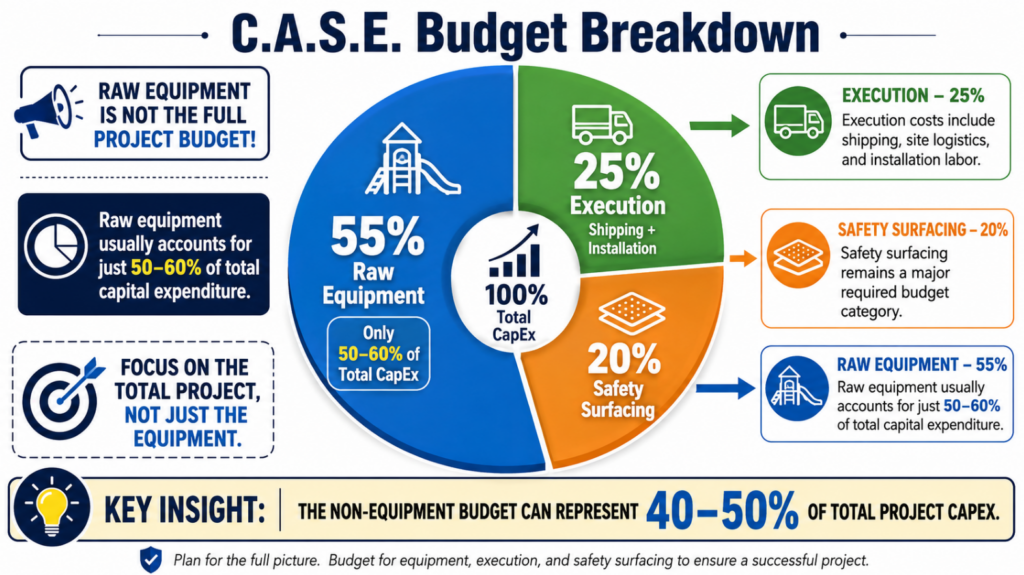
First-time buyers routinely bankrupt their commercial projects by misinterpreting “FOB” (Free On Board) factory pricing. Avoid this exact procurement trap to secure your actual landed budget.
A manufacturer quoting 50,000FOBmeanstheyonlypaytomanufacturethegoodsandloadthemontoavesselattheirlocalexportport.Thisdeceptivelylowpricetagdeliberatelyexcludesoceanfreight(50,000FOBmeanstheyonlypaytomanufacturethegoodsandloadthemontoavesselattheirlocalexportport.Thisdeceptivelylowpricetagdeliberatelyexcludesoceanfreight(4,000-$8,000 per container), import duties (up to 25% depending on the country of origin), customs clearance broker fees, inland 18-wheeler trucking to your retail facility, and the massive cost of installation labor. A seemingly cheap $50,000 FOB invoice instantly balloons into an $85,000 actual setup cost. You must demand a DDP (Delivered Duty Paid) or a complete turnkey installation quote to reveal the true financial requirement of the project.
Real-world procurement demands absolute financial transparency to secure bank loans or investor funding. We stripped down a recent 2026 commercial build-out for a 3,000 square foot Family Entertainment Center (FEC) playground addition to expose the exact hard costs.
| Expense Category | Low-End Estimate | High-End Estimate |
|---|---|---|
| Custom Structural Equipment (Steel/Foam/Plastics) | $180,000 | $300,000 |
| Interactive Tech Upgrades (RFID/LED) | $35,000 | $95,000 |
| Safety Flooring (EVA/PIP Rubber) | $45,000 | $110,000 |
| Ocean Freight & Port Tariffs | $25,000 | $70,000 |
| Certified Installation Labor & Travel | $60,000 | $140,000 |
| Total Estimated CapEx | $345,000 | $715,000 |
How much does an indoor playground cost per square foot?
The true setup budget runs strictly between $40 and $70 per square foot for a complete, turnkey commercial installation. This metric fully accounts for the raw play structure, safety flooring, shipping, and physical assembly. Adding high-tech digital attractions or complex ceiling-height obstacle courses pushes the capital requirement toward the $85 to $100 per square foot range.
How much is a indoor playground if I import it directly from a factory?
Importing directly from source manufacturers reduces the raw equipment cost by 40% to 60% compared to purchasing through local distributors. A 2,000 sq ft commercial playground structure might cost $30,000 to $50,000 in raw manufacturing materials. You must explicitly add container shipping costs, import duties, and local installation crew fees to calculate your final landed CapEx.
What is the most expensive part of building an indoor playground?
Aside from the customized steel and plastic manufacturing, installation labor and logistics dominate the budget. Certified assembly crews require flights, lodging, and high daily rates to construct the complex structural framework and stretch the safety netting precisely to international building codes.
How much to allocate for spare parts during the initial purchase?
Smart commercial developers allocate exactly 3% to 5% of their initial equipment budget to a spare parts inventory. Purchasing extra foam tubing, high-wear vinyl covers, specific zip ties, and netting during the initial factory order eliminates exorbitant express air-freight costs when routine maintenance is required six months later.
How much does an indoor playground cost for a shopping mall installation?
A commercial mall setup requires heavy-duty structural builds ranging from $100,000 to $250,000 depending on the exact footprint. Mall developers face higher costs because they must utilize strict Class A fire-retardant materials, pay unionized night-shift installation labor to comply with mall hours, and engineer structures that do not anchor into the ceiling.
Are toddler soft play areas cheaper to build?
Yes. Dedicated toddler zones (ages 0-3) cost between $10,000 and $25,000 for a standard 400 to 600 sq ft section. These specific areas utilize dense, low-profile soft play geometric blocks, small ground-level ball pits, and thick floor padding, completely avoiding the heavy structural steel pipes and multi-level platforms required for older kid structures.
افهم أهمية حدود وزن الترامبولين من أجل السلامة. تعلم كيفية اختيار الترامبولين الذي يوفر الأمان.
عرض التفاصيل
Learn how to assess equipment, age fit, venue conditions, and evidence for an adult adventure park indoor project.
عرض التفاصيل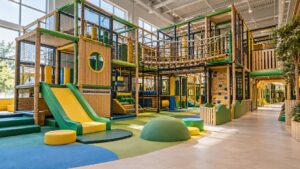
Plan an adventure park indoor layout with clear activity zones, sensible routes, visible play areas and room to operate.
عرض التفاصيل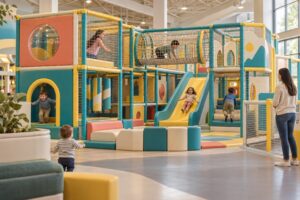
Plan An Adventure Playground Indoor With Clear Play Routes, Age-Aware Zones, Safe Exits, And Practical Supervision.
عرض التفاصيل