


...

product search

Are Rectangular Trampolines Better

Blog 930

Generally speaking, rectangular trampolines perform better. Rectangular trampoline and circular trampoline are not only different shapes, they are completely different in performance, force feedback and space utilization logic. If your child wants to practice gymnastics, play stunts, or simply the child is older, the rectangle is usually a better choice; but if it is just for young children to jump around, the round cost performance and natural safety are indeed more advantageous.
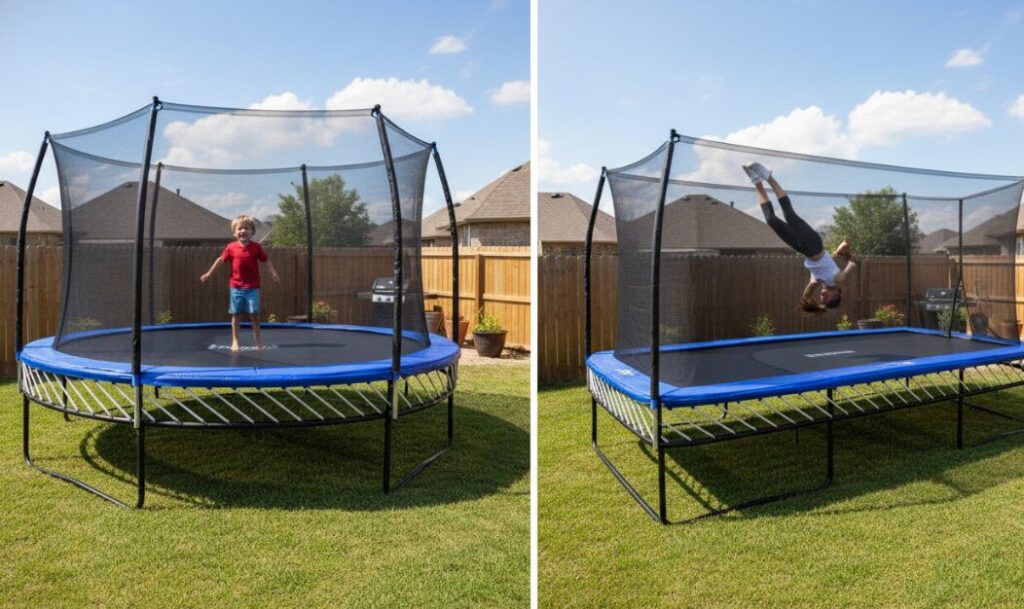
Core Points: Rectangular Vs. Circular

  • Elastic texture: Rectangular trampoline with independent spring force, full pad surface elastic uniform and strong. The circular trampoline pulls the jumper towards the center, with the strongest elasticity in the center and the more fleshy edges.
  • Applicable crowd: professional athletes, gymnasts and teenagers are more inclined to rectangle; it is recommended to choose round for young children or pure entertainment purposes.
  • Space layout: Rectangular shape saves more space and can be close to fences or corners. Circular shape takes up more space and is easy to leave dead corners in the corner of the yard.
  • Safety logic: the circular trampoline relies on the physical structure to “drive” people to the middle to prevent hitting the edge; Rectangular trampoline requires higher control for beginners because of its large elasticity, but it has a large area and lower collision risk when many people share it.
  • Durability and cost: the rectangular frame is thicker and more load-bearing, but the price is also expensive cut.
Comparison of circular and rectangular trampolines

Elastic Quality: Why Rectangular Performance More Hard Core

When discussing “whether a rectangular trampoline is better”, the feedback at the physical level cannot be bypassed. The core of the rectangular performance lies in its independent spring mechanism. When the circular trampoline jumps, all the springs will pull you towards the center of the circle at the same time. The spring of the rectangular trampoline is triggered locally according to your landing point.

  • No dead corner “dessert area”: inside the rectangular trampoline, whether you are in the center or near the edge, the elastic feedback is almost the same, and the entire jumping mat can be fully utilized.
  • Stronger response: This independent trigger can produce a kind of “instantaneous rebound”, which can send people higher, which is just needed for somersaults and air turns.
  • Limitations of the circle: The circular trampoline has only one center of gravity. Once you jump off, the tension of the spring will become stiff and uneven, and the effective jumping area is actually very limited.

How To Choose Trampoline

Which shape to choose depends to a large extent on who the trampoline is bought.

  • Gymnasts, enthusiasts and teenagers: If your child is practicing gymnastics, cheerleading, or obsessed with parkour, don’t hesitate to go straight to the rectangle. Its long strip structure provides sufficient “runway” to complete continuous movements such as somersaults, while the circular trampoline simply cannot provide such linear acceleration space. Moreover, this stable vertical rebound can help athletes correct their movements and will not be inexplicably thrown to the center.
  • toddler children and buddha entertainment: For 4-8 years old children, the round is actually more fragrant. Its design has its own “error correction function”, which can bounce the jumping child back to the center, reducing the chance of hitting the fence or spring, which is more worry-free for parents.

Space Efficiency: Layout Art In The Yard

Most backyards are square, round trampolines are put in, and all four corners are “dead zones”, looking messy.

  • Corner Adaptation: Rectangular trampolines can be quickly tucked into the corner of the yard or placed along the fence, and the rest of the lawn can be left to play football or do other things.
  • Actual utilization rate: don’t look at the data, a 10x 14 foot rectangular trampoline, the actual jumping area is larger than that of a 14 foot round trampoline, because the edge elasticity of the round trampoline is too poor to stand.

The Game Of Security: Control Vs. Fault Tolerance

As for safety, we have to look at it dialectically. The so-called “safer” circular trampoline is mainly aimed at beginners who have little experience and use centripetal force to protect them. The risk of the rectangular trampoline is that it plays too high. If the child cannot control the center of gravity, it is easy to fall heavily.

But from another point of view, if there are several children playing together at home , the rectangle is actually safer. Because it is long, the children can occupy one head each without interfering with each other; while the round one will squeeze everyone into the middle, and it is easy to bump heads.
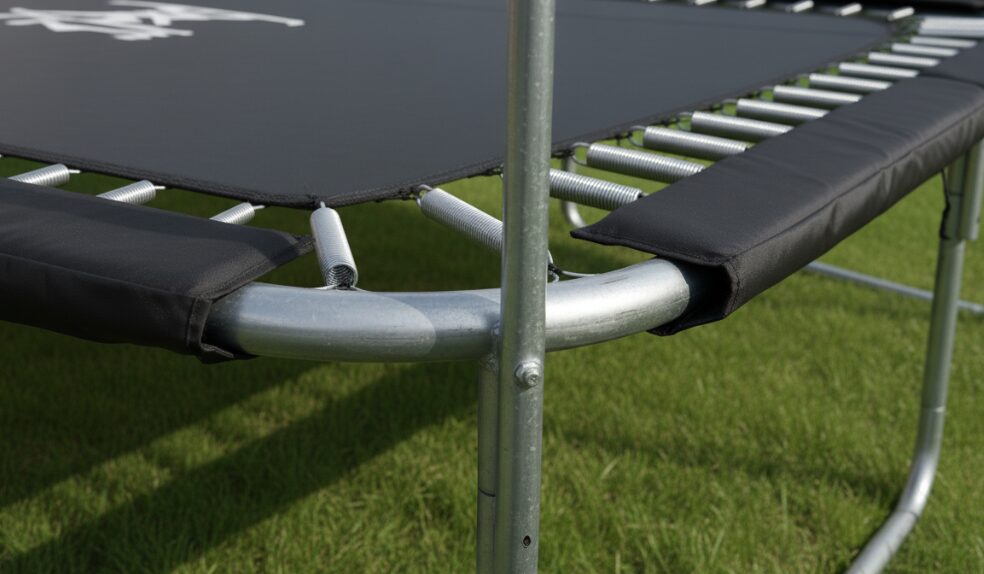
Durability, Frame Strength And Wallet Considerations

Rectangular trampoline with thickened steel frame and reinforced springs

Why is the rectangle expensive? Because the rectangular frame is not evenly stressed and cannot be offset by circumferential tension like a circle, manufacturers must use thicker and heavier high-grade steel to reinforce the frame.

  • Load-bearing capacity: This heavy-duty frame means a higher load-bearing limit, and there is no pressure for adults to jump up.
  • Cost-effective: If you have a limited budget, the round shape is a cost-effective choice for into the pit; but if you want to get in place at one time, buy a device that can last for more than ten years and the whole family can toss about, the long-term investment value of the rectangle is higher.

Author: Marcus Thorne
“With over a decade of experience in professional gymnastics coaching and backyard equipment testing, I’ve seen firsthand how the right gear can transform an athlete’s progress. I’m passionate about breaking down the technical physics of bounce and safety to help families and athletes make informed decisions. “
The prev: The next:

Related recommendations

Expand more!