 Mimu Play








product search
Indoor PlaygroundNinja WarriorOutdoor PlaygroundTrampoline
search

The job of assembling a trampoline is a set of processes such as building a shelf, putting on a leg, pulling a spring and installing a protective net. The steps sound simple, but the details determine success or failure. First spread out all the parts, then connect the top rails and fix the legs. The most important thing is to use the spring hook tool to hang the jumping pad. Remember to use the “cross method” to balance the tension, otherwise you can’t pull the last few springs at all.
This video provides a visual guide on how to assemble a trampoline:
Assemble the Frame: Connect the top rail parts (those pipes with T-joints and sockets) on the flat ground to form a complete ring.
Attach the Legs: Insert the leg extension tube and U-shaped base into the T-shaped joint just put together. Note that the bolts and nuts must be tightened immediately.
Install the jump mat: Spread the jump mat in the middle. With the spring hook tool, first hook the spring on the V-ring of the cushion, and then pull it into the frame hole. Tip: don’t hang along the 1 circle! First hang the opposite four points (12 o’clock, 6 o’clock, 3 o’clock and 9 o’clock direction) to balance the pulling force. Operation skills: after setting these four points, press clockwise to fill in the new spring on the left side of each 1 spring that has been hung, which saves the most effort.
Secure the Frame Pad: Cover the safety pad on the spring and tie it to the frame with a strap to prevent it from running.
Set Up the Enclosure Net: Assemble net rods (sponge on the pipe) and fix them on the inside or outside of the trampoline legs according to the instructions of different models.
Final Touches: Hang the protective net on the top of the pole. The most important thing is to fix the bottom of the net on the V-ring or frame.
Discover endless fun and spark imagination! Our indoor playground products create a safe, exciting paradise for children. Experience boundless joy now!
Embrace adventure and fresh air! Our outdoor playground products offer thrilling, safe experiences for kids to explore, play, and grow. Unleash the fun outside!
Before he starts construction, getting ready can save the latter half of the trouble. As mentioned earlier, it is essential to spread all the parts flat first. Too many people find fewer nuts or take the wrong pipe in the middle of the installation, so please stack the pipes, springs, nuts and bolts separately. This not only prevents chaos, but also confirms whether the parts are complete before starting.
Tools required: The most important tool for this job is the Spring puller. Usually the box comes with one, which is a necessary artifact for safely stretching high-strength springs. In addition, it is best to have a rubber hammer on hand. The metal parts sometimes bite tightly, and can be aligned and fixed with a hammer without breaking the shelf.
Advice: Although one person can work hard, I suggest two people to cooperate. One person holds the frame and the other turns the screws, which makes the whole process much faster and safer.
A safe trampoline starts with a solid base. Start by building the ring parallel to the ground. Find out all the top rail pieces-the curved pipes, usually with spigots or T-joints pre-installed. Connect them into a perfect circle on the ground. Make sure each connector is plugged in to the end. In my experience, if a joint is particularly tight, don’t do it hard and gently knock it in with a rubber hammer.
After the ring frame is laid, it has to be braced. Find the leg extension tube and the U-shaped support leg and first put them together into a complete leg assembly. Then insert these legs into the T-joint of the main frame. There is a key point here: insert it and fix it with bolts and nuts immediately. Don’t leave a loose shelf for the sake of saving trouble. The next step of pulling the spring requires extremely stable frame support.
You can watch this video to see how to install the jumping mat and springs:
This is the most physical and skillful step in the whole process. If the spring is not hung correctly, the frame may be pulled and deformed, resulting in the last few springs not hanging up anyway. Place the jumping mat in the center of the frame circle. Use your spring tool to pull the hook from the V-ring of the cushion into the corresponding hole in the frame.
Key advice on tension: Never hang springs one after another down the circle. Instead, the four diagonal positions of 12 o’clock, 6 o’clock, 3 o’clock and 9 o’clock must be hung first. This “criss-cross mode” can spread the huge pulling force evenly over the entire frame. Once these anchors are set, go clockwise to fill the vacancy. Generally speaking, install a new spring on the left side of each installed spring to keep the pressure even.
Safety is of paramount importance, but exposed springs can pinch people. Pads are used to cover these metal parts. Lay the safety pad over the spring, making sure it covers both the spring and the outer metal frame. Adjust the position and don’t block the jump area. Tie the strap securely to the frame. This is to prevent the pad from slipping or turning up during use, causing safety hazards.
Most modern trampolines are now equipped with a safety fence to prevent falls. Assemble the vertical net pole. If your model is equipped with a sponge protective tube, put the sponge on the tube before installation. Attach the pole to the leg of the trampoline. Take a look at the manual of your specific model. These poles may be installed on the inside of the frame or on the outside. Finally, the protective net is hung up, usually by putting the sleeve on the top of the pole or snapping it on the top cover.
You want to make sure the net is tight and the structure is solid. Fix the bottom of the protective net and connect the lower edge of the net to the V-ring or frame rail of the cushion to ensure that there are no gaps-the gaps are large and the feet are easy to slip out and get stuck.
Safety check: walk 1 circles around the entire trampoline at the end. Touch and make sure that all the bolts are fully tightened and each fixing point of the protective net is firmly hung. After confirmation, this trampoline is really ready for use.
Author: Mike Stevens
As an outdoor equipment assembly specialist, I’ve built hundreds of backyard setups. I write clear, practical guides to help you assemble your trampoline safely and quickly, ensuring every spring and bolt is perfectly in place.
Learn How To Clean A Trampoline Safely Using Mild Soap. Avoid Bleach, Scrub Gently, And Prevent Rust With Our Easy Guide.
View details
Aim For 10-15 Minutes Of Rebounding To Flush Toxins. Start With 2-5 Minutes If You’re A Beginner For Best Results.
View details
Discover How Many Calories Trampoline Jumping Burns And Effectively Lose Weight With This Fun, Low-Impact Exercise.
View details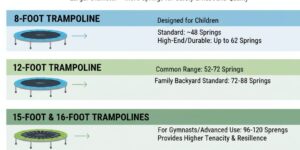
Find Out How Many Springs Are On Your Trampoline. Learn How Size And Shape Affect The Count For A Safe, Quality Bounce.
View details