 Mimu Play








product search
Indoor PlaygroundNinja WarriorOutdoor PlaygroundTrampoline
search

The answer is yes. Trampoline (commonly referred to as “Rebounding” in the professional world) is indeed effective in building muscle, especially for the quadriceps, hamstrings, gluteus and deep core stabilization muscles.
Trampolines create a rather unique training environment: your muscles must fight both gravity and gravitational acceleration (G-force). According to biomechanical analysis, every time you fall back on the mattress, your body needs to absorb up to three times its own body weight. In order to stabilize the joint and not let you directly “kneel” on the mat, the lower limb muscles must be strong “centrifugal contraction”. This is the value of trampoline-it stimulates the growth of lean muscles (also known as the sense of line) and significantly improves muscle endurance, but completely avoids the destructive high impact on the knees and spine like running on concrete.
These are your main sources of motivation. As you take off, the quadriceps and gluteal muscles perform centripetal contractions that push you into the air. But the real training actually occurs at the moment of landing. To prevent the body from collapsing, these large muscle groups must contract vigorously to absorb the impact. In rehabilitation training, we attach great importance to this deceleration ability.
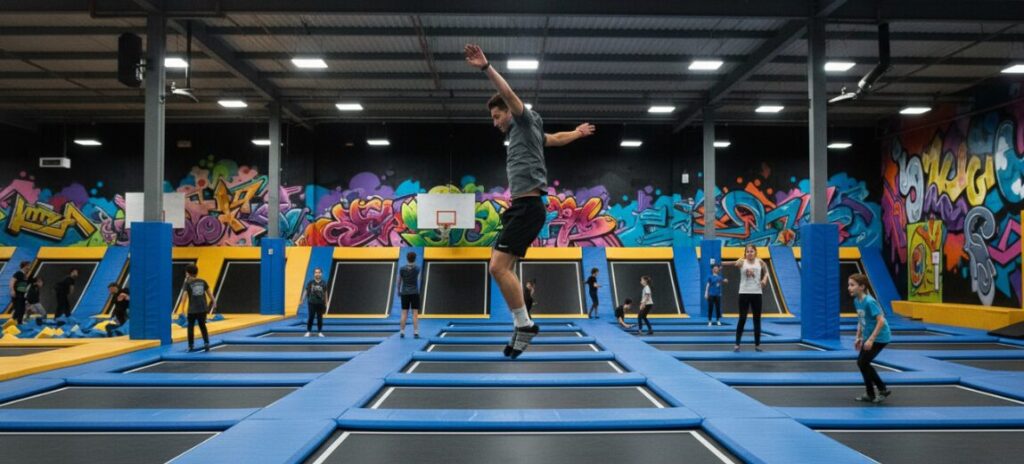
During the rapid transition from landing to taking off again, the hamstring muscles work together with the quadriceps to play a key role in stabilizing the knee joint.
Because the jumping mattress is a moving plane under your feet at any time, your abdominal muscles and lower back (especially the transverse abdominal muscles) must maintain continuous tension. They are not simply “tightening”, but must be constantly neurologically activated to keep the center of gravity in balance. The core strength of this process is much more practical than static support on the floor.
The central factor that distinguishes trampoline from running or riding is the manipulation of gravity.
When you jump to the highest point, you will experience instantaneous weightlessness; and when you fall into contact with the pad surface, your effective weight will double or even triple at the lowest point due to the effect of gravitational acceleration (G-Force). It’s not just lifting your usual weight, your muscular system must resist a heavier load. This forces the neuromuscular system to adapt to this higher demand, resulting in increased strength-which is much more hardcore than a seemingly “relaxed” bounce.
Discover endless fun and spark imagination! Our indoor playground products create a safe, exciting paradise for children. Experience boundless joy now!
Embrace adventure and fresh air! Our outdoor playground products offer thrilling, safe experiences for kids to explore, play, and grow. Unleash the fun outside!
In simple terms, eccentric contraction occurs when a muscle is stretched under force. You can think of it as the “down” phase of a weight-bearing squat. When the mattress sags down, your legs flex and your muscles are stretched, but still work to absorb energy. Numerous studies have shown that centrifugal contractions tend to be more effective in stimulating muscle protein synthesis than centripetal contractions (muscle shortening). This repeated centrifugal load is what brings “lean muscle growth” and firming effects. It can sculpt leg lines without over-expanding dimensions like heavy weight lifting.
Finally, trampolines excel at building muscle endurance. Because the trampoline mattress absorbs a large of the impact (which is completely unmatched by cement or asphalt), you can maintain a longer training time.
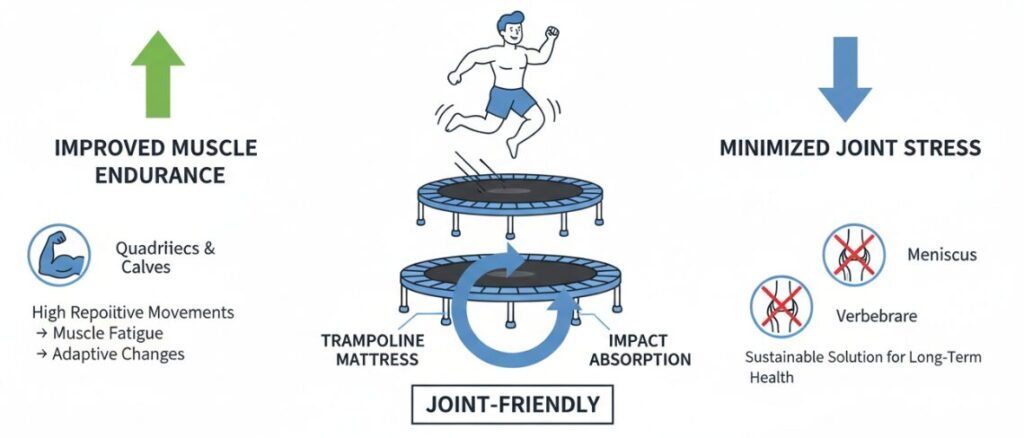
This low-impact feature allows you to perform a high number of repetitive movements, allowing the muscles to fatigue until adaptive changes occur. You can not only get the benefits of high-intensity leg training-improve the endurance of the quadriceps and calves, but also minimize the wear on the meniscus and vertebrae. This is a very sustainable solution for those who want to maintain muscle strength over the long term but are concerned about aging joints.
Usually not. The centrifugal contraction involved in the Rebounding mainly stimulates the growth and tightening of lean muscles, rather than muscle hypertrophy as caused by heavy weight resistance training. The sport focuses on muscular endurance and line portrayal, and the result is often that lean, athletic look.
G-Force actually created the resistance training effect that didn’t require dumbbells. When you fall on the mat, affected by gravity, the body needs to withstand up to three times the weight of the pressure. Your muscles have to contract harder to combat this added weight and stabilize the body, which creates kind of high-intensity strengthening stimulation unique to trampolines.
For many people, yes, especially when it comes to joint safety. Running is primarily aerobic exercise, while trampoline combines aerobic and resistance training because of the presence of G-Force. In addition, Rebounding can improve muscle endurance without putting high impact pressure on your knees and back, which means you can train more continuously, which can build up strength over the long term and are less prone to injury.
Author: Jordan Hayes
Hi, I’m a certified fitness instructor specializing in rebound training and biomechanics. I am passionate about helping clients sculpt lean muscle by harnessing the science of G-force. I hope to prove that low-impact workouts, when done correctly, can deliver high-intensity strength results for your glutes and core.