 Mimu Play








product search
Indoor PlaygroundNinja WarriorOutdoor PlaygroundTrampoline
search

Trampoline is dangerous, the core is that it can easily cause from a slight sprain to enough to change the life of the head, neck, spinal cord trauma. The causes of most accidents are very typical: many people jump on the mat surface (accounting for 75% of the total number of accidents), fall directly from the mat, attempt to flip and other difficult movements, wrong landing posture, or mechanical failure caused by improper equipment maintenance (such as stepping on a bare spring). These accidents can cause bruising and catastrophic nerve damage or even paralysis.
Although we think trampoline is a simple jump up and down, but it involves the physical force is extremely complex. By analyzing medical data, we can identify several highly predictive risk scenarios.
As long as there is more than one person on the mat, the risk increases exponentially.
“Double Bounce” effect: When two people of different weights take off at the same time, the tension on the pad will fluctuate violently. This physical feedback will eject the lighter person with more force than expected, and the landing force is impossible to control.
Collision risk: When multiple people jump together, the smaller person is 14 times more likely to be injured than the larger person. They lack sufficient physical mass to withstand secondary collisions in the air or on the surface.

Don’t think that with a safety net, everything will be fine. Falls are still a major cause of trampoline injuries in the emergency room.
Falling out of the mat: the user may still fall out of the gap in the fence, or overexert himself directly over the guardrail and fall on the concrete floor or surrounding obstacles, resulting in limb fractures.
High-risk moves: somersaults and somersaults are extremely dangerous. Once the landing angle is wrong, the weight of the whole body will instantly press on the head and neck, which often causes permanent spinal cord injury.
Even if you stay in the center of the mat, the danger is not completely eliminated.
Torsional force injury: a simple landing, if the posture is not right to produce torsion, the ankle and knee ligaments will face a serious risk of tear or fracture.
Mechanical hazards: Stepping on unobstructed metal springs or hard frames can cause serious cuts or broken bones. Over time, the pads are worn and the mesh is torn. These “mechanical fatigue” will turn the equipment into an invisible trap.
Discover endless fun and spark imagination! Our indoor playground products create a safe, exciting paradise for children. Experience boundless joy now!
Embrace adventure and fresh air! Our outdoor playground products offer thrilling, safe experiences for kids to explore, play, and grow. Unleash the fun outside!
Trampoline accidents have a wide range of medical effects on the human body, from temporary pain to lifelong disability.
Minor Injuries: This is the most common and includes bruises, abrasions, and soft tissue contusions, usually centered on the wrists, ankles, and shoulders.
Moderate to severe trauma: This category includes complex fractures and concussions. I have to remind the that sometimes even if there is no direct head impact, the violent shock caused by the “whip effect” of the fall is enough to cause a traumatic brain injury.
Catastrophic damage: This is the last thing we want to see. Severe neck and spinal cord injuries can lead to paralysis, permanent neurological dysfunction and, in the most extreme cases, death.
Risk is not evenly distributed, age and environment play a decisive role.
Children under the age of six are most vulnerable to serious injuries. Their motor skills, balance and coordination are not fully developed. What’s more, their bones are still in the ossification stage (developing), making it harder for them to withstand the same impact than older children. Statistics show that children aged 5 to 14 in the emergency room are the “main force” in trampoline accidents “.
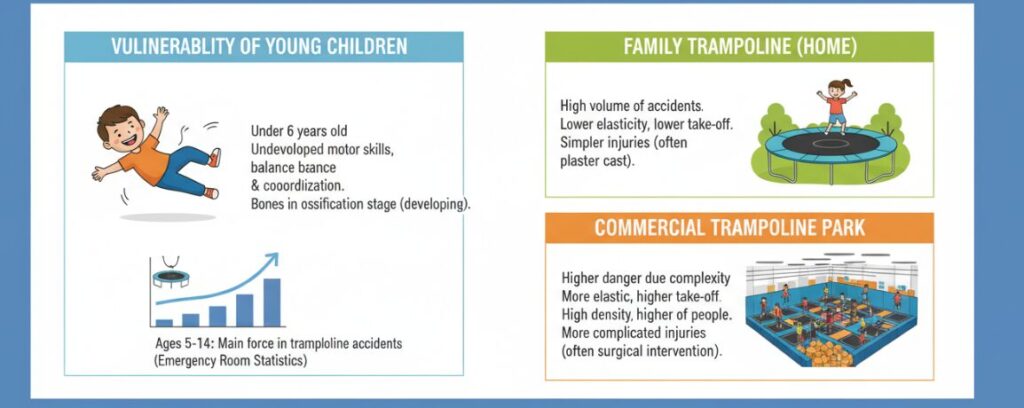
While the volume of accidents at home is high, the danger of a commercial trampoline park lies in its complexity. Because the trampoline in the park is more elastic, takes off higher, and has a high density of people, the injuries there are often more complicated. Injuries caused by park accidents often require surgical intervention, not just a simple plaster cast.
In addition to personal safety, trampolines are also a heavy financial burden.
As medical organizations have spoken out against the use of trampolines, many insurance companies regard it as a “seductive hazard” (Attractive Nuisance). Many home insurance contracts will clearly state that the injury caused by the trampoline is not covered by the claim. This means that if a guest is injured on your trampoline, all medical expenses and legal costs may have to be borne by you personally. This is definitely a high-risk asset from both an engineering and a legal perspective.
Author : Sarah Thompson
“I am a health and safety consultant dedicated to child injury prevention. With years of experience analyzing pediatric health data, I help families navigate the hidden risks of common recreational activities. In this article, I break down the clinical warnings from organizations like the AAP and AAOS to explain why trampolines pose a significant threat to young children. “