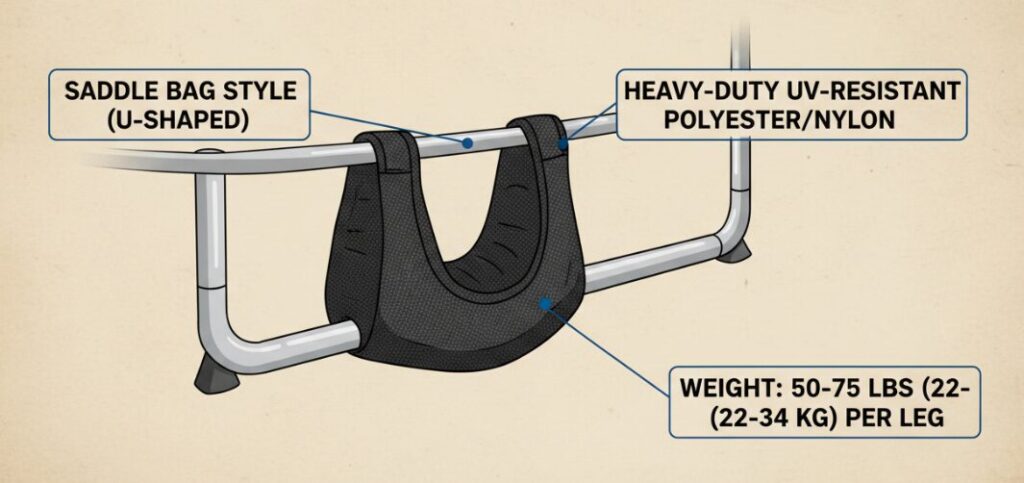
The most effective way to secure a trampoline without stakes is by weighing it down with heavy-duty sandbags or tethering it to a permanent structure. For hard surfaces like concrete or artificial turf, place at least one 50–75 lb (22–34 kg) sandbag over each U-shaped leg to provide stability and prevent shifting. Alternatively, use heavy-duty ratchet straps to anchor the trampoline frame to a nearby solid object, such as a sturdy fence post, deck railing, or mature tree. These methods ensure maximum security against wind without requiring any ground drilling or soil penetration.
Method 1: Anchoring With Heavy Sandbags
For trampoline owners who plan to place their equipment on concrete terraces, driveways or artificial turf, using gravity is actually the safest and least destructive way. Since you can’t use traditional spiral ground nails to drill into the ground, sandbags become the most important counterweight to resist wind rising.
Choose The Right Sandbag
If you want to re-nail that level of grip, the standard light weight on the market is simply not enough. Your goal should be to configure each leg with a weight of 50-75 pounds (about 22-34kg).
Design: Look for the “saddle bag” style or U-shaped sandbags specially designed for trampolines and awnings. This design can perfectly straddle the pipe at the bottom of the trampoline, and the center of gravity is more stable.
Material: This is easy to overlook-make sure that the bag is made of heavy-duty polyester fiber or nylon, and must have UV resistance. Otherwise, after a few months of outdoor exposure, the bag will be very troublesome to burst and leak sand.
Installation Guide
Filling: Fill the bag with playground sand, pea gravel or small stones.Sand is the first choice because it is dense and can fit along the shape of the legs, providing better friction.
Placement: At least one sandbag must be pressed in the middle of each U-shaped leg base.
Reinforcement To Cope With Strong Winds: If you live in an area that falls into a storm-haidelic zone, don’t hesitate to fold two bags on each leg. Our ultimate goal is to make the trampoline “dead” so that a gust of wind can’t overturn it.
Where Childhood Meet Inspired Play
Advanced Equipment、Skilled Craftsmanship、Strict Quality Control and Comprehensive Service.We Provide A Safe And Engaging Play Environment Where Children Can Explore And Grow.
If you don’t want to rely solely on weights, or if you need extra security during storm season, tethering the trampoline to a permanent structure is a safer alternative. This method uses tension to effectively “lock” the trampoline in place.
Identify Safe Anchor Points
Before you start to tie the strap, make sure that the structure can withstand the huge pulling force. According to safe operating guidelines, the best options are usually the following:
Strong Fence Posts: Must be the kind of posts poured into the ground, loose wooden posts will not work.
Balcony Railing: Remember to tie it to the main support beam of the wooden terrace, and never tie it to those decorative slats, which will break when pulled .
Adult Trees: Choose strong and healthy trunks (avoid small saplings that break easily).
How To Use Ratchet Straps Correctly
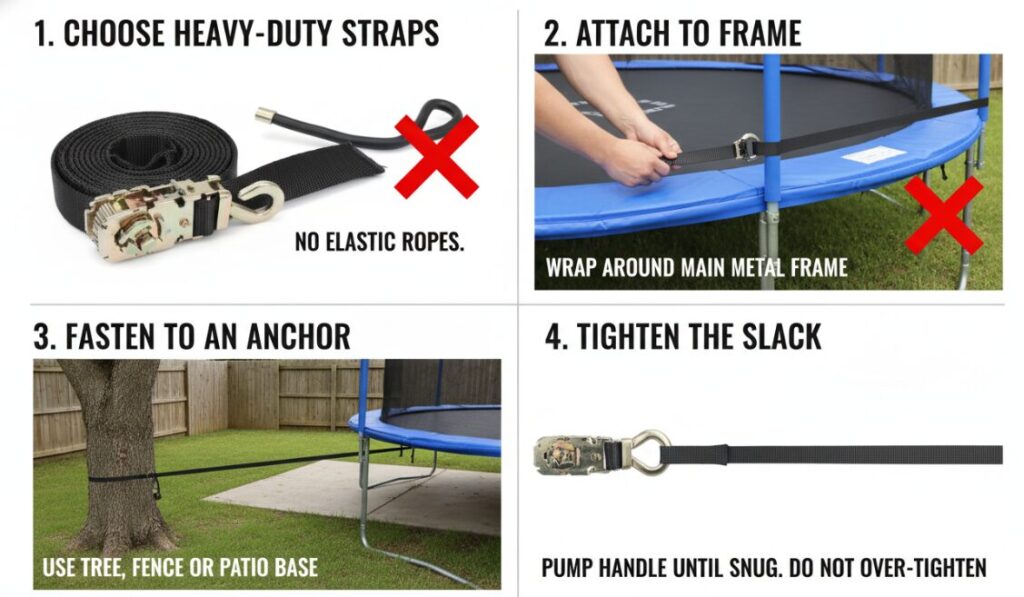
Choose Heavy-Duty Straps: Go for the kind of high-tension ratchet straps that are used for trucks to pull goods. It is strictly forbidden to use elastic ropes , which have too much space to play a fixed role.
Attaching The Frame: Wrap the strap around the main circular metal frame of the trampoline (the loop where the spring is hung) instead of just tying it to the leg. I have seen too many cases where the frame and legs are separated when the wind is strong, so this is very important.
Fasten To An Anchor: Wrap the other end around a permanent structure of your choice (tree, fence, or terrace).
Tighten The Slack: Use the ratchet mechanism to tighten the strap until it is straight.
Note: Don’t compete to tighten it too tightly and cause the trampoline frame to deform. As long as the looseness is eliminated, it is enough to make the trampoline unable to shift.
Why These Two Methods Are Crucial For Hard Surfaces
Traditional fixing kits require soft soil to screw the screw in. However, the landscape design of many backyards now makes this approach impossible.
Concrete And Paving Stones: Punching holes in concrete for a few bolts? This is usually not a good idea, causing property damage and making the trampoline impossible to move later. In contrast, sandbags offer a mobile and lossless solution.
Artificial Turf: Although it looks like grass, piling on it will directly puncture the grass-proof and drainage layer underneath. Press the weighted sandbag against the surface of the lawn so that it is secure and will not cause perforations or tears.
By using enough weight (50-75 pounds per leg) or using the existing backyard structure, you can ensure that your trampoline is safe and stable without damaging the ground.
Author:Mark
“Hi, I’m a backyard safety specialist and outdoor equipment enthusiast. With over a decade of experience in home recreation setups, I focus on practical, damage-free solutions for securing trampolines on challenging surfaces like concrete, artificial turf, and patios to keep families safe from high winds.”
 Mimu Play