 Mimu Play








product search
Indoor PlaygroundNinja WarriorOutdoor PlaygroundTrampoline
search

While specific trampoline weight limits vary by design and material quality, most standard backyard trampolines typically range from 200 to 450 lbs (90–205 kg), whereas mini-trampolines generally support 100–250 lbs. When choosing a trampoline, it is crucial to distinguish between the “Individual User Weight Limit” (safe capacity for a single jumper) and total structural capacity.
To ensure safety and longevity, check the specific weight rating for your size:
| Trampoline Type / Size | Weight Limit (lbs) | Weight Limit (kg) |
| Mini / Kids’ Trampolines | 100 – 250 lbs | 45 – 113 kg |
| 8ft – 10ft Backyard Models | 175 – 250+ lbs | 80 – 115+ kg |
| 12ft – 14ft Standard Models | 200 – 450+ lbs | 90 – 205+ kg |
| 15ft – 16ft+ Heavy-Duty Models | 250 – 500+ lbs | 115 – 225+ kg |
| Fitness Rebounders | 300 – 600 lbs | 135 – 270 kg |
The weight limit of the trampoline is definitely not a number casually filled in by the manufacturer. It is strictly determined by the design and materials of the equipment. This can also explain why the two trampolines, which are exactly the same size, have different load-bearing capacities.
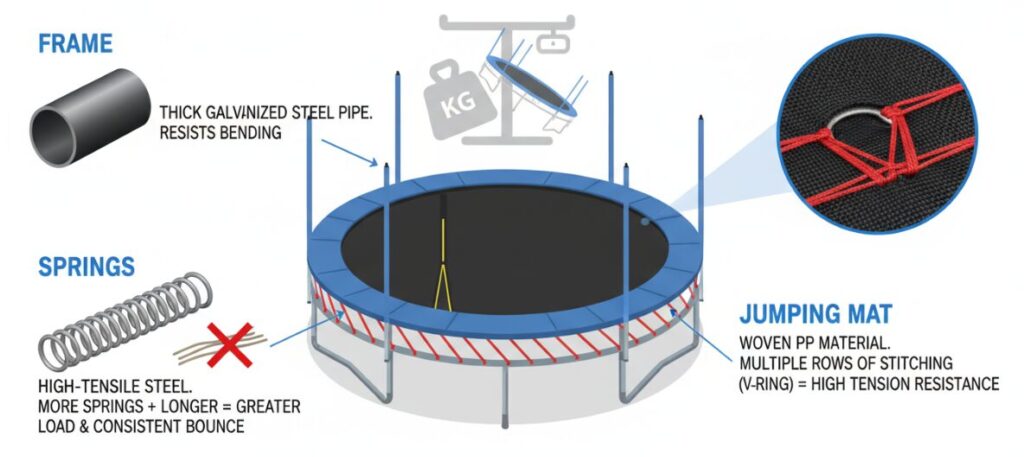
When reading product specifications, it is too important to distinguish between these two concepts. “Single user weight limit” refers to the safe capacity of a single user when jumping. This is also the number you should stare at when buying.
Even if some trampolines claim to have a “structural load” of 1000 pounds, their single-person limit may be 250 pounds. This is because according to the principle of mechanics, the dynamic impact of a person falling on the same point is much higher than his static weight. Once this single limit is exceeded, the jumper can easily “hit the bottom” (that is, hit the mat to the ground) and even break the spring directly-it has nothing to do with whether the overall structure can hold 1000 pounds.
To help you select the right equipment for your family or fitness needs, here’s a detailed breakdown of the different weight ratings:
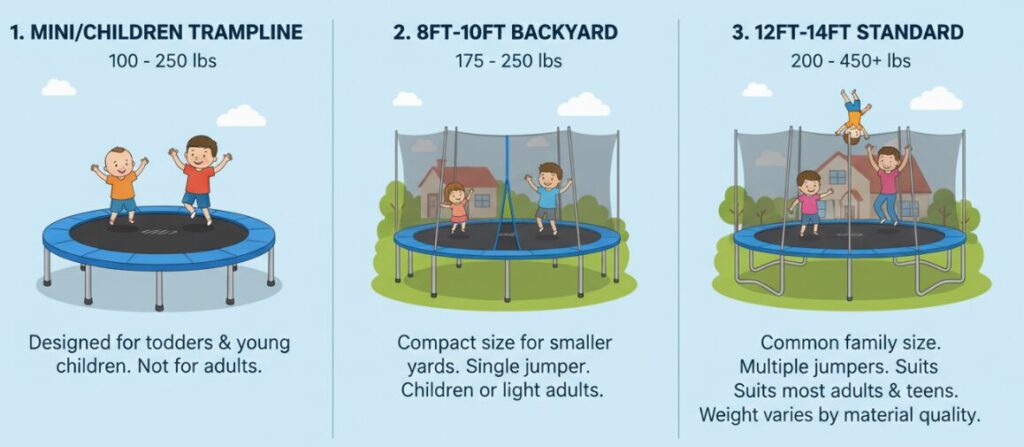
This type is mainly designed for toddlers and children during the toddler period. In order to adapt to the target user, their weight limit is naturally lower. The 100-to -250-pound range is safe for kids, these models are usually not suitable for adults or older teenagers to “join in”.
If the home yard space is tight, these small models are suitable. The weight bearing is generally more than 175 to 250 pounds, which is very suitable for children or light weight adults to carry out single jumping. It should be noted that due to the limited jump area, the springs they are equipped with are usually shorter, which also physically limits their maximum load-bearing capacity and cannot be compared with large sizes.
This is the most common backyard standard size available today. At this level, the load-bearing capacity has been significantly improved, ranging from 200 to more than 450 pounds. This interval can basically meet the needs of most adults, and it can also make teenagers jump more at ease. As for why there is such a big gap between 200 and 450, it usually depends on whether the manufacturer uses cheap materials to make up the number or high-quality heavy steel.
If you’re looking for ultimate durability and performance, a 15-or 16-foot trampoline is the gold standard. They tend to have a weight limit of 250 to more than 500 pounds and are designed for gymnasts, professionals or large weight adults. After all, to support such a large span, the frame structure must be made very strong, and the bearing capacity will naturally go up.
Although they are small, fitness rebound bed and children’s mini trampoline are completely different things in engineering design. They are designed for high-intensity exercise for adults and are usually equipped with high-tension elastic ropes or hard springs that can carry 300 to 600 pounds. The reason for making such a high weight limit is to deal with the huge repeated impact of high-frequency fitness actions.
Strictly abide by the manufacturer’s calibration of the weight limit, in fact, is to protect the life of your trampoline and family safety of the best solution.
Author:Jackson
As a backyard recreation enthusiast and outdoor gear safety specialist. With over a decade of experience reviewing fitness equipment and family play structures, I am dedicated to helping you choose the right trampoline that ensures both fun and structural safety for jumpers of all sizes.”