 Mimu Play








product search
Indoor PlaygroundNinja WarriorOutdoor PlaygroundTrampoline
search

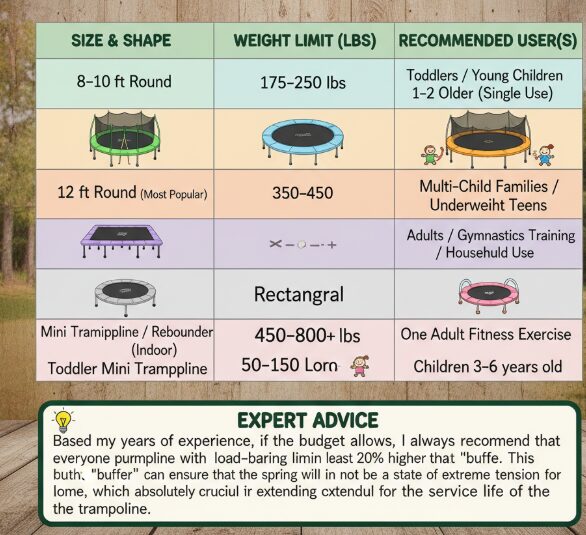
When discussing the load-bearing limits of home backyard trampolines, I found that most standard models typically fluctuate between 200 pounds (about 90 kilograms) and 500 pounds (about 225 kilograms). This figure is not set randomly. It varies greatly depending on the size, shape of the trampoline and, crucially, the quality of the frame. Generally speaking, those small trampolines that are 8 to 10 feet long can bear a weight of about 200 to 250 pounds. The more common 12 to 16-foot models usually weigh between 250 and 450 pounds. If there are adults in the family who want to play or there are many family members, I suggest you directly consider those “heavy-duty” rectangular trampolines. They can often easily carry 800 pounds or even more. If these limits are exceeded, the consequences will be troublesome: the spring may fail, the frame may deform, and the most dangerous situation is that there may be what is called a “bottoming out”.
To help everyone make a quick choice, I have compiled this general load-bearing limit chart based on the industry average.
The trampoline’s size, shape, average load-bearing capacity limit is the most suitable for its purpose
Expert advice: Based on my years of experience, if the budget allows, I always recommend that everyone purchase a trampoline with a load-bearing limit at least 20% higher than the actual demand. This “buffer” can ensure that the spring will not be in a state of extreme tension for a long time, which is absolutely crucial for extending the service life of the equipment.
During the years I have been engaged in quality control, I have gradually come to understand that weight limits are by no means just a random number – they reflect the quality of the materials used. Based on my professional judgment, when looking for a heavy trampoline suitable for adults or multiple children, all those fancy marketing words can be ignored. What you really need to focus on are the following three key specifications:
Many people have a misconception that the jump pad is the main load-bearing component. In fact, this is not the case. It is the frame that truly bears the weight. Based on my years of inspection experience, the frame steel pipes of those ordinary models of trampolines on the market are usually only 1.2 millimeters thick. However, if you need a high-load-bearing model, I would definitely recommend that you choose a 2.0mm thick (or No. 14 gauge) galvanized steel frame. The thicker the frame is, the more effectively it can prevent structural distortion, which is the key to avoiding collapse.
The function of a spring is to disperse the energy generated by jumping. For instance, a regular 14-foot trampoline might have 72 springs and a load capacity of 300 pounds. But if it’s a high-performance model of the same size, you might see 96 to 104 longer springs (over 8.5 inches). My experience tells me that the more springs there are and the longer they are, the more evenly the weight distribution will be, the smoother the jump will feel, and the less impact on the joints of adults will be.
Some brands, such as Spring free, adopt spring-free technology, replacing traditional metal springs with flexible composite rods. In my opinion, this kind of design is usually meticulously engineered in terms of durability and safety. Some models can even pass static load tests of over 1,000 pounds. For those families who attach great importance to safety, this is definitely a very worthwhile investment.

Regarding what will happen if the load-bearing limit is exceeded, I must seriously remind everyone: Never ignore this upper limit. Of course, trampolines won’t explode the moment you step on them, but overloading does bring real physical risks immediately, which has been a common occurrence in my years of consulting cases.
In my years of consulting, I have found that buyers often confuse two terms. Therefore, to thoroughly understand the physical principles of trampolines, it is crucial to distinguish between them: static load-bearing limit and dynamic load-bearing limit.

Finally, for buyers, my advice is that if you expect adults to use trampolines, do not be tempted by low prices. Please be sure to invest in purchasing a rectangular or heavy circular trampoline with a load-bearing capacity of at least 449 pounds (approximately 200 kilograms).
For friends who already own trampolines, please be sure to check the springs regularly. If you notice that the spring is significantly stretched (losing its original winding tension), this is a clear signal indicating that your trampoline may have been overloaded. The most crucial point, and one that I have been emphasizing all along, is to adhere to the principle that “only one person is allowed to jump at a time.” In my opinion, this is the most effective way to ensure that the load-bearing limit is not exceeded and to avoid injury, without any exception.
Mark “The Trampoline Guy”
Senior Backyard Play Specialist & Safety Consultant
Hi, I’m Mark. With over 10 years of experience in the outdoor recreation industry, I’ve made it my mission to help families build safer backyards. I started my career as a Quality Control Manager for a major sports equipment manufacturer, where I personally stress-tested over 50 different trampoline models—pushing everything from budget 8ft bouncers to Olympic-grade rectangular units to their breaking points. I write these guides to help you look past the marketing fluff and understand the real physics behind weight limits and frame durability. When I’m not measuring spring tension or analyzing steel gauges, I’m usually in my own backyard, watching my two kids jump on the very equipment I recommend.