 Mimu Play








pesquisa de produtos
Parque infantil interiorGuerreiro NinjaParque infantil exteriorTrampolim
pesquisa

A climbing frame (Jungle Gym) is a three-dimensional structure composed of interlocking metal tubes, ropes or wooden beams, designed for children to hang, climb and shuttle on multiple spatial levels. Most buyers only stare at size and price, completely ignoring the core geometric features that can really stimulate brain development. Selecting the wrong climbing frame will not only delay the child’s great motor development in vain, but also bury the hidden danger of fatal card injuries. I’ll teach you how to evaluate outdoor play equipment like a professional child occupational therapist and help you avoid those expensive but nutritious IQ tax products.
A climbing frame is, in essence, a ‘spatial puzzle game’ disguised as playground equipment. Whilst swings merely provide repetitive linear motion, a climbing frame forces children to make split-second decisions regarding where to place their hands, how to shift their centre of gravity and how to counteract the pull of gravity with every movement. Within the industry, ‘climbing frames’ and ‘monkey gyms’ are often used interchangeably, but a true climbing frame must feature an ‘open-mesh’ design. This open structure allows children to move freely through the interior of the equipment, rather than being restricted to crawling back and forth along the surface.
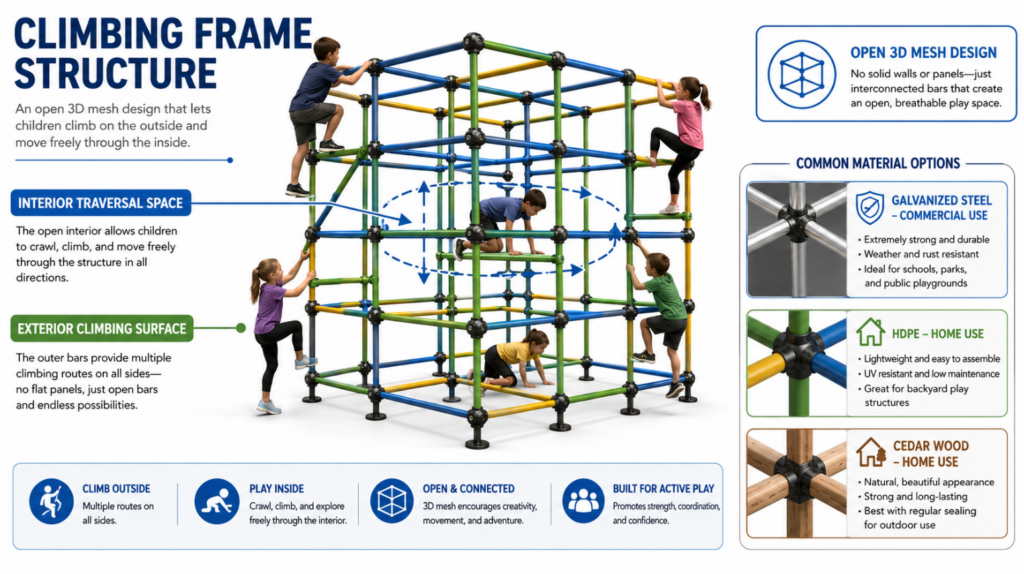
The material directly determines the life and safety of the structure. Due to its extremely high tensile strength and weather resistance, galvanized steel dominates commercial playgrounds. High-density polyethylene (HDPE) and cedar wood dominate the home market, specifically for buyers who are looking for soft touch and constant temperature surfaces.
Parents often spend thousands of dollars on piles of 1 complex, but developmentally useless, scrap metal. The “CSS Playful Pyramid” (Core Core, Spatial Spatial, Sensory Sensory) I summarized is an extremely rigorous evaluation framework designed to determine whether a set of structures can really benefit your children.
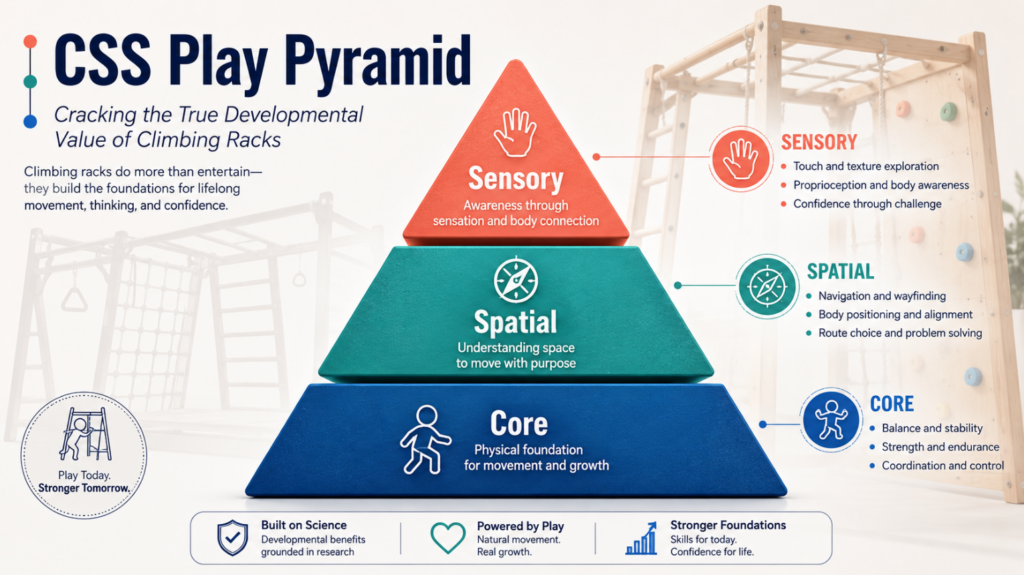
Climbing requires continuous exertion of the core muscle group and a high degree of overdraft grip strength. Every time a child reaches for a higher bar, he must hang all his weight on the phalanges, while his abdominal muscles must hold the pelvis firmly. This extremely hard-core basic physical exertion can directly end the common physical weakness of modern “sedentary” children.
Shuttling through an intricate grid forces the brain to build a 3D map of space. The child must accurately calculate the distance between the crossbars, assess the proportions of his body, and blindly complete a series of movements without seeing the feet. This continuous computation has greatly enhanced proprioception (Proprioception)-the body’s neural ability to sense its own position, movement and action.
Hanging gold hooks upside down or swinging on a high pole can pour a huge amount of vestibular and proprioceptive stimulation into the brain. Pediatric occupational therapists use these specific actions to help children regulate their nervous system. The “deep pressure sensation” produced by holding metal or wood with both hands can instantly soothe extremely excited sensory receptors. Even if you leave the playground for a long time, this deep stimulation can still significantly improve your child’s concentration and emotional management skills.
Modern climbing frames have long been not static decorations placed in the yard, but multifunctional developmental intervention tools.
The geometric dome climbing frame has no designated entrance and no preset slide. It is this “no way to go” design that forces children to plan their own routes, turning cold metal grids into spaceships, cages or mountains. Because the rules are set by the child himself, rather than being led by the device, this uninstructed play can greatly reshape the cognitive flexibility of the brain.
Crossing the monkey rack with bare hands requires alternating movements of both hands, which necessarily crosses the center line of the body. The physical action of crossing the midline 1 forcibly opens up the neural pathways connecting the left and right hemispheres of the brain. Educational experts have even made this specific playground movement a rigid prerequisite for children to learn complex cognitive tasks such as reading and writing.
Do not understand the specific safety indicators on the blind purchase of outdoor climbing equipment, is tantamount to directly put the child into danger.
Head entrapment (head and neck entrapment) is the most lethal risk factor in outdoor play equipment. The ASTM (American Society for Testing and Materials) safety standard expressly prohibits any structural gap between 3.5 and 9 inches (about 8.9 to 22.8cm) in the equipment. The child’s torso can easily pass through this width of the gap, but the head will become stuck, eventually leading to suffocation. Before payment, take a tape measure to 1 measure the spacing between each 1 bar.
Put the climbing frame directly on the grass, and the buffer protection effect is equal to zero. After a few weeks of trampling and weather changes, the soil will be crushed as hard as cement. You must lay a professional impact absorbing layer. For a fall of 6 feet (about 1.8 meters), only 9-inch thick engineered wood fiber (EWF) or rubber floor mats poured on site are the only reliable life-saving solutions.
| Surface Material | Fall-Impact Absorption Rating | Maintenance Cost | Expected Service Life |
|---|---|---|---|
| Grass / Natural Soil | ★☆☆☆☆ — Unsuitable; rapidly compacts and loses cushioning performance | Elevado — requires mowing, drainage control and surface restoration but still cannot provide certified fall protection | Not applicable as a compliant protective surface |
| Engineered Wood Fiber (EWF) | ★★★★☆ — Very Good when installed and maintained at the product’s certified depth | Médio — requires frequent raking, depth inspections and periodic top-ups because material compacts and migrates | Approximately 2–5 years before substantial replenishment or replacement |
| Palha de borracha | ★★★★★ — Excelente when the selected product is ASTM F1292 tested for the equipment’s fall height | Low to Medium — occasional raking, debris removal and depth correction are still required | Approximately 10–12+ years with proper installation and maintenance |
The cheap steel climbing frame was rusted from the inside. Black heart manufacturers often only spray bright powder coating on the outer surface of the pipe, but the inner wall is directly exposed to the condensed water. Before buying, the inspection report must be checked to confirm that the inner and outer surfaces of the metal pipe are actually hot-dip galvanized.
The amusement equipment industry is eliminating dazzling inferior plastic and vulgar primary color blocks at a very fast speed.
The pro-nature (Biophilic) design concept has taken over the high-end villa and school projects in full. Manufacturers began to introduce a large number of locust wood (Robinia wood), native climbing rope and earth color coating, so that the equipment seamlessly into the natural landscape. This practice directly cuts out the visual overstimulation common in playgrounds, prompting children to establish a deeper natural connection with the outdoor environment.
The modular climbing system provides parents with the most efficient long-term return on investment. Traditional climbing frames are often eliminated by grown children after two years, while modern systems are designed with interchangeable accessories. With the evolution of children’s physical fitness, you can remove the special anti-falling net for young children at any time and replace it with a high-level ninja warrior gymnastics ring.
What is the difference between Jungle gym and Climbing frame?
There is no difference in structure. “Jungle gym” is the North American market jargon, and “Climbing frame” is the British and Australian standard name. Both refer to multi-dimensional structures designed for suspension and climbing.
How old can a child safely use a climbing frame?
As long as the equipment matches the age, 18-month-old children can start playing. Designed for young children, the climbing frame is strictly controlled within 3 feet (about 0.9 meters) in height and is equipped with extremely thick, easy-to-grip railings. The standard climbing frame in the playground usually requires children to grow up to about 5 years old and have enough basic grip strength and spatial perception ability to challenge.
What material is the climbing frame made?
Top-of-the-line climbing frames are usually made of hot-dip galvanized steel, powder-coated aluminum alloy, heavy-duty HDPE plastic, or extremely weather-resistant wood (such as Cedarwood and locust wood). The material directly locks the maximum load-bearing limit and corrosion resistance life of the climbing frame.
How much safety clearance is required around the climbing frame?
Safety regulations bite hard: There must be at least 6 feet (1.8 meters) of fall buffers in every direction around the equipment. Fences, trees, concrete paths or any other amusement equipment are absolutely not allowed within this red line.
Can the climbing frame be directly installed on the artificial turf?
Standard artificial turf simply cannot absorb the impact of climbing and falling. For compliance installation on artificial turf, a special damping pad (usually foam or rubber) must be laid under the turf, and the damping data must meet the safety compliance standards for the corresponding fall height.

Explore Indoor Play Slide Options And Playground Costs. Maximize Throughput And Avoid Hidden Freight Traps.
Ver pormenores
Top Custom Indoor Playground Trampoline Park Manufacturers. Maximize Roi With Expert Layouts And Proven Safety Guides.
Ver pormenores
Find Indoor Trampoline Park Builders. Explore Turnkey Solutions, Exact Fees, And Avoid Hidden Installation Traps.
Ver pormenores
Avoid Indoor Play Manufacturer Scams. Discover How To Verify Suppliers And Protect Your B2B Investment.
Ver pormenores