 Mimu Play








recherche de produits
Terrain de jeux intérieurNinja WarriorAire de jeux extérieureTrampoline
recherche

Want to open an indoor children’s playground? You have to be ready to shell out $150000 to $500000 in real money. Much of this money will be spent on deposits at commercial sites, ASTM-certified safety equipment, and high commercial liability insurance.
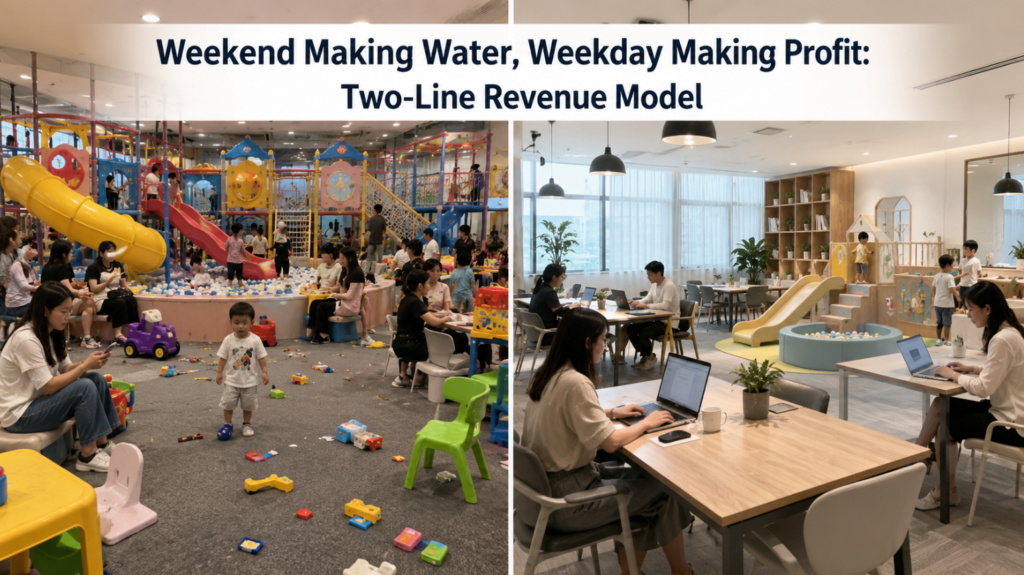
To tell the truth: many novice bosses will not survive the first two years. Why? Because when they do the math, all they think about is the full weekend. However, the high-end venues that can really make a lot of money and stabilize the gross profit margin at more than 65% actually rely on the passenger flow on weekdays. How do they do it? It’s a “mixed space” approach-like creating a parent-sharing office area with a great view, or promoting monthly card classes for preschoolers.
This article is not one of those generalities of entrepreneurial chicken soup. The next thing I’m going to talk to you about is the strictly confidential financial indicators of the head indoor home entertainment center (FEC), the pits that can’t be prevented when renting shops, and the hard-core standards for equipment partitions.
In this line of business, your survival hinges entirely on your “store productivity” (revenue per square foot). Suppose you’ve rented a 5,000-square-foot venue; if you’re counting on selling single‑session tickets at just $15 each, you’re headed straight for failure. No matter how many guests you have today, your rent, utilities, and employee salaries are all fixed costs that remain unchanged.
Therefore, before signing the lease, your business plan must include a multi‑dimensional pricing strategy. The revenue of a truly profitable amusement park typically comes from three sources: 40% from weekend private-party bookings, 35% from weekday membership cards and subscription fees, and the remaining 25% from sales of food, beverages, and merchandise. If you can secure a food-service license or even bring in a local catering provider, parents’ average time spent in the store could jump from 60 minutes to over 150 minutes. If the length of stay doubles, their secondary spending on food and beverages will naturally double as well.
| Revenue Source | Profit Margin | Average Contribution to Total Revenue |
|---|---|---|
| Walk-in Tickets | High Margin | 30% |
| Birthday Parties | Very High Margin | 40% |
| Café / Snacks | Moderate Margin | 15% |
| Merchandise / Anti-Slip Socks | Very High Margin | 15% |
When setting up a store, industry veterans typically follow a framework known as the “R.O.A.R. Profit Pyramid.” Following this logic, your money will become a goose that lays golden eggs continuously, rather than creating a bunch of dead corners that no one ever uses.
Commercial playground equipment must comply with the ASTM F1918 safety standard (known as EN 1176 in Europe). Never go for cheap, unqualified “three-no” products sold overseas; once something goes wrong, your commercial liability insurance will simply deny the claim. Before paying the deposit, insist that the manufacturer provide a compliance certificate. Safety netting, EVA shock-absorbing floor mats at least 2 inches thick, and flame‑retardant vinyl surfacing—these are non‑negotiable minimum requirements for opening an indoor playground.
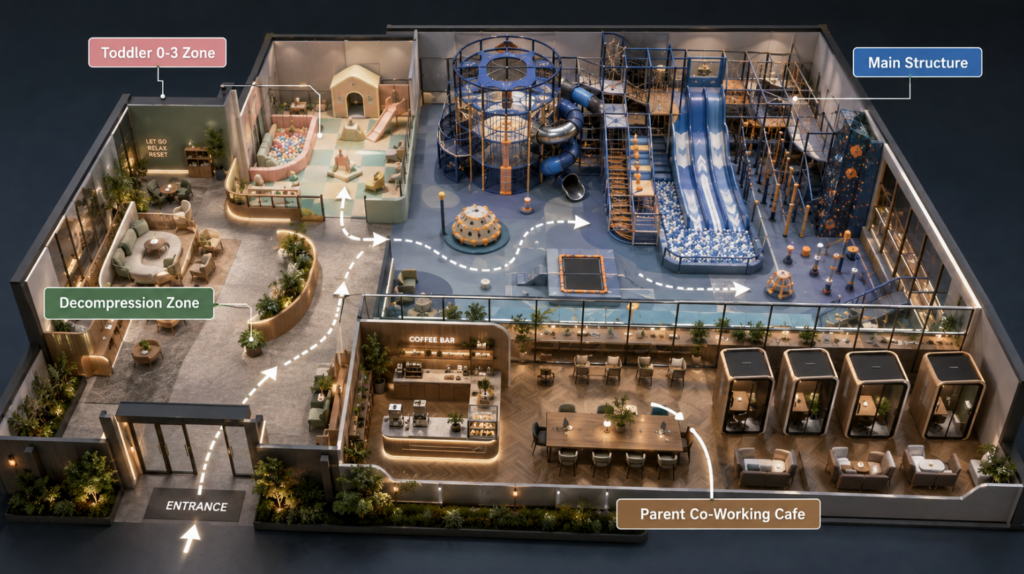
If the entrance becomes a chaotic crowd, the customer experience plummets to rock bottom. You must set aside a spacious “buffer decompression zone” behind the ticketing counters, accommodating a large shoe locker area, a stroller parking zone, and a dedicated lane for attaching wristbands to children. Moreover, mixing toddlers who are still learning to walk with boisterous older children is a surefire recipe for injuries and negative reviews. You must physically separate the soft-play area for children aged 0–3 from the main equipment area for children aged 4–12 using a low wall. The design of the low wall is carefully considered, ensuring that parents seated in the seating area can keep their children in full view.
Looking at historical data, weekday mornings are practically the “Achilles’ heel” of indoor amusement parks. To break the deadlock, high-end venues are now embracing the “office‑meets‑kids’ play” model. As long as you’re willing to invest in soundproof office pods, gigabit‑speed broadband, and a premium coffee bar with a sweeping view of the entire amusement area, you can keep those working‑from‑home parents firmly by your side. This move has transformed what was once an occasional weekend pastime into a daily necessity for families in the surrounding community.
Renting commercial real estate for an amusement park comes with a host of hidden costs that can easily bankrupt a startup team. In the landlord’s eyes, a children’s playground is a high‑risk tenant that “extremely wears down the premises.”
The “base rent” listed on that rental ad you saw is only a small part of what you’ll pay each month. Most commercial leases are “triple-net (NNN)” leases, which means that in addition to the base rent, you are also required to pay your pro-rata share of property taxes, building insurance, and common-area maintenance (CAM) expenses. For example, a quoted rent of $15 per square foot can easily jump to $22 once you factor in NNN expenses. When drawing up your budget, be sure to calculate based on the “total rent” and don’t let the base rent mislead you.
In typical warehouses or retail stores, the HVAC system is designed for very low occupancy densities. But what exactly is a playground? Hundreds of kids, running wild and drenched in sweat, all crammed into a confined space. An ordinary 5-ton air conditioner would be completely overwhelmed by that kind of heat in an instant. Before signing the contract, you must have a qualified professional thoroughly inspect the existing air-conditioning and ventilation systems. If the ventilation system is to be upgraded to meet fire safety standards for commercial venues with high occupancy, it would easily cost over $40,000. If, during the lease negotiations, you failed to have the landlord include this amount as part of the tenant improvement allowance (TI), you’ll be stuck footing the bill yourself.
When it comes to opening a store, speed is everything. From the moment you sign the lease to the day you officially open, you’re burning cash every single day.
Whether you approach a local bank or apply for an SBA (Small Business Administration) loan, lenders will only look at data‑driven financial projections. Your business plan must include a local demographic analysis demonstrating that within a 15-minute drive of your store, there is a sufficient number of children aged 0–12. Lenders focus most closely on two key metrics: What is your customer acquisition cost (CAC)? And what is your risk‑hedging strategy? Therefore, be sure to attach the quotes for standard general liability insurance and the infectious disease rider provided by your insurance broker directly to the back of your business plan.
The advantage of going it alone is that you get to keep 100% of the profits, but you’ll have to shoulder all the hard work—from design to building your own brand—on your own. If you choose to franchise a well-established amusement park brand, the entry threshold is a franchise fee of between $30,000 and $50,000, plus a royalty ranging from 6% to 8% of your monthly revenue. Of course, the advantages of franchising are that you’ll be provided with reliable equipment suppliers, ready‑made standard operating procedures (SOPs), and nationwide brand endorsement. If you insist on doing it yourself, let me give you some advice: spend the money to hire a designer who specializes in FEC (home entertainment centers) to tailor-make your setup—never settle for those cookie-cutter templates that factories hand out for free.
Take a look at the financial records of urban and suburban venues that are already open, and you’ll find that their profitable periods are highly unevenly distributed.
Venues that fail to generate even $300,000 in annual revenue typically see weekday sales account for less than 10% of their total income. Whether a well‑targeted early childhood education program can fully maximize per‑square‑meter productivity from Monday to Friday is the crucial dividing line between a struggling facility and a cash‑generating powerhouse.
Combien coûte l'ouverture d'une aire de jeux couverte ?
The upfront investment is probably between $150000 and $500000. The money covers commercial real estate deposits, tenant hard-fitting renovations (air conditioning, toilets), ASTM-certified soft bag equipment, cash register systems, and the first commercial insurance premium.
Does this line really make money?
Earn. With proper operation, net profit margin can be stable at 15% to 25% after deducting all daily expenses. But the premise is: you must have a full weekend birthday party and a large number of weekday members with monthly renewals in your hand.
Software amusement park have to buy what insurance?
You must buy extremely high “Commercial Liability Insurance (CGL)”, which usually requires a minimum claim amount of $1 million for a single accident. In addition, but also to buy employee injury insurance, commercial property insurance. If there is a trampoline, or considering the risk of infectious diseases, you must also buy targeted additional insurance.
How big is the site?
A profitable independent store must 3000 at least 5000 square feet. Only so big can you cram into the main equipment area, separate toddler area, party room, bathroom, and absolutely indispensable parent rest/coffee area.
How are tickets usually priced?
It depends on your local average income. Typically, a single two-hour child ticket costs between $12 and $20. Adults (parents/guardians) are generally free of charge, or a nominal charge of $2 to $5, mainly to prevent the rest area from being filled with people who have no consumption.
Open children’s playground must join?
It’s not necessary. If you do it yourself, you can save 6-8% of the running water, and you can do whatever you want in design. But joining can indeed provide a business model that has been verified by the market, get cheaper equipment discounts, and a set of ready-made marketing methods. For novices who don’t know anything, it can greatly shorten the pain of exploration. period.
Discover How To Build A Safe Ninja Warrior Obstacle Course With Pro Hardware And Our Expert Rigging Guide.
Voir les détails
Master The Adult Indoor Adventure Park. Conquer Any Indoor Adult Obstacle Course With The Expert P.A.R.K. Framework.
Voir les détails
Find Premium Jungle Gym Equipment For Your Jungle Playground. Build A Safe, Durable And Commercial-Grade Play Area.
Voir les détails
Discover What Is A Jungle Gym. Explore Top Playground Uses, Key CSS Benefits, And Hidden Safety Traps To Avoid.
Voir les détails