 ميمو بلاي








البحث عن المنتج
ملعب داخليمحارب النينجاملعب خارجيالترامبولين
البحث

Want to build a safe and fun “Ninja Hurdle” obstacle course? It’s not as simple as building a wooden shelf. You have to calculate the moving load, bolt through and fix it, and lay precise shock absorption and fall prevention zones under those commercial-grade obstacles. To be honest, many of the projects that people were working on in their backyards ended up collapsing for a simple reason: they treated it like a regular amusement ride. You know, real ninja training will produce extremely exaggerated horizontal swing power, which can tear apart ordinary wood screws and inferior mountaineering buckles. Next, I will teach you how to design and build a back-yard facility that can withstand adult-level dynamic loads, prevent catastrophic hardware breakage, and fully meet professional training standards.
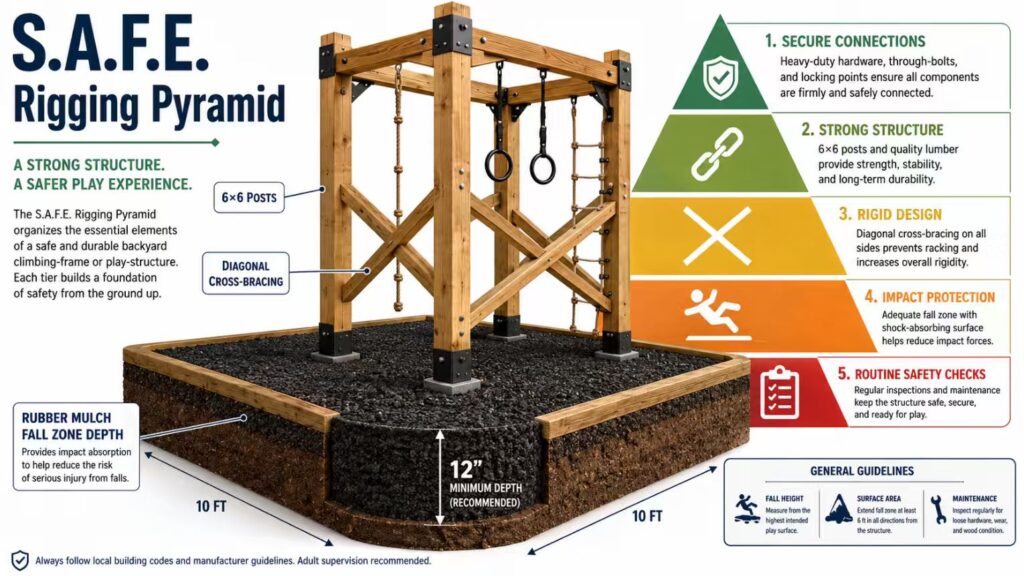
In order to build a stable structure, you must strictly adhere to a set of engineering principles of priority, which we call the “S.A.F.E. Rigming Pyramid”. Remember one thing: before hanging any obstacle, tamp the base for me.
S-Structural Anchors (structural anchor): at least 6 × 6 anticorrosive wood must be used for independent columns, which is the bottom line. If you use a 4 × 4 column, it is easy to bend or even break under the weight of horizontal swing. You have to bury these pillars at least 36 inches deep in the ground and then fasten them to death with high-strength concrete.
A – Active Fall Zones (Active Fall Prevention Zone): Gravity is not a joke with you. It is not important to look at it when it falls, so the ground under the site is your core safety guarantee. You must lay a rubber mulch that is at least 12 inches thick and will not be compacted. How does this range be defined? Based on the farthest arc that any obstacle can swing to, it extends outward for another 6 feet.
F-Force Distribution (power distribution): if you want the shelf not to wander, cross support is the key. At each 90-degree corner of the wooden frame, you must bolt the upper diagonal structural support. The purpose of this is to conduct kinetic energy directly into the ground, rather than allowing the entire frame to resist that kind of shaking.
E-Ergonomic Spacing (ergonomic spacing): The distance between obstacles directly determines the smoothness and safety of the entry. The spacing of the hanging elements depends on the arm span of the main user, generally just 1.5 to 2.5 feet apart. In this way, even if you don’t catch it, you will fall straight and not hit the next obstacle.
Picking on obstacles not only determines the difficulty of the challenge, but also determines which specific installation accessories you need. Each 1 type of obstacle has its own unique structural requirements.
This thing requires absolute rigidity and has to be cut out at an extremely precise angle to function properly. The rest rung must be tilted upward, and it must be exactly 30 degrees. Cut flat? The take-off bar will bounce straight away; the angle is too steep? You simply can’t make enough vertical space to take the pole off. In addition, the rungs must be made of extremely dense hardwood such as maple or oak. Ordinary pine will split in an instant under the violent impact of the carbon fiber take-off bar.
In the current backyard obstacle stability training, the tight walking rope matrix has long replaced the rigid wooden balance beam and has become the industry benchmark. What you have to do is to fix the heavy-duty ratchet directly to the 6 × 6 anchor post, and then tighten the industrial-grade braid. This setting not only safely cushions the force of the falling body, but also creates that kind of lateral shaking that people can’t touch. Compared with static obstacles, it is much better to practice core stable muscle groups.
The installation of climbing boards is absolutely inseparable from heavy wall anchors and strong backboards. Imagine a large living man swinging around, his whole body weight on two small wooden plungers. Therefore, it is important to note that when punching, it must be slightly tilted upward by about 5 degrees. In this way, when people put weight on it, the stake will automatically lock in, avoiding the fatal danger of the stake slipping because of the peaceful hole.
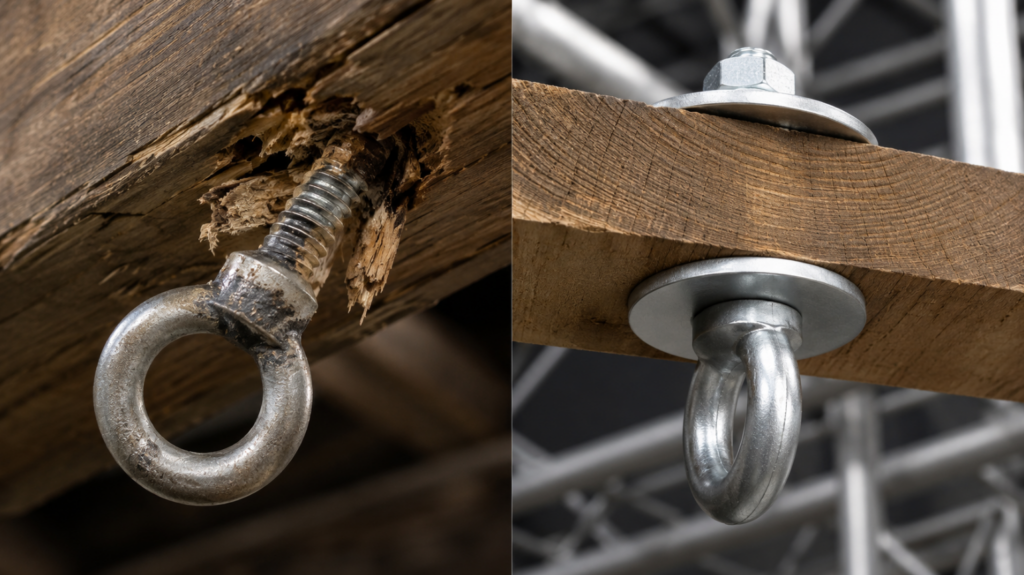
If you use ordinary screw-in sheep’s eye ring (threaded ring screw) to hang obstacles, I dare to pack a ticket, this structure will fall apart sooner or later. Many friends who like DIY often go to the nearby hardware store and buy a few standard threaded sheep eye rings to hang the swing rings. Did you know that when a 150-pound person swings over an obstacle, the dynamic kinetic energy generated can easily break through 300 pounds. This lateral pulling force will pull the thread of the screw-in hook out of the wood alive, and the result is that the person hits the ground hard.
Listen up, for each suspension attachment point, you must use only forged through-bolts. This bolt goes completely through the entire wooden beam and is then locked at the top with a thick washer and nylon locknut. In this way, you hold the wood firmly, and the stress point is transferred from the fragile wood thread to the strong solid steel.
When the real knife and the gun are fired, the steps must not be disorderly, so as to ensure the absolute stability of the structure from bottom to top.
Dig and pour the foundation: Dig your 6 × 6 column to a depth below the freezing line (minimum 36 inches). First lay a 4-inch thick gravel under it to drain water, level the column with a laser level, and finally fill it with quick-setting cement.
Installation of load-bearing beams: load-bearing beams (at least 4 × 6 or two 2 × 8 pieces of wood) must be fixed with galvanized carriage bolts. Never use ordinary deck screws at the joints of load-bearing wood. The shear resistance of that thing is too poor, and it will break 1 pressure.
Arrange the anti-falling area: use landscape wood to frame the scope of the ground. Lay a layer of commercial-grade anti-grass cloth under the bottom to prevent dirt from mixing in, and then fill the circled area with 12-inch-thick certified playground rubber mulch.
Hanging obstacles: punch holes in the beam and install forged eye bolts. Remember, be sure to use self-locking steel mountaineering buckles (never use the aluminum quick hangers with springs) to connect your ninja barrier to the bolts.
Last summer, our team measured the engineering limits of the backyard facility 1 times to prove how important cross-bracing and penetrating bolts really are. We built two identical 12-foot wooden brackets. A bracket uses ordinary 4 × 4 columns and screw-in hardware (that is, everyone’s favorite DIY set). The B bracket uses 6 × 6 columns, diagonal cross supports, and penetrating forged steel bolts (fully conforming to S.A.F.E. standards).
We tied a 200-pound sandbag to the barrier right in the middle of each bracket, and then used an electric pendulum device to shake wildly, simulating the appearance of a big adult playing for his life on it.
The data show everything: the bracket experienced severe structural deformation in just 45 seconds, deviating from the center point by a full 8 inches, and then the screw-in sheep’s eye ring was violently torn out of the beam. Look at the B bracket again. It eats the kinetic energy clean through the reinforced wooden frame. The hardware not only has no deformation, but after 10 minutes of continuous shaking under the maximum dynamic load, its lateral swing amplitude is actually less than 0.5 inches.
The ability to choose the exact specifications of the hardware is the biggest difference between professional facilities and dangerous backyard “wounding traps.
| Hardware Component | Unsafe (Do Not Use) | Professional Standard (Required) | Load Capacity |
| Anchor Hooks | Zinc-plated Screw-in Eye Hooks | Drop-Forged Steel Through-Bolts | 2,500+ lbs |
| Attachment Clips | Aluminum Spring-gate Carabiners | Steel Auto-Locking Carabiners | 4,000+ lbs |
| Main Support Posts | 4×4 Untreated Pine | 6×6 Pressure-Treated Timber | Handles High Lateral Force |
| Hanging Ropes | Natural Manila/Hemp (Rots) | UV-Treated Poly-Dacron | Weather & Fray Resistant |
A minimum of 12 inches of rubber mulch or engineered wood fiber (EWF). This is a hard standard, only to reach this depth, in order to safely absorb the impact of falling from 10 feet, to avoid serious head injury.
It can be, but you must use that kind of wide, thick tree guard and never bolt directly into the trunk. The hole will rot the inside of the tree and destroy its own structural strength. Maybe one day a big branch will hit your training ground directly.
After embalming treatment of southern yellow pine or cedar is the best choice. Cedar is naturally anti-corrosive and insect-proof, while heavily embalmed pine has a very high structural density, which is completely out of the question to deal with that extreme dynamic load.
If it is for children to play, leave a 1.5 to 2.5 feet between the elements of the swing. For adults, pull it apart to 3 to 4 feet. The specific distance depends on the user’s natural arm span and the parabolic trajectory of the pull cut (lache, that is, swing release jump).
This is mostly because your anchor point is not well played, or the ratchet force is insufficient. You have to fix the walking rope on the motionless behemoth (such as a 24-inch diameter tree, or a 6 × 6 column poured with cement), and then tighten it with an industrial ratchet to achieve its required tension.
Absolutely must. The kind of ordinary mountaineering buckle without a lock is easy to reverse when people shake violently on it, and they may bounce off by themselves. The automatic locking steel mountaineering buckle cannot be opened at the physical level unless you manually turn the heavy outer sleeve.
Discover What Is A Jungle Gym. Explore Top Playground Uses, Key CSS Benefits, And Hidden Safety Traps To Avoid.
عرض التفاصيل
What Does A Jungle Gym Look Like? Compare Top Design Types, View Backyard Blueprints, And Read Expert Setup Tips.
عرض التفاصيل
Explore Indoor Play Slide Options And Playground Costs. Maximize Throughput And Avoid Hidden Freight Traps.
عرض التفاصيل
Find Indoor Trampoline Park Builders. Explore Turnkey Solutions, Exact Fees, And Avoid Hidden Installation Traps.
عرض التفاصيل